The Peter Principle at Work in Family Businesses

Perhaps nowhere is the Peter Principle more prevalent than in a family business. Lawrence J. Peter and Raymond Hull wrote about the principle in their 1969 book “The Peter Principle,” which stated simply is “Employees tend to rise to the level of their incompetence.”

I thought about the Peter Principle when I was reading an article on the Harvard Business Review Blog Network about the effect enabled family members could have on a business. Keeping incompetent or unskilled family members as employees can be devastating to a business and can ultimately cause it to fail.

I’ve seen it so many times. Uncle Joe runs a division of the company because he invested a couple thousand of dollars when the business was formed 20 years ago but he doesn’t have a clue what he’s doing. A couple starts a business and their son takes over and runs it when they retire. But he’d spent most of his time playing golf and traveling, stopping by occasionally to pick up a check and flirt with the women in the sales department. The only thing he knows how to manage is his account at the country club.

Even if they don’t know how to do their present jobs, they sometimes continue to be promoted. And the business suffers.

The authors of the article, Josh Baron and Rob Lachenauer, co-founders of Banyan Family Business Advisors, included a quiz so you can determine whether you are coddling a family member. If you answer yes to four or more of these questions, then you probably are overindulging him or her. Here are their questions:

1. Has a family member worked exclusively in the family’s business?

2. Has he reported within his parent’s span of control for most, or all, of his career?

3. Has she never received 360 feedback on her performance?

4. Is the family member paid above the market-based compensation for his position?

5. Has the family member been promoted beyond his capabilities?

6. Is the family member’s behavior often outside the boundaries of acceptable value-based behavior of the company?

Do these scenarios sound familiar to you? Coddling a family member does no good for anyone. The business suffers if someone is incompetent to handle his or her job. The individual often knows he or she is not performing the job the way it should be done and is ashamed or may be embarrassed. Morale at the company suffers when the other employees witness the family member receiving preferential treatment and not handling their job responsibilities.

In a previous column I gave five tips for successful family businesses. If you have a suspicion you may be coddling a family member, I suggest you pay particular attention to one of these suggestions: Put the right people in the right jobs. I don’t care if Uncle Joe gave you seed money to start a division of your company. If he doesn’t know how to manage a department don’t put him in charge of it. Don’t let the Peter Principle be at work in your family business.

For tips on how to handle the situation of a coddled relative, please read my next post. 

Qualities to Look for in a CEO

The Wall Street Journal reported this week that the pace of CEO changes is picking up again and almost 20 major companies are searching for a replacement in the top position. These include Microsoft, J.C. Penney Co. and Toys ‘R’ Us. Martha Stewart Living Omnimedia Inc. has been searching since late last year to replace Lisa Gersh.

What should these search committees be looking for?

A study done by Russell Reynolds Associates found nine attributes that differentiated CEOs from other top executives. The study assessed areas like communication skills, relationship skills and decision-making approaches. These nine attributes fell into three areas: willingness to take calculated risks, bias toward action and the ability to efficiently read people.

I can agree with these attributes as being critical to those taking over management of a major company. Having hired, fired and served as a CEO for several companies, I suggest they look for CEOs who have these qualities as well.

1. A person who is willing to admit his or her mistakes

This one is so important that Chapter One of my book, “How Not to Hire a Guy Like Me: Lessons Learned from CEOs’ Mistakes,” is about checking your ego.

A CEO must be willing to admit his mistakes, learn from them and move on. Covering up mistakes can not only lead to bigger problems, when you are found out you risk losing the respect of all those who work for your company as well as those that do business with you.

Making mistakes is not usually the major cause of a company’s failure. It’s covering them up or adhering to the mistakes that can lead to major issues.

2. A person who isn’t afraid to hire people smarter than himself

A CEO has to be able to leverage the talents of others. When I am acting as Interim CEO I am always happy when I am surrounded by people smarter than I am. I am the catalyst to get a job done and that is easier to accomplish when the people around me are smart and capable.

3. A person who doesn’t back down from the realities of a bad situation

I devoted a chapter in my book to this as well, called “Confront Your Harsh Realities.” One of the biggest mistakes CEOs make is refusing to recognize challenging situations. Whether it’s an issue with a vendor, problem employees, financing difficulties, a changing marketplace — whatever the issue, a good CEO needs to recognize when a bad situation is brewing and be prepared to handle it.

4. A person who is proactive, not reactive

A good leader needs to head off potential problems before they occur, preventing crises if possible. If a leader is proactive he will have the people, ideas, tools and other resources in place to handle anything that comes along.

5. A person who communicates openly and regularly

A company grows and thrives on open communication in good times. And in bad times, a staff that feels fully informed about what is happening is better able to pull together and weather the harsh periods. And CEOs that keep lines of communication open across all levels in a company can learn a lot from those on the front lines.

I thought of the bias toward action attribute when I read a story about Stephen Elop, who may be Microsoft’s next CEO. According to an article on UsNews.NBCnews.com, when Stephen was a college student in the 1980s he didn’t like the data-sharing methods available. So he bought some Ethernet cable and ran 22 miles of cable around the campus from building to building, creating one of the first Internet networks in Canada.

That’s the kind of man you want leading your company.

Improve Your Productivity: Take Time Off

My wife will probably chuckle when she sees this topic. Yes, I’ve been accused at times of suffering with an acute case of workaholism. When you love what you do and are excited about helping companies emerge from tough situations to be viable and more successful, it can be tough to shut down work at a reasonable hour.

Yet studies show that people are actually more productive if they engage in “strategic renewal.” That includes sleeping more, taking more frequent vacations and spending more time away from the office.

An article earlier this year in The New York Times, “Relax! You’ll Be More Productive” claims that paradoxically, the best way to get more done may be to actually do less.

One of my favorite ways to get away from the pressures of work is to go on a cruise.

One of my favorite ways to get away from the pressures of work is to go on a cruise.

While the article discusses studies that show the benefits on productivity of extra sleep and working out, being a numbers guy, this part caught my eye.

“In 2006, the accounting firm Ernst & Young did an internal study of its employees and found that for each additional 10 hours of vacation employees took, their year-end performance ratings from supervisors (on a scale of one to five) improved by 8 percent. Frequent vacationers were also significantly less likely to leave the firm.”

Now that’s something to take note of. Improved performance of 8 percent and a higher retention rate? Those are major benefits that companies can take advantage of just by encouraging employees to take their allotted vacation time.

In the United States we start out with far less vacation time to begin with than our European counterparts. And we don’t even take the few days we do accrue.

In 2010 Expedia, the online travel agency, conducted a survey about vacation days. The average American earns 18 vacation days, but only used 14. Contrast that with countries in Europe where in France, for instance, the average worker gets a whopping 37 vacation days and uses 35 of them.

Only 38 percent of Americans say they use all of their vacation time, while 63 percent of the French do.

This seems a fitting topic at the beginning of a holiday weekend, a time when most workers are actually forced to take a day off when their businesses are closed. But a large percentage of our workforce now works on computers and laptops away from the office, so there may rarely be such a thing as a forced vacation.

You can still disengage from the pressures of work and engage with those around you by shutting off your cell phone or leaving it in the car during social events with friends and spouse. Answering a text during spousal time dampens the mood.

When dining out with friends, have everyone put their cell phones on the table. The first one who touches his or her phone gets the check!

One of my favorite ways to really get away is to go on a cruise. Then I only look at emails at 6:00 a.m. or at midnight when my wife is asleep. I leave my cell phone and iPad in my room during the day so I can really enjoy my vacation.

That means you have to make an effort to well, do less. In recent years I have decreased my working hours somewhat and try to take time to enjoy vacations with my wife. This Monday I’ll be joining millions of Americans who relax on Labor Day weekend, visiting with family or getting one last long summer weekend in before fall sets in.

Aren’t you due for some strategic renewal of your own?

Should You Work for a Family Business?

The title of a recent Wall Street Journal feature caught my attention: “The Upside of Being an Outsider in a Family Business.” As an interim CEO, I know a lot about being the outsider in a family business. But my position is different from the start — I have been brought in as the boss at a critical time, with power and authority to weigh in on decisions about the future of the company.

What about executives that chose to go to work for a family business, knowing from the beginning that they are outsiders? They would naturally have doubts about their ability to move up in the company. Will they be eligible for promotions or will those automatically go to family members, who may be less experienced and less qualified?

If you go to work for a family business, are you limiting your career and opportunities for future growth? Will you be caught up in family squabbles?

While those potential disadvantages of working for a family-owned business are ones to consider, there are actually several advantages to working as a non-family executive in a family-owned business.

You may be more respected for bringing in an outside perspective.

In many family-owned businesses, the family members’ experience is limited to just that business. You are bringing a wider spectrum of experience and more knowledge about the market. Every business needs a fresh perspective and new ideas.

Competition for executive jobs may be less.

Forbes Insights released research in the spring that showed 47 percent of executives from private companies perceive that their upward mobility will be limited if they go to work for a family-owned business. Fifty-five percent of people that run family businesses reported that this perception harms the talent pool. While it isn’t always the case that a family member will be considered over any other applicant for a promotion, that perception may keep qualified people from seeking out the position in the first place.

• You may be given more responsibility and enjoy more flexibility than in a publicly owned company.

If a rigid, corporate lifestyle is not for you, you may find more flexibility at a family-owned business where rigid policies don’t have to be enforced. And because family-owned businesses tend to be smaller, you may actually move up the ladder and take on more responsibility faster.

• Family-owned businesses rely on outside talent and may do more to keep you on board.

Family members in a family-run business tend to be more loyal to the company as it is in their family and they may also have an ownership stake. But if you are hired as an executive and prove yourself to be a valuable employee, that company will have to work harder to keep you in a senior position. In a recent article on Fox Small Business Center, consultant Mary Hladio, president of Ember Carriers Leadership Group in Cincinnati, Ohio addressed this issue.

“In today’s competitive market, family-owned businesses have to be mindful of how non-family talent can benefit their business,” she said. “Businesses need to be prepared to offer fair compensation, competitive benefits, a growth track and perhaps some non-traditional benefits.”

Those benefits may even include an ownership stake in the company. Other family-run businesses like RDG Concessions, which operates several luggage and apparel shops at San Francisco International Airport, tries to retain senior employees by treating them like family and involving them in operational decisions.

Working in a family business as a non-family member may not be for you. But you may not want to automatically rule it out, either.

Encouraging the Next Generation to Join Your Family Business

Maybe you’ve started a family business. With a lot of hard work, you’ve built it into a successful one. Your hope is that one day your children will want to take it over and run it and even pass it down to their children one day.

While it’s never a good idea to force a child into a family business, there are steps you can take when they are younger to encourage them to think about the possibility.

1. Don’t make comments assuming they will take over.

Yes, it may be your greatest hope. But it may not be theirs. Or even if it eventually is, they would prefer to have it be their idea, not yours. They want to feel like they have a choice and that joining the family business is not their only option.

2. Be careful what you share about the business.

When we get home from work we often want to vent about all the negative things that happened during the day. We tell our spouses about the shipment that went wrong, the manufacturer that messed up, the client who yelled at us. But if those are the prevailing type of comments your children hear growing us, they will most likely want to go work anywhere but at your business.

Let them hear you mention the positive aspects of your business as well: the rewarding relationships you have with the customers, how proud you are when your product is selling well, how valuable your company is in the community.

3. Share your passion.

Tell your family the story of why you started the business and what it means to you beyond just the moneymaking side of it. When they are younger it may not be apparent why you take pleasure in running a video production business or manufacturing company. Take them to the office and show them some of the videos or products you produced and how they help people and other businesses. If you have testimonial letters from customers, share those as well.

4. Offer them a summer job in the business.

If possible, tailor it around an area they have shown an interest in. If one of your children shows an affinity for numbers, they may want to work in the accounting area. Or if one is an extrovert and loves talking with people, he or she may enjoy a customer service position.

5. Let them use your business as an example for assignments in school.

If they have to interview someone about a job, let them pick someone who works for you. If they have to write a business plan or work on a case study, offer your business as an example.

If keeping the business in the family is a goal for you, offer it as an option. Just make sure that option looks like an attractive one to your children. In future posts, we’ll discuss other issues with children taking over a family business, like what do you do when there are multiple siblings?

How They Got Caught

Continuing our series on corporate fraud, today’s topic is how people who steal from their companies get caught. In addition to all helping themselves to money that doesn’t belong to them, they have something in common. They never thought they’d get caught. Here are some stories on how they did.

As a fraud deterrent I’ll always advise people to tell your CFO to take two consecutive weeks of vacation a year. Take that opportunity to sit at his desk, open his mail and talk to his secretary. You may be surprised at what you learn.

I did just that for a company where I was Interim CEO. I found that the CFO was having his Cayman Island bank account statements sent to his office, clearly detailing the money he was stealing from the company. Another time I suspected a CFO of fraud so I poked around on his computer. I found a spreadsheet detailing all the money he had stolen, dated and tracked. I love organized thieves. They make my job so much easier.

2010.07.28m3You never know how you’ll find fraud. I once had a potential client that found the controller had siphoned $3 million from the payroll account over the period of four years by creating dummy employees. The company hired a new CEO who determined that the headcount didn’t match. I never got them as a client. Once the bank found out, it decided it couldn’t trust the balance sheets and called the loan. The company had to shut its doors.

And here’s a story that literally takes the cake. Tom Murphy started the hugely popular Murphy’s restaurant more than 30 years in Atlanta. He wrote a lot of checks and had huge statements so he hired a Georgia State grad to help out as a bookkeeper. He knew Murphy’s was taking in a lot of money but he never seemed to have enough to cover his expenses.

So he looked over the bank statements himself one day. In just one month he found the bookkeeper had written checks for $3000 to himself. Going back through older statements, Tom found the guy had stolen $35,000 over the past year.

He called the guy who said he had “borrowed it” because he was getting married, planned to pay it back etc. Back in his more naïve days, Tom believed him. As he writes in his book, Murphy’s: 30 Years of Recipes and Memories, “Lesson learned: After you find someone stealing from you, chances are good he is lying when he says he will pay you back.”

The guy didn’t show up for work the next day so Tom called the police. Turns out he hightailed it to Mexico and eventually landed in Texas.

Here’s the fun part. Two weeks later the guy’s sister called Tom and said her brother was in town and she was having a going-away party for him. “Would you make the cake?” she asked.

“Of course,” he said and got the address. Then he called the chief of police to arrange a special delivery. Now that’s a surprise party where everyone was surprised.

So there’s a lesson for would-be thieves. While you may be justifying your crime to yourself, as we discussed in a previous column when I wrote about rationalization as part of the fraud triangle, you’ll have a lot harder time justifying it when you get caught. And you most likely will.

Sometimes Family Business Should Be Sold

It was shocking news. After eight decades of ownership, the Graham family sold The Washington Post to Amazon founder Jeff Bezos for $250 million. The announcement stunned everyone, from The Post employees to the media industry.

You have to hand it to them. They kept their courtship of several potential buyers and the impending sale a secret, despite employing some of the best investigative reporters in the country.

Publisher Katharine Weymouth, who is Katherine Graham’s granddaughter, wrote to the staff, “This is a day that my family and I never expected to come. The Washington Post Company is selling the newspaper it has owned and nurtured for eight decades.”

bezos_washingtonpost_0805Her uncle, Donald E. Graham, Chairman and CEO of The Washington Post, said, “I, along with Katharine Weymouth and our board of directors, decided to sell only after years of familiar newspaper-industry challenges made us wonder if there might be another owner who would be better for the Post (after a transaction that would be in the best interest of our shareholders).”

It takes courage to admit that you may no longer be the best person to run any business, much less one that has been in your family for generations.

It’s a hard truth and one I’ve had to relate to some of my turnaround clients who have nurtured family businesses for years. It’s tough to tell them that the best thing they can do for the family business is to let it go. It doesn’t matter how many years the family has owned it, how much it meant to Grandpappy, or how tough it is that your generation is the one to lose it. Sometimes if you want a company to survive, the best thing to do is sell it.

It may be time to sell if the heirs that are available in the next generation of management either do not want the responsibility or do not have the capability to run the business successfully. Maybe you’ve received a large offer, one that really is too good to refuse. In both cases, it’s a win for the family to sell the company.

Sometimes the current ownership of a family business just isn’t able to handle the changes in the industry and can’t find a way to keep the company financially viable.

That seems to be the case for the Post. In the first half of 2013, the company lost $49.3 million. Circulation has declined for seven years in a row. The Post has been slow to embrace the digital revolution. It has the fewest digital subscribers and lowest ratio of digital subscribers to print subscribers of any of the top 10 U.S. newspapers, according to an article in Mashable.com.

Bezos may be just what the company needs. Associate Editor Bob Woodward, the Pulitzer-Prize winner for his exposure of Watergate, said in an article in thedailybeast.com, “It’s very sad. But if there’s somebody who can succeed, it’s Bezos. He’s the innovator, he’s got the money and the patience, so we’ll see. I think in some ways, this may be the Post’s last chance to survive, at least in some form of what it was.”

As Donald wrote in the letter to staffers, “The point of our ownership has always been that it was supposed to be good for the Post. As the newspaper business continued to bring up questions to which we have no answers, Katharine and I began to ask ourselves if our small public company was still the best home for the newspaper …. We were certain the paper would survive under our ownership, but we wanted it to do more than that. We wanted it to succeed.”

That should be the goal for any company. Not just to exist but to succeed. And sometimes the best way to ensure that success is to hand it over to someone else.

Lessons from the Fraud Triangle

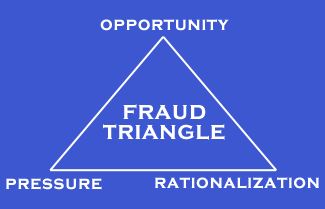
Fraud can occur when three elements are present: pressure, opportunity and rationalization. That’s the premise of the Fraud Triangle that I wrote about in last week’s column, “Why Fraud Occurs: The Fraud Triangle.”

So what lessons can we learn from these three elements of the Fraud Triangle? With a better understanding of why fraud occurs, what can we do in our businesses to prevent it?

The Fraud Triangle needs to be the basis of any effective fraud-deterrence program and should address its three elements.

1. Pressure

While some employees steal due to financial pressure, they may also be stressed due to difficult circumstances at home or addiction issues. Remember the example of Amy that I wrote about last week, the office manager who embezzled $345,000 from her company over a four-year period. She began stealing because her son had been arrested and she used the money to hire a lawyer to defend him.

Other than paying employees fairly, there is not a lot a company can due to relieve many sources of pressure, financial or otherwise. But it can train managers to recognize employees that seem to be under unusual stress. In some cases the HR department can point them to resources to get help.

fraudhandcuffs2. Opportunity

This is the area where a business can be most effective and should focus its efforts. Every company needs to have an effective fraud prevention program with strong internal controls and management oversight.

Most employees steal only when they perceive no chance they will get caught. Remember, it’s only the people you trust that will steal from you. If you don’t trust them, you’ll make sure they don’t have the opportunity to steal. Trust no one implicitly.

For tips on preventing fraud, please see my previous columns, including “The High Cost of Fraud and How to Prevent It,” “My Number One Tip for Fraud Prevention” and “13 Fraud Prevention Tips.”

3. Rationalization

Like pressure, this element is harder for an employer to deal with as it is done internally and no one may know that the employee feels it’s okay to “borrow” the money from the company or is owed it because he is feeling overworked. Amy the office manager began working harder and longer hours to justify the money she was stealing from the company, telling herself that she was really earning it.

Rationalization lets a person continue to commit a crime while telling himself that he is really not a criminal; he is still an honest person. Make sure every employee knows that fraud will not be tolerated in your business and it will be prosecuted.

I also recommend you follow Lee’s Fraud Policy and post it in the employee manual and reinforce it verbally: If you steal, I’ll put your butt in jail!

Because it is more difficult for a company to deal with an employee feeling pressured and his ability to rationalize crime, the majority of efforts should be focused on the most effective way to prevent it in the first place — by not providing any opportunity for thieves to steal. That way, all your employees truly can remain honest.

The Path of a Peanut Seller

It started as a blog post I wrote in January and now the moment that changed my life as a teenager is a video in the Moments series on the Saporta Report. And it all started with peanuts.

Please click this link to view the short video and find out how I gamed the system in the peanut-selling business, which led to my career as The Turnaround Authority. I no longer work for peanuts.

Grant Field in the 1960s, where I began my peanut-selling career.

Grant Field in the 1960s, where I began my peanut-selling career.


Why Fraud Occurs: The Fraud Triangle

Pressure, opportunity and rationalization. Those are the three factors that must be present for a person to commit fraud in workplace.

I’ve written a lot about the effects of fraud, the cost of it to the US economy and how to prevent it. But why is there so much fraudulent activity going on every day?

Criminologist Dr. Donald Cressey asked the same question in 1950. Cressey, who is considered the founder of the modern study of organized crime, became fascinated with embezzlers and wrote his dissertation on them for his Ph.D. in criminology. He was puzzled because most people who commit fraud are not criminals. They are generally “good” people. So what happens?

He interviewed 250 criminals who must have accepted a position of trust in good faith and must have violated that trust. His research was published in Other People’s Money: A Study in Social Psychology of Embezzlement in 1953. His theory on why fraud occurs eventually became know as the Fraud Triangle and is still the classic model to explain why people commit fraud in the workplace.

Cressey wrote that all three factors of the fraud triangle must be in place for an employee to commit fraud.

fraud7Pressure/Incentive

The thief is initially motivated because he or she has some type of non-sharable financial pressure or incentive. They may be involved in gambling, have a drug addiction or possibly took on more debt than they can handle. Or they could have a desire for material goods beyond their means, such as designer clothes and handbags or a new car. Sometimes an employee feels unfairly treated by a company and this is their way to get back.

The non-sharable aspect is an important distinction because the person generally feels shame or embarrassment over the situation or is concerned about potential disgrace. These are generally crimes committed in secret.

Amy Wilson was a respected office manager when she was caught for embezzling $345,000 and sent to jail. Now out and reformed, she speaks about what she did to help businesses prevent fraud. The first time she embezzled, ironically, was to hire a lawyer for her 18-year-old son, who had been charged with a felony and put in jail. When she was caught, not even her husband knew of her crime.

Opportunity

The second factor is opportunity. The criminal has to see what he perceives to be an opportunity and one that he can keep secret. He has gained the knowledge and has the authority to circumvent internal controls and devises a scheme to exploit those.

Amy’s company had no internal controls and as the office manager, she had access to all the bank accounts and computers. “For me, stealing money was as easy as printing checks in the accounting software test module and forging the vice president’s signature,” she says. “I then paid my personal credit card account with a company check.”

Rationalization

Most people who commit fraud in the workplace have no criminal past. They are first-time offenders and despite stealing from their companies, believe themselves to still be honest and decent people. To continue along the path of denial, they come up with ways to justify their crimes to themselves. These include: I was stealing to provide for my family; I am underpaid at work and deserve to have this money; I was going to eventually pay it back; everyone else at work steals things like office supplies and no one seems to care.

Amy worked long harder and longer hours, one of the ways she was able to justify her theft to herself. “Somehow, this made me feel less guilty and less shameful about my behavior,” she says. “I vowed to find a way to pay back the money I’d ‘borrowed.’”

There are great lessons to learn about how to handle fraud by looking at the fraud triangle and the behavior of people like Amy. Read next week’s column to find out what the fraud triangle tells us about how to handle fraud in the workplace. What works, and what doesn’t?