Famous Sibling Partnerships that Worked

This is the first in a two-part series on siblings in family businesses. Part one will cover some successful sibling partnerships, while part two will discuss lessons for siblings who are in business together.

Running a family business is never easy, and can be particularly hard when siblings run it together. Ever since the days of Cain and Abel, siblings have fought and competed and vied for their parents’ attention. To make it worse, they often didn’t choose to be partners, but were forced into the situation by a parent.

But these partnerships can and do work. Siblings can run a successful business together. Here’s a look at three famous sibling partnerships.

The Wright Brothers, whose successful partnership led to the first functional flying machine.

The Wright Brothers, whose successful partnership led to the first functional flying machine.

The Wright Brothers

Although they weren’t the first to build a flying machine, Orville and Wilbur Wright invented aircraft controls that let a pilot steer an aircraft. They took lessons from their work repairing bicycles to figure out how to control an airplane.

Their first business was a printing shop, with Orville serving as publisher while Wilbur was the editor, when Wilbur was 22 and Orville was just 18. That business was short-lived, followed by the bicycle repair shop. Their interest in flying eventually led to the first successful airplane flights in Kitty Hawk, North Caroline in 1903.

While Wilbur supplied the research skills, Orville was the more adventurous and ambitious one. Their skills complemented each other, with Orville able to overcome any doubts Wilbur had. Wilbur said, “I confess that in 1901 I said to my brother that man would not fly for fifty years.”

Their partnership was a successful one for these brothers known as the fathers of aviation. Despite what the former president and chairman of American Airlines Robert Crandall said, “If the Wright Brothers were alive today, Orville would have to lay off Wilbur.”

The McDonalds

Brothers Maurice and Richard McDonald planned to make their millions in the movie business after a move to southern California from their native New Hampshire. When that didn’t work out, they sold barbeque and hot dogs.

In 1948, they revamped McDonald’s Famous BBQ by downsizing the menu, getting rid of car hops and streamlining production in the kitchen. They wanted a symbol for their restaurants, creating the famous Golden Arches, much to the distress of their architect. They also began franchising their concept, which caught the eye of Ray Kroc, a milkshake machine salesman.

Ray bought the national franchise rights in 1955, purchasing the company outright in 1961 for $2.7 million. Now the fast food giant takes in more than $27 billion a year.

The brother’s partnership worked well and Richard expressed no regret at selling the company. “I would have wound up in some skyscraper somewhere with about four ulcers and eight tax attorneys trying to figure out how to pay all my income tax,” he said.

The Disneys

We all know who Walt Disney is. Less famous is his older brother Roy, who was his co-founder of Walt Disney Productions. Walt was the visionary; Roy was the finance guy, generally a less flashy role.

“Walt had this idea [for Walt Disney World]. My job all along was to help Walt do the things he wanted to do. He did the dreaming. I did the building,” he once told reporters.

They started working together at a young age, delivering newspapers after their dad bought a route. Roy was a banker in Los Angeles when Walt moved there and they founded Disney Brothers Studio in 1923 to produce short live action, animated films. In 2014, the company reported revenue of more than $48 billion.

Despite any lingering childhood issues, siblings can form successful partnerships. Come back next week for tips on how to run a business with your brother or sister.


4 Reasons Family Businesses Have Survived

Forbes 2015 list of The World’s Billionaires recently came out and I was interested to see how many of the world’s richest people got there through affiliations with family businesses.

(#4) founded Inditex, the parent company of fashion retailers Zara, Massimo Dutti and Bershka, with his recently departed ex-wife Rosalia. They were both shop assistants and decided to try their hands at making baby clothes. They switched to nightgowns, and opened the first Zara shop in 1975 in Spain. The Inditex empire now has more than 6,000 outlets.

Charles and David Koch, tied for #6, are two of the four sons of Fred Koch who co-founded Koch Industries in 1940, which has more than $100 billion revenue annually. They bought their two brothers out in 1983 and own 43 percent of the company.

Christy (#8) and Jim Walton (#10) are also members of the Lucky Sperm Club. Christy was married to the late John Walton, one of Sam Walton’s sons. He, of course, founded WalMart, the world’s largest family firm. Jim is her brother-in-law, Sam’s youngest son.

Liliane Bettencourt (#10) also inherited her wealth from her father, Eugene Schueller, who founded the beauty company L’Oreal in 1907. In 2014, the company had sales in excess of 22 billion euros.

Family businesses are a major economic force in the world, making up 19 percent of the companies in the Fortune Global 500, up from 15 percent in 2005, according to an article in TheEconomist.com, “Business in the Blood.”

The article points to four reasons why huge companies have managed to stay under family control.

  1. Family firms were founded by a talented entrepreneur, like Sam Walton. If heirs continue to follow a successful formula and the founders’ principles, they can keep the business running.
  1. Family firms take a longer-term perspective. Businesses are often pressured to meet short-term goals to keep investors happy. Companies within the control of family members often look to the bigger, long-term picture, which can lead to greater profits.
  1. Family firms are less likely to take on debt. While this reluctance may limit growth sometimes, it can also make these businesses more resilient when the business is not going as well.
  1. Family businesses generally have better labor relations. It could be because workers are treated better or have more trust in the owners when they are part of a family and not members of a huge conglomerate who come and go.

I’ve worked with many family businesses in my decades as the Turnaround Authority, and I’ve seen the good, the bad and the very, very ugly. When a family business is well run, it can have amazing staying power, produce billionaires and become a major player in the world economy.

Unethical Tech Workers Pose Danger to Your Business

Fraud and embezzlement are two dangers to every company. I’ve written a lot about instituting policies and steps to take to help make your company safe from employee theft. These tips primarily focus on those employees who have access to your financial accounts.

But they aren’t the only employees you need to worry about. Your IT employees may also be capable of potentially causing massive damage to your company, as pointed out in a recent article in Fortune magazine, “How much do you really know about the tech worker you just hired?”

We have all read the headlines about companies like Sony, Target and Anthem/Blue Cross being hacked by outsiders. What is less common knowledge are the problems that can come from within the company. Yes, your own IT employees could be a threat. They have access to valuable information, and if they desire, can threaten to make it public if you don’t pay up. It’s the new age of blackmail.

There is really no way to know how often this happens, because like with many cases of fraud or embezzlement, the corporation often keeps it quiet so it won’t draw unwanted publicity.

And even if an employee leaves, he or she can still potentially blackmail you. It’s been reported that Nokia regularly deals with security issues, including being blackmailed by a former employee who obtained classified information. According to an article in the Helsinki Times, in 2007 a blackmailer asked for millions of euros to protect an encryption key of Symbian phones. The release of that information could have caused millions of dollars in damage.

At least he’s a charitable blackmailer — he asked for half of the money in cash and for the other half to go to charity. Nokia made the donation and paid the ransom, delivering half of it in an ice hockey equipment bag. The blackmailer took the money and ran. The crime is still under investigation.

So how do you protect your company? Your tech employees most likely have access to potentially damaging information about your business. And it can be a whole lot more difficult and complicated to prevent tech blackmailers than it is to set up checks and balances on your financial accounts.

How to prevent problems with tech employees

The key is to start with your hiring practices. Companies desperate to hire qualified tech workers have been guilty of skipping over crucial steps when selecting new employees. Ken Springer, a former FBI agent and founder of Corporate Resolutions, suggested these steps in the Fortune article: Verify everything on the resume, ask your current IT people to check their references, let prospective employees know you will do a thorough background check and reward employees for referring good tech people to hire.

In addition to these tips, I would add some of my previously recommended tips on fraud prevention that can apply here as well, including:

  • Conduct credit checks. Exercise caution in considering any employee in a dire financial situation.
  • Always prosecute fraud. Make it clear you have a no-tolerance policy.
  • Train your managers to pay close attention to their employees’ behavior and for any changes in that behavior. See More Red Flags of Fraud and The Red Flags of Fraud.

Sadly, threats to the wellbeing of your company can come from both internal and external sources. It’s worth the time and expense to make sure you are hiring ethical and honest tech employees.


Excuses for Fraud: Now We’ve Heard It All

Call it the lighter side of fraud, if there is one. As a follow-up to my columns on fraud prevention, I thought I’d share some of the more entertaining excuses people have given for why they committed some type of fraud.

One guy from Glasgow tried to use the soap opera defense. He claimed the investigators were really seeking his “evil twin brother” who lived in Pakistan about the identity and benefit fraud he was accused of. Wait, it gets better. He had two Pakistani passports with the same children listed on them. Seems his evil twin had children born on the exact same days with the exact same names. Wow, what are the odds?

This one could be called the “50 Shades of Grey” excuse. One man was collecting housing benefit money in Great Britain while working but hadn’t informed authorities. He claimed he owed money to his landlady. Her efforts to collect included wearing high heels, brandishing a prop similar to those in the movie and chasing him down for “payment in kind.”

How about the “I never got that raise” excuse? A bookkeeper was once denied a monthly raise of $100. He was angry and decided to help himself to the company till, stealing exactly $100 a month. For 20 years, until he retired.

Then there’s the CFO of a bank in Tennessee who tried the “It’s the tractors fault” excuse. The case study was reported by the Journal of Accountancy of the CFO who invested a lot of money in a local tractor dealership. He borrowed from his own employer to increase his investment and when the investment soured, didn’t want to admit to his employer that he was no good with his own money. So he began stealing from the bank, and by the end of the year had helped himself to $150,000.

He became so enamored of stealing money that when a customer accidentally paid a note twice, this guy just signed his own name on it and put it into his checking account. That was his downfall. He was caught when the customer noticed the duplicate payment and they tracked it to his account. He spent three years in prison.

And finally, the “My ego was too big to admit failure” excuse. That’s what Russell Wasendorf Sr., who was the owner and CEO of Peregrine Financial Group, said when he admitted he had embezzled an estimated $215 million with forged bank statements over a period of close to 20 years.

Wasendorf received all bank statements from US Bank and was able to make counterfeit statements and deliver those to the accounting department. He also made forgeries of nearly every document that came from US Bank and established a PO box to intercept paperwork sent by regulators.

In a signed statement, he said he began stealing when his business was on the verge of failing if it didn’t receive additional capital. “I was forced into a difficult decision: Should I go out of business or cheat? I guess my ego was too big to admit failure. So I cheated.”

In 2013, Wasendorf was sentenced to 50 years in prison and was ordered to pay $215.5 million in restitution.

Don’t set yourself up to hear any of these excuses. Make sure you have adequate fraud prevention policies and measures in place. Check my previous columns on the topic and the chapter in my book, How Not to Hire a Guy Like Me: Lessons Learned From CEOs’ Mistakes. These excuses may be comical, but fraud is not.

7 Fraud Prevention Tips for Small Businesses

Last week’s post, More Red Flags of Fraud, discussed how management should be trained to always be on the lookout for behavioral changes in employees that may be red flags for fraud. As the column pointed out, 92 percent of the people who committed fraud exhibited certain behavioral traits. Recognizing those can be the key to detecting and preventing fraud.

Being aware of and dealing with fraud is crucial for any size business, but particularly for small businesses for three reasons:

  • They are disproportionately victimized by fraud
  • They are less likely to have fraud protection measures in place
  • There tends to be a greater level of trust in small offices

That’s according to the Association of Certified Fraud Examiners (AFCE). Small businesses, defined as those with fewer than 100 employees, suffered 28.8 percent of all fraud cases, with an average median loss of $154,000.

The average median loss was higher for the largest entities, defined as more than 10,000 employees, at $160,000. But obviously that is a much smaller fraction of overall revenue than for smaller companies.

So you’re a small business and can’t afford the most expensive fraud detection systems. But there are plenty of measures you can enact to cut down potential for fraud in your company. Here are a few suggestions.

  • Select the right employees. Always check references and criminal records. You may want to conduct credit checks to make sure your potential employee is not in dire financial straits, which can set the stage for him to consider committing fraud.
  • Separate accounting duties. Many small businesses delegate all the financial dealings to one person, who opens the mail, writes checks, reconciles the accounts and generates invoices. This makes a business vulnerable. If you don’t have the staff to completely separate duties, then have some of the responsibility rotate around the office if possible.
  • Always prosecute theft and fraud. Make it clear that you have a no-tolerance policy towards any type of theft or fraud and you will prosecute any and all people involved. This is easy to include in an employee manual. “If you steal, you will be prosecuted to the fullest extent of the law.” If the policy is equally applied to all employees, no one, even in a small office, should feel mistrusted.
  • Conduct surprise audits. Ask to see the books and review invoices and accounts payable. Call a few of the businesses to make sure they are legit and that your company is doing business with them. Or call your CPA in for an unannounced mini audit to uncover any problems.
  • Have your controller, bookkeeper or CFO take off two consecutive weeks each year. I recommend this measure to all my clients as a way to prevent and detect fraud. In their absence, do their jobs. Open the mail, review deposits, correspond with vendors.
  • Purchase the ACFE’s Small Business Fraud Prevention Manual. At $59, it’s money well spent. The manual goes into detail on how employees steal. It also gives prevention tips and how to deal with dishonest employees.

And as long as you are buying books, add my book to the list. How Not to Hire a Guy Like Me: Lessons Learned from CEOs’ Mistakes contains a chapter called “Stop Fraud Before It Starts” and includes ways to create an office fraud as well as tips on preventing fraud in all size companies.

You’ve worked hard to create revenue for your business. Don’t let anyone steal any of it from you.

More Red Flags of Fraud

In a previous post, Red Flags of Fraud, I wrote about 5 red flags you should be on the lookout for in your employees’ behavior to prevent fraud in your company.

These are:

  1. An employee refuses to take vacation and rarely takes personal or sick days
  2. An employee gets annoyed at reasonable questions or offers unreasonable explanations
  3. An employee wants to remain in his or her current position
  4. An employee exhibits behavioral changes, undergoes a sudden change in lifestyle or has financial difficulties
  5. An employee has unusually close relationships with vendors

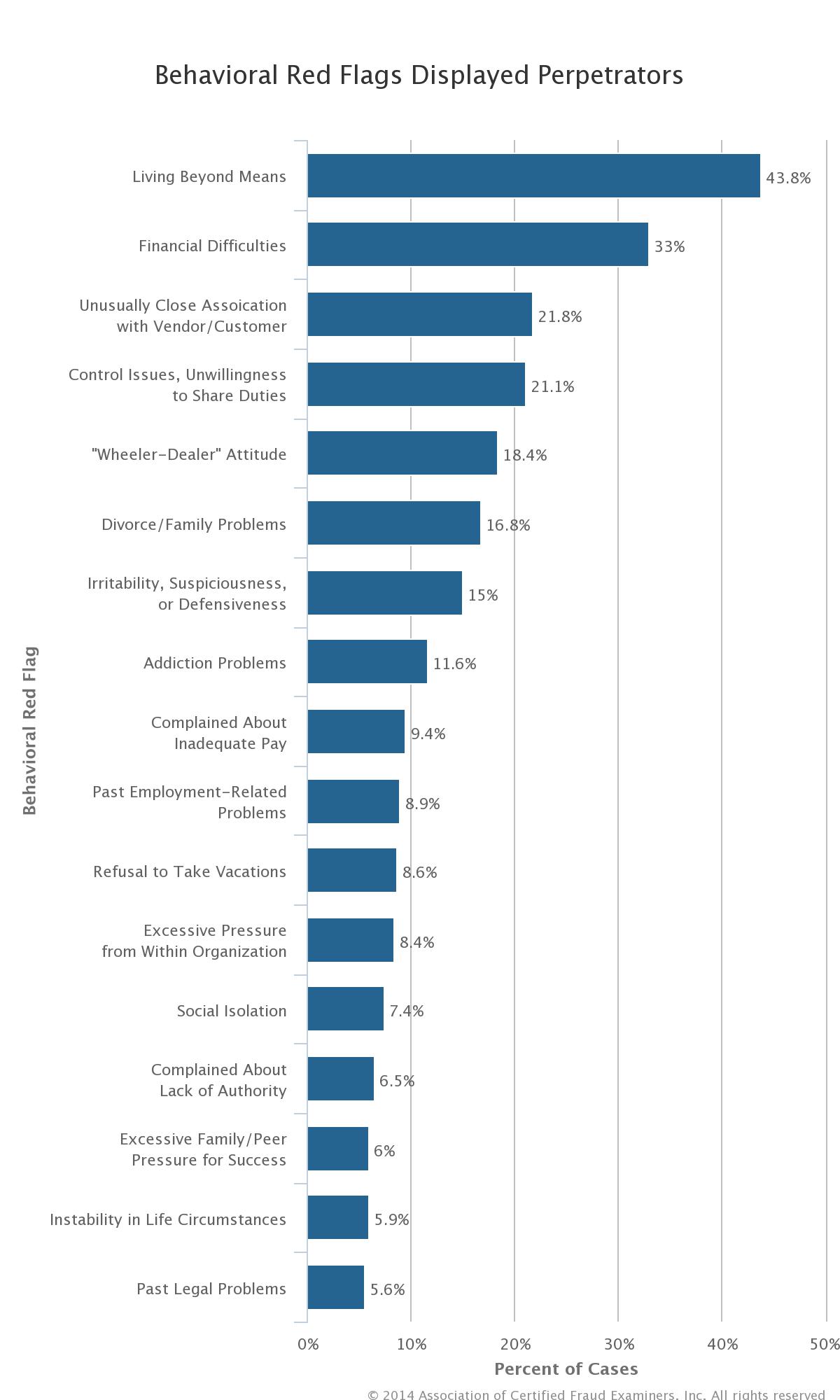
The 2014 Global Fraud Study done by the Association of Certified Fraud Examiners found of all cases they analyzed, 92 percent of the people who committed fraud exhibited certain behavioral traits, all of which are listed above.

fraudchartThe top two traits the study found are Living Beyond Means (43.8 percent) and Financial Difficulties (33 percent), as listed in #4. I’d like to expand on these two behaviors, as they may be harder to detect than the others above and on the chart you see here.

If an employee begins to talk about financial difficulties, too much credit card debt or high medical bills, that’s the time to pay a bit more attention to him. Pressure from financial problems due to things such as overspending, a divorce or health problems can set the stage for an employee to consider fraud as a way out of his difficulties.

Another behavioral change to note is when an employee who may have previously complained about being overworked, underpaid or passed over for a promotion no longer talks about workplace issues and seems more content although nothing has changed.

If she is committing fraud, she may feel that she is evening the score and taking what she considers is due to her. She now feels happier in the workplace.

Changes in lifestyle can be a bit trickier to determine. An employee may start driving an expensive new car, talk about a new second home or take high-end vacations. She may chat about moving to a new home in an upscale neighborhood or bring in photos of a new boat.

It can be tricky to question someone about these purchases and where the money came from. And they could be explained by claiming to have gotten an unexpected inheritance, or a spouse with a new high-paying job.

Or, as often happens, the money is spent somewhere the employee would not be eager to share at his workplace. Michael Dennehy embezzled over $1.7 million from Bexar Waste in San Antonio by forging company checks for more than six years. He admitted that he spent it on escort services and gambling. As a married father of five, he probably wasn’t sharing those stories in the break room.

Make observing behavioral changes part of your fraud prevention program and share this information with your management team, so they can be vigilant about these behaviors.

Fraud prevention is vital for any business. The median loss caused by fraud in the ACFE study was $145,000, with 22 percent of the cases costing a company more than $1 million.

Come back next time when I’ll discuss why small businesses are disproportionately affected by fraud and what small business owners can do to protect themselves.

How to Have a Successful Failure, Part Two

This is part two of a two-part series on how your business can not only survive but also thrive after a major setback by embracing failure as an opportunity. Part one discussed successful businessmen who persevered after failures and ultimately became successful. Part two contains specific tips on how you can achieve a successful failure for your business.

We’ve all failed at something. Maybe it was your driver’s test when you were 16. Perhaps you didn’t make that weight loss goal you set for yourself last year. Or maybe you’ve suffered a major setback in your business and are starting to feel like a failure.

You can move on from failure. As Maya Angelou said, “You may encounter many defeats, but you must not be defeated. In fact, it may be necessary to encounter the defeats, so you can know who you are, what you can rise from, how you can still come out of it.”

I’d like to offer a few tips on how to overcome that feeling of failure and perceive it as an opportunity for success.

  1. Accept failure, but view it as temporary.

As motivational speaker and writer Denis Waitley said, “Failure should be our teacher, not our undertaker. Failure is a delay, not a defeat. It is a temporary detour, not a dead end.”

So some marketing initiative or new product launch didn’t work out as planned. Perhaps your company has suffered a huge financial setback. Acknowledge that the attempt to meet your goal failed, but vow to move on.

  1. Learn from your previous mistakes.

If possible, determine what went wrong to cause the failure. If it’s not possible for you to uncover the issue internally, consider hiring outside help to find out the cause and help ensure success next time. An outside consultant can also help you determine if you’ve correctly pinpointed the issue. I’ve been hired to help failing companies that thought they knew exactly what the issue is, only for me to determine they were wrong and that the solution they had proposed was doomed to fail.

  1. Set realistic expectations.

It’s great to stretch yourself and set ambitious goals for you and your company. But setting them too high can result in yet another failure and demoralize your employees.

I tell the story in my book, How Not to Hire a Guy Like Me, of working with a company in Florida that bought a company in Minnesota and wanted to move it to Florida and have it operational in three days. Given their resources and logistical considerations, the plan was absolutely impossible.

I worked with them to map out a two-month process for the relocation. The move went smoothly and with a minimum of downtime.

  1. Consider your definition of success.

During the recession a lot of companies had to reconsider what their definition of success is. As I heard it described then, “Survival is the new success.” Sometimes in tough times, just keeping your business afloat is a success. Recognize that and congratulate yourself for it.

We will all fail at something in our life, and yes, that can be disappointing. But it’s how we react to it that makes all the difference. Dale Carnegie said, “Develop success from failures. Discouragement and failure are two of the surest stepping stones to success.”

How to Have a Successful Failure

This is the first in a two-part series on how your business can not only survive but also thrive after a major setback by embracing failure as an opportunity. This blog discusses successful businessmen who persevered after failures and ultimately became successful. Part 2 will contain specific tips on how you can achieve a successful failure for your business.

After two failed attempts to design an economical and reliable car, Henry Ford lost his financial backing and the confidence of people in the car business.

Undeterred and tired of those who knew nothing about design injecting their opinions, he found a more appropriate business partner from Scotland, Alexander Malcomson, who promised to not interfere in the design process.

With Malcolmson’s backing, Ford designed the Model T, which debuted in 1908 for $825. In the first year, 10,000 were sold. When the price dropped to $525 four years later, sales zoomed and Ford had a 48 percent share of the automobile market.

Henry Ford used what he learned from his failures to make a better product. “Failure is simply the opportunity to begin again, this time more intelligently,” he said.

Get Past Feeling Like a Failure

As a Turnaround Authority, I practice this philosophy when I work with companies that are failing. When I meet with senior management, they are often feeling pretty bad that the company is having difficulties. They may be feeling like failures on several levels.

One of the first things I try to do is to help them focus not just on past failures, but the opportunities the company now has in its current situation. These can often be difficult to see when your business is not doing well.

Great examples can be found in companies that not only survived the Great Recession but also actually came out stronger. An article in the Wall Street Journal in 2012, “For Big Companies, Life is Good,” referred to an analysis done by the Wall Street Journal of corporate financial reports. It found that “cumulative sales, profits and employment last year among members of the Standard & Poor’s 500-stock index exceeded the totals of 2007, before the recession and financial crisis.”

These companies turned to deep cost cutting and cautious investing to outperform their competitors. “U.S. companies became leaner, meaner and hungrier,” said Sung Won Sohn, a former chief economist at Wells Fargo & Co.

What is a Successful Failure?

Once you’ve acknowledged that your company is failing and that this situation can be overcome, that presents you with an opportunity to emerge leaner and meaner, what is termed a “successful failure.”

Let’s say your company does totally fail. Look at that as an opportunity to try again. Here’s just one example of a guy whose business failed and he came back even stronger.

Gary Heavin dropped out of college in 1976 and started a gym, becoming a millionaire by age 25. But his rapid expansion and high overhead costs led to financial difficulties and by age 30 the company went bankrupt.

Taking the lessons he learned from that business failure, Gary started Curves, a women-only gym. Again, he met with rapid success. He then franchised the business, which now has 10,000 locations around the world, and he is a billionaire.

Failures can be turned around into success stories if you perceive them as opportunities. After all, that’s what I do as the Turnaround Authority. It can happen for your company, too. Come back for part two for my tips on how to get started.

Work-Life Balance: The #1 Thing to Offer

This is part two of a two-part series on the growing importance of offering a work-life balance to employees in your company.

To compete in recruiting the best new employees and to retain your current employees, you need to offer work-life balance programs, as I discussed in my last column.

So how do you go about doing this? Is it going to cost you a lot of money to implement these programs and result in lost productivity? It doesn’t have to.

The number one consideration for work-life balance is flexibility. That’s what many potential employees value most. Being chained to a desk from 9-5 with a strict two-week vacation policy every year is an old-fashioned and outdated model.

imagesWork-Life Balance and Flexibility

Here are a few ways to bring flexibility to your workplace. And surprisingly, many of these measures result in increased productivity as your employees are happier, feel more independent and motivated.

  • Offer flexible schedules and telecommuting

Stagger starting and quitting times if appropriate. Some people prefer to start work earlier or later to avoid the traffic during rush hour or to leave earlier in the day to exercise or be with their children.

While some jobs can’t be performed at home, many can be done better outside an office so consider telecommuting some or all of the time. Salespeople who spend a good amount of time on the road could be more productive catching up between sales calls by going to their home office or working in a coffee shop rather than making an appearance in an office.

One PR firm in Atlanta allows all employees to work from home every Friday. They are still connected to each other online. Many of them feel that they are more productive at home than in their shared office.

Make it easy for employees to take off a few hours one day to attend a school event, and make up the time at home or on a different day.

  • Be flexible on PTO

I’ve written before about companies that put no limits on vacation time. Maybe that doesn’t work for your company but you can make sure employees have enough time to take off to recharge their batteries. Increase their PTO each year, even if it’s just by a small amount, to motivate and retain employees.

  • Be flexible and understanding about family emergencies

Allow unpaid leave if an employee has a health crisis, a family emergency or is caring for a sick relative. Chances are good that few employees will need to take advantage of this benefit, but just knowing that it’s an option makes employees feel better about working for your company.

  • Provide child care options if possible

If your company is big enough and demand warrants it, check into setting up an on-site childcare facility. Or partner with one nearby and provide a discount to your employees.

Employees Like to Feel Heard

To best meet the needs of your employees, consider conducting a survey to ask them what they would like to see added to your company. That has the added benefit of allowing employees to feel like their opinions are being heard and considered by management.

Just remember, the key is flexibility. When your employees feel that your company is responsive to their needs and their desire for flexible working options, they will be happier and more productive employees. And that is always good for your bottom line.

Offering Work-Life Balance Key to Recruiting, Retention – Part 1

This is part one of a two-part series on the growing importance of offering a work-life balance to employees in your company.

I’ve always worked too much. I promise my wife I’ll take time off every year for vacation, and I do. Just not too much – two weeks and I’m still connected. If I ever do retire, which I have no plans to do, that will probably mean I cut my workweek to 50 hours, down from 60.

That’s not an unusual work schedule for Americans. Especially for the Baby Boomers, a generation that expects to pay its dues and works long hours to be successful. They tend to be more motivated by money and prestige.

Hey, at least we aren’t as bad the Japanese, notorious workaholics. Some executives don’t even make it home at night, opting to sleep in hotel capsules, coffin-sized rooms stacked on top of each other like crates in a kennel.

The truth is I really enjoy my work as the Turnaround Authority. Yes, it can be stressful and the hours can be long. But it works for me. And I have plenty of time to be with my wife. We catch up with each other every single day with what we call Couch Time, a period of time where we sit on the couch and spend time discussing all aspects of our lives. When I’m on the road, I always call so we can still stay connected.

Achieving that work-life balance has become increasingly important and is instrumental in recruiting younger generations to your business. In fact, the definition of success has changed for many people. Having a work-life balance was ahead of money, recognition and autonomy for more than half the people surveyed in a study done by Accenture in determining whether or not they have a successful career.

And here’s a critical point. More than half of those surveyed had turned down a job offer because of the impact the new job could have on their work-life balance. Seventy percent of those surveyed believe that a satisfactory balance is possible, and often make their job choices based on achieving it.

In 2013, PwC announced results of NextGen: a two-year global generational study that focused on the motivations of millennials in the workplace. The study included responses from 4,000 people, both millennials and non-millennials. One of the key findings was that many millennial employees are not convinced that excessive work demands are worth the sacrifices to their personal life. A majority of them are unwilling to make work an exclusive priority, valuing work/life balance over rapid advancement and skill development.

So if you want to attract the younger generations, you have to think about work-life balance programs. In addition to offering these programs to recruit employees, they will also help you retain valuable employees and can actually increase their productivity as they will be happier and more focused.

Now that you understand how critical it is to offer work-life balance to your present and future employees, how do you do that? Come back for part 2.