More Red Flags of Fraud

In a previous post, Red Flags of Fraud, I wrote about 5 red flags you should be on the lookout for in your employees’ behavior to prevent fraud in your company.

These are:

  1. An employee refuses to take vacation and rarely takes personal or sick days
  2. An employee gets annoyed at reasonable questions or offers unreasonable explanations
  3. An employee wants to remain in his or her current position
  4. An employee exhibits behavioral changes, undergoes a sudden change in lifestyle or has financial difficulties
  5. An employee has unusually close relationships with vendors

The 2014 Global Fraud Study done by the Association of Certified Fraud Examiners found of all cases they analyzed, 92 percent of the people who committed fraud exhibited certain behavioral traits, all of which are listed above.
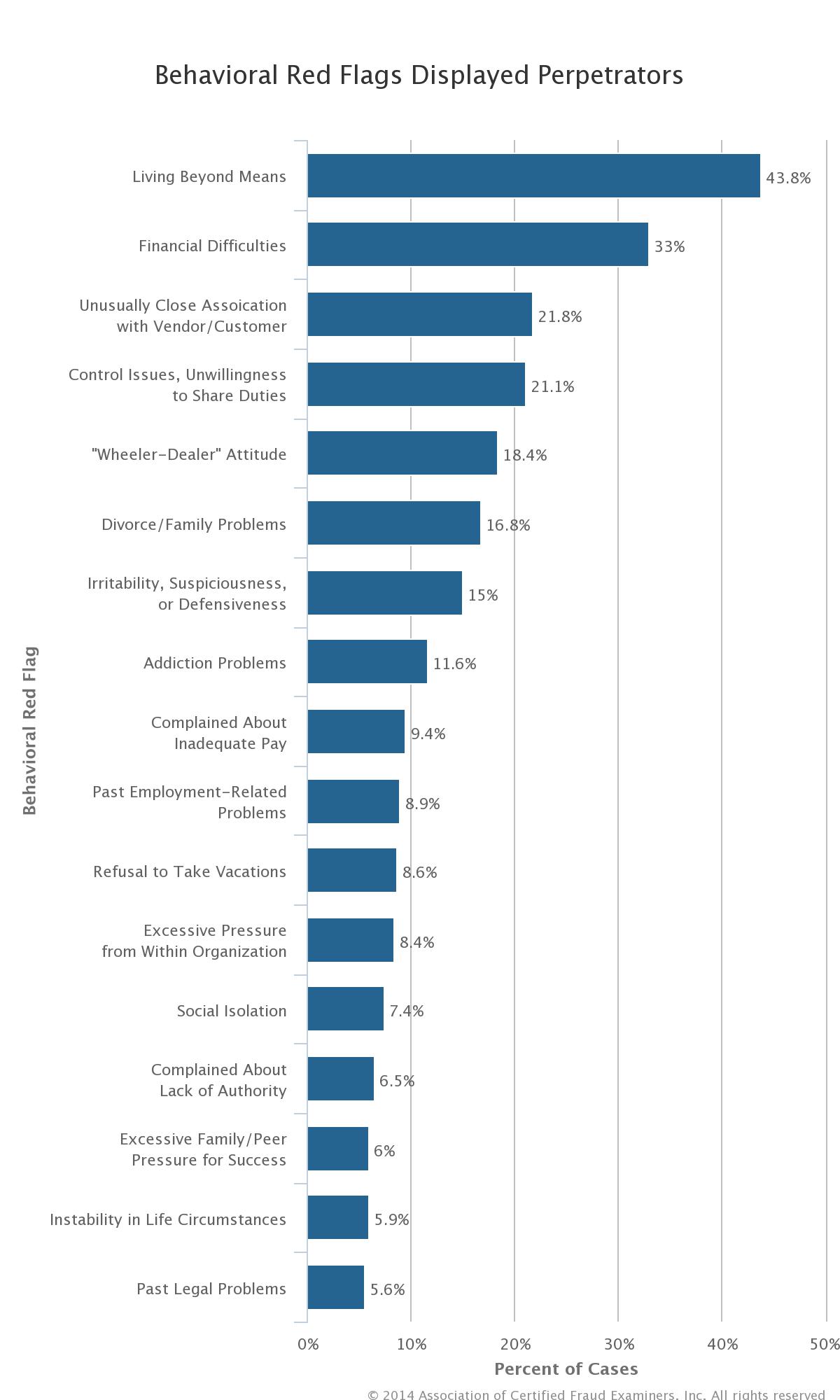
fraudchartThe top two traits the study found are Living Beyond Means (43.8 percent) and Financial Difficulties (33 percent), as listed in #4. I’d like to expand on these two behaviors, as they may be harder to detect than the others above and on the chart you see here.

If an employee begins to talk about financial difficulties, too much credit card debt or high medical bills, that’s the time to pay a bit more attention to him. Pressure from financial problems due to things such as overspending, a divorce or health problems can set the stage for an employee to consider fraud as a way out of his difficulties.

Another behavioral change to note is when an employee who may have previously complained about being overworked, underpaid or passed over for a promotion no longer talks about workplace issues and seems more content although nothing has changed.

If she is committing fraud, she may feel that she is evening the score and taking what she considers is due to her. She now feels happier in the workplace.

Changes in lifestyle can be a bit trickier to determine. An employee may start driving an expensive new car, talk about a new second home or take high-end vacations. She may chat about moving to a new home in an upscale neighborhood or bring in photos of a new boat.

It can be tricky to question someone about these purchases and where the money came from. And they could be explained by claiming to have gotten an unexpected inheritance, or a spouse with a new high-paying job.

Or, as often happens, the money is spent somewhere the employee would not be eager to share at his workplace. Michael Dennehy embezzled over $1.7 million from Bexar Waste in San Antonio by forging company checks for more than six years. He admitted that he spent it on escort services and gambling. As a married father of five, he probably wasn’t sharing those stories in the break room.

Make observing behavioral changes part of your fraud prevention program and share this information with your management team, so they can be vigilant about these behaviors.

Fraud prevention is vital for any business. The median loss caused by fraud in the ACFE study was $145,000, with 22 percent of the cases costing a company more than $1 million.

Come back next time when I’ll discuss why small businesses are disproportionately affected by fraud and what small business owners can do to protect themselves.

How to Have a Successful Failure, Part Two

This is part two of a two-part series on how your business can not only survive but also thrive after a major setback by embracing failure as an opportunity. Part one discussed successful businessmen who persevered after failures and ultimately became successful. Part two contains specific tips on how you can achieve a successful failure for your business.

We’ve all failed at something. Maybe it was your driver’s test when you were 16. Perhaps you didn’t make that weight loss goal you set for yourself last year. Or maybe you’ve suffered a major setback in your business and are starting to feel like a failure.

You can move on from failure. As Maya Angelou said, “You may encounter many defeats, but you must not be defeated. In fact, it may be necessary to encounter the defeats, so you can know who you are, what you can rise from, how you can still come out of it.”

I’d like to offer a few tips on how to overcome that feeling of failure and perceive it as an opportunity for success.

  1. Accept failure, but view it as temporary.

As motivational speaker and writer Denis Waitley said, “Failure should be our teacher, not our undertaker. Failure is a delay, not a defeat. It is a temporary detour, not a dead end.”

So some marketing initiative or new product launch didn’t work out as planned. Perhaps your company has suffered a huge financial setback. Acknowledge that the attempt to meet your goal failed, but vow to move on.

  1. Learn from your previous mistakes.

If possible, determine what went wrong to cause the failure. If it’s not possible for you to uncover the issue internally, consider hiring outside help to find out the cause and help ensure success next time. An outside consultant can also help you determine if you’ve correctly pinpointed the issue. I’ve been hired to help failing companies that thought they knew exactly what the issue is, only for me to determine they were wrong and that the solution they had proposed was doomed to fail.

  1. Set realistic expectations.

It’s great to stretch yourself and set ambitious goals for you and your company. But setting them too high can result in yet another failure and demoralize your employees.

I tell the story in my book, How Not to Hire a Guy Like Me, of working with a company in Florida that bought a company in Minnesota and wanted to move it to Florida and have it operational in three days. Given their resources and logistical considerations, the plan was absolutely impossible.

I worked with them to map out a two-month process for the relocation. The move went smoothly and with a minimum of downtime.

  1. Consider your definition of success.

During the recession a lot of companies had to reconsider what their definition of success is. As I heard it described then, “Survival is the new success.” Sometimes in tough times, just keeping your business afloat is a success. Recognize that and congratulate yourself for it.

We will all fail at something in our life, and yes, that can be disappointing. But it’s how we react to it that makes all the difference. Dale Carnegie said, “Develop success from failures. Discouragement and failure are two of the surest stepping stones to success.”

How to Have a Successful Failure

This is the first in a two-part series on how your business can not only survive but also thrive after a major setback by embracing failure as an opportunity. This blog discusses successful businessmen who persevered after failures and ultimately became successful. Part 2 will contain specific tips on how you can achieve a successful failure for your business.

After two failed attempts to design an economical and reliable car, Henry Ford lost his financial backing and the confidence of people in the car business.

Undeterred and tired of those who knew nothing about design injecting their opinions, he found a more appropriate business partner from Scotland, Alexander Malcomson, who promised to not interfere in the design process.

With Malcolmson’s backing, Ford designed the Model T, which debuted in 1908 for $825. In the first year, 10,000 were sold. When the price dropped to $525 four years later, sales zoomed and Ford had a 48 percent share of the automobile market.

Henry Ford used what he learned from his failures to make a better product. “Failure is simply the opportunity to begin again, this time more intelligently,” he said.

Get Past Feeling Like a Failure

As a Turnaround Authority, I practice this philosophy when I work with companies that are failing. When I meet with senior management, they are often feeling pretty bad that the company is having difficulties. They may be feeling like failures on several levels.

One of the first things I try to do is to help them focus not just on past failures, but the opportunities the company now has in its current situation. These can often be difficult to see when your business is not doing well.

Great examples can be found in companies that not only survived the Great Recession but also actually came out stronger. An article in the Wall Street Journal in 2012, “For Big Companies, Life is Good,” referred to an analysis done by the Wall Street Journal of corporate financial reports. It found that “cumulative sales, profits and employment last year among members of the Standard & Poor’s 500-stock index exceeded the totals of 2007, before the recession and financial crisis.”

These companies turned to deep cost cutting and cautious investing to outperform their competitors. “U.S. companies became leaner, meaner and hungrier,” said Sung Won Sohn, a former chief economist at Wells Fargo & Co.

What is a Successful Failure?

Once you’ve acknowledged that your company is failing and that this situation can be overcome, that presents you with an opportunity to emerge leaner and meaner, what is termed a “successful failure.”

Let’s say your company does totally fail. Look at that as an opportunity to try again. Here’s just one example of a guy whose business failed and he came back even stronger.

Gary Heavin dropped out of college in 1976 and started a gym, becoming a millionaire by age 25. But his rapid expansion and high overhead costs led to financial difficulties and by age 30 the company went bankrupt.

Taking the lessons he learned from that business failure, Gary started Curves, a women-only gym. Again, he met with rapid success. He then franchised the business, which now has 10,000 locations around the world, and he is a billionaire.

Failures can be turned around into success stories if you perceive them as opportunities. After all, that’s what I do as the Turnaround Authority. It can happen for your company, too. Come back for part two for my tips on how to get started.

Work-Life Balance: The #1 Thing to Offer

This is part two of a two-part series on the growing importance of offering a work-life balance to employees in your company.

To compete in recruiting the best new employees and to retain your current employees, you need to offer work-life balance programs, as I discussed in my last column.

So how do you go about doing this? Is it going to cost you a lot of money to implement these programs and result in lost productivity? It doesn’t have to.

The number one consideration for work-life balance is flexibility. That’s what many potential employees value most. Being chained to a desk from 9-5 with a strict two-week vacation policy every year is an old-fashioned and outdated model.

imagesWork-Life Balance and Flexibility

Here are a few ways to bring flexibility to your workplace. And surprisingly, many of these measures result in increased productivity as your employees are happier, feel more independent and motivated.

  • Offer flexible schedules and telecommuting

Stagger starting and quitting times if appropriate. Some people prefer to start work earlier or later to avoid the traffic during rush hour or to leave earlier in the day to exercise or be with their children.

While some jobs can’t be performed at home, many can be done better outside an office so consider telecommuting some or all of the time. Salespeople who spend a good amount of time on the road could be more productive catching up between sales calls by going to their home office or working in a coffee shop rather than making an appearance in an office.

One PR firm in Atlanta allows all employees to work from home every Friday. They are still connected to each other online. Many of them feel that they are more productive at home than in their shared office.

Make it easy for employees to take off a few hours one day to attend a school event, and make up the time at home or on a different day.

  • Be flexible on PTO

I’ve written before about companies that put no limits on vacation time. Maybe that doesn’t work for your company but you can make sure employees have enough time to take off to recharge their batteries. Increase their PTO each year, even if it’s just by a small amount, to motivate and retain employees.

  • Be flexible and understanding about family emergencies

Allow unpaid leave if an employee has a health crisis, a family emergency or is caring for a sick relative. Chances are good that few employees will need to take advantage of this benefit, but just knowing that it’s an option makes employees feel better about working for your company.

  • Provide child care options if possible

If your company is big enough and demand warrants it, check into setting up an on-site childcare facility. Or partner with one nearby and provide a discount to your employees.

Employees Like to Feel Heard

To best meet the needs of your employees, consider conducting a survey to ask them what they would like to see added to your company. That has the added benefit of allowing employees to feel like their opinions are being heard and considered by management.

Just remember, the key is flexibility. When your employees feel that your company is responsive to their needs and their desire for flexible working options, they will be happier and more productive employees. And that is always good for your bottom line.

Offering Work-Life Balance Key to Recruiting, Retention – Part 1

This is part one of a two-part series on the growing importance of offering a work-life balance to employees in your company.

I’ve always worked too much. I promise my wife I’ll take time off every year for vacation, and I do. Just not too much – two weeks and I’m still connected. If I ever do retire, which I have no plans to do, that will probably mean I cut my workweek to 50 hours, down from 60.

That’s not an unusual work schedule for Americans. Especially for the Baby Boomers, a generation that expects to pay its dues and works long hours to be successful. They tend to be more motivated by money and prestige.

Hey, at least we aren’t as bad the Japanese, notorious workaholics. Some executives don’t even make it home at night, opting to sleep in hotel capsules, coffin-sized rooms stacked on top of each other like crates in a kennel.

The truth is I really enjoy my work as the Turnaround Authority. Yes, it can be stressful and the hours can be long. But it works for me. And I have plenty of time to be with my wife. We catch up with each other every single day with what we call Couch Time, a period of time where we sit on the couch and spend time discussing all aspects of our lives. When I’m on the road, I always call so we can still stay connected.

Achieving that work-life balance has become increasingly important and is instrumental in recruiting younger generations to your business. In fact, the definition of success has changed for many people. Having a work-life balance was ahead of money, recognition and autonomy for more than half the people surveyed in a study done by Accenture in determining whether or not they have a successful career.

And here’s a critical point. More than half of those surveyed had turned down a job offer because of the impact the new job could have on their work-life balance. Seventy percent of those surveyed believe that a satisfactory balance is possible, and often make their job choices based on achieving it.

In 2013, PwC announced results of NextGen: a two-year global generational study that focused on the motivations of millennials in the workplace. The study included responses from 4,000 people, both millennials and non-millennials. One of the key findings was that many millennial employees are not convinced that excessive work demands are worth the sacrifices to their personal life. A majority of them are unwilling to make work an exclusive priority, valuing work/life balance over rapid advancement and skill development.

So if you want to attract the younger generations, you have to think about work-life balance programs. In addition to offering these programs to recruit employees, they will also help you retain valuable employees and can actually increase their productivity as they will be happier and more focused.

Now that you understand how critical it is to offer work-life balance to your present and future employees, how do you do that? Come back for part 2.


To Catch Fraud, Just Do the Math

Numbers play a large role in my career as a turnaround authority. When I am trying to save a company from financial ruin, I spend a lot of time looking at the books. All those hours I spent in math class have paid off.

My favorite use of math is uncovering fraud, which costs this country an estimated $300 billion a year. So a recent article about fraud in WSJ caught my eye — “Accountants Increasingly Use Data Analysis to Catch Fraud.”

Seems that auditors at KPMG discovered that the numbers at a national call center weren’t adding up. The operators there each issued more than 10,000 refunds a year and were authorized to issue checks for up to $50.

The firm decided to analyze some data and applied something called Benford’s Law. When they did so, they determined there were too many fours in the refund checks. So what is Benford’s Law and what’s wrong with the number 4?

Also called the First-Digit Law, it refers to the frequency of digits appearing first in a list of numbers. It seems that the number one occurs first 30 percent of the time, with each successive number occurring less and less. The number 9 appears first less than 5% of the time.

This holds true whether you’re talking about street addresses or stock prices. That’s probably why we are advised not to start a passcode with the number 1.

The phenomenon was first mentioned by the American astronomer Simon Newcomb in 1881. Then physicist Frank Benford ran all sorts of data that included things like the surface area of 335 rivers, sizes of U.S. populations and numbers listed in an issue of Reader’s Digest. He found the phenomenon to hold true in a variety of situations. The law was then named after him.

So the accountants applied Benford’s Law, and took a look at the first number of the refunds issued by the operators. When they hit the number four they saw a huge spike in the number of refunds. Can you guess what was happening?

Turns out some of these operators, less than a dozen, were issuing fraudulent refunds at the $40 level, knowing they wouldn’t be checked.

These refunds totaled several hundred thousand dollars. And the only way they were caught was by applying Benford’s Law.

Whenever there is a set limit like this, I always encourage people to ask their auditors to look below it.

I tell the story in my book, “How Not to Hire a Guy Like Me: Lessons Learned from CEO’s Mistakes” of a CFO at a manufacturing company in Wilmington, DE. He knew the level at which auditors would review expense reports was $5,000. So what did he do? He wrote himself lots of checks in the mid-$4,000 range.

Part of my review process at a company that is losing money is to look at expense reports at the senior level. I became really suspicious when this CFO dragged his feet in getting me the information I requested. I learned why when I found $180,000 of recent fraud.

Here’s a tip I offer anyone looking for fraud in a business. If you have any type levels set up like this, make sure you or your auditors are sampling below the limit of that transaction to make sure you are not getting defrauded. That seems to be a sweet spot for those committing fraud. And you may want to add Benford’s Law to your fraud detection toolbox.

How Do You Define Success?

When I interview with the owners and board of directors of a company that is considering hiring me, I am sometimes asked about my batting record. I generally state that I bat over 800, which by baseball standards means I qualify for the Hall of Fame.

By the time I am called in, a company is generally in dire straits. I deal with many unfortunate situations. Companies are on the verge of failing, they have had several rounds of layoffs, shareholder value is in decline, and creditors may be banging on the door. There are also often many personal issues of the CEOs pertaining to personal guarantees, side collateral, impending divorces or medical issues.

So what would success look like? Success needs to be defined by the goals of the owners and board of directors, as it is their business and their lives that are involved. Success may be to structure a successful liquidation or sale of a business. Success may be defined by negotiating with the bank to release or lower a personal exposure on a guarantee. Success may be to downsize, invest all of the family’s capital into a re-engineered business, and refinance with another capital source.

Success may also be defined as filing for bankruptcy and working with creditors in a structured Plan of Reorganization that is fair for all of the parties. Or a CEO may just want out and say, “Here are the keys, Lee. I just want to get off the merry-go-round and save my marriage and keep my family together.”

It’s my job in those initial meetings to determine what their definition of success is and work towards that goal.

I recently spoke to a group of turnaround professionals and was asked a few questions that had me thinking about this idea of the definition of success. The first was why was one business where I was Chief Restructuring Office liquidated?

The short answer is that sometimes liquidation is the meaning of success for that particular company. Other times it’s the only option available. And in some circumstances, the owners or board of directors chose not to follow my recommendation and the company had to be liquidated. Those are the most heart breaking for me as I feel that had my recommendations been followed, we could have saved the company.

I was also asked about some of my “failed” turnarounds. Again, it may have been too late, my recommendations perhaps weren’t followed or maybe some strategies didn’t work. Turnarounds are complicated and difficult by definition and morph constantly throughout the process.

No one in this industry can claim a 100 percent success rate and I am proud of my record. Do I wish I could save every single company I work with? Of course, and I always act as if the company were my own and try everything in my power to meet the definition of success as defined by the owners and board of directors.

Even if a company being liquidated is the best-case scenario is a given situation, it’s still tough for the owners. So the next time you know of someone that has lost a business, gone bankrupt or been downsized, be sensitive to that person’s situation. They need the support of their friends, and sometimes counseling and medication to get through a rough spot in their life.

And ask yourself, what would you do when faced with a tough decision? How would you define success?

As the saying goes, “Beauty is in the eye of the beholder.” The same can be said of the meaning of success.

Why You Want Beam Holders in Your Business

This is part one of a two-part series on beam holders. Read on to find out what that is, and how you can find them.

I love it when I come across a new phrase in business. Especially one that describes someone or something that I encounter frequently and can then use myself.

I recently came across such a useful phrase as I was reading an interview with Sharon Sloane, chief executive of Will Interactive, a company that makes training videos.

Her interview was in Corner Office, the weekly NYT column by Adam Bryant. He asked her what she looks for when she hires people.

She responded that she looks for “beam holders.” By that she meant, “Someone who feels personally responsible for the welfare and growth of the company and will do whatever it takes.”

She explained that she wants people who are personally invested in the success of the company and are willing to go the extra mile.

You know the type she is talking about. The ones who stay late for days to make sure a deadline is met. The manager who picks up trash off the warehouse floor when he is walking around or steps up to help a customer when the line is too long. The customer service rep that stays on the phone after her shift has ended to make sure a customer is satisfied.

You will never hear a beam holder say, “That’s not my job.” If it helps the business succeed, a beam holder will take care of what needs doing at that moment, whether it falls within her job duties or not.

This person will also not say, “I don’t have time to do that.” If time is an issue, the beam holder will take responsibility for finding someone who can handle the task or project.

I look for those types of people too when I go into an organization because they are the ones who will help me pull it out of trouble. I refer to them as Super Stars in Game Breaking Positions. They aren’t hard to spot. In fact, I can generally tell within just a few minutes whether I’m talking to a beam holder or not.

These are the folks that have taken on additional responsibility for no extra pay when the company was downsized. These are the people who still show passion for the company they work for. Despite often being mistreated, unappreciated and expected to do more with less, they are still loyal to their companies and want to see them succeed.

I’ve encountered beam holders at all levels of an organization. Sometimes the CEO has pretty much thrown in the towel, but he has people in the warehouse who are still busting their butts every week to make the delivery schedule and customer service personnel who still do their best to handle the increasing customer complaints.

Sometimes beam holders may be the silent ones, initially hesitant to talk to me. It’s because they have been punished for speaking out before, or labeled difficult when they pointed out problems with the way the company was run. These people are sometimes the unhappiest because they know how the company could and should be run better. It bothers them immensely to see how far off track it’s gotten.

Beam holders are the people you want in your business — in good times and in bad. They will devote themselves to the company and do their best to see it succeed.

Come back for part two when I discuss how to find and hire beam holders for your business — how you can get those Super Stars in Game Breaking Positions.


What Kind of Intuition Do You Have?

Financial reports, pie charts, spreadsheets — all the numbers in the world will only tell you so much. Like me, turns out a majority of people rely on their gut instincts when making a decision.

A survey done by The International Association of Administrative Professionals and OfficeTeam of 1,300 senior managers and 3,500 administrative professionals found that a whopping 88 percent of them make decisions based on gut feelings.

I’ve written before about the value of trusting my gut. I have found that if I make a decision that goes against what my gut tells me to do, 99 percent of the time it turns out badly.

I trust in my gut to connect the dots in the future, as Steve Jobs referred to it, because, “You can’t connect the dots looking forward; you can only connect them looking backwards.” As he said, “This approach has never let me down, and it has made all the difference in my life.”

It seems the higher up the corporate ladder you are, the more important your gut instincts can be, according to an article in the Harvard Business Review, When to Trust Your Gut.

“Over the years, various management studies have found that executives routinely rely on their intuitions to solve complex problems when logical methods (such as a cost-benefit analysis) simply won’t do. In fact, the consensus is that the higher up on the corporate ladder people climb, the more they’ll need well-honed business instincts. In other words, intuition is one of the X factors separating the men from the boys.”

It can be helpful to understand what type of intuition you generally rely on. If you know which skills serve you best, you can hone them and bring them to the forefront when faced with a big decision.

So what type are you? There’s a quiz for that, developed by OfficeTeam, an international staffing service. Take the 10-question quiz, What’s Your Intuition Style? to find out.

The five possible types, according to the quiz are:

  • Adapter. With this type of intuition you have the ability to use multiple strategies, including asking a lot of questions, observing people’s behavior and researching the situation. Don’t take it personally when your own needs are overlooked and let others know what you need.
  • Analyst. You are good at digging up facts, doing research and coming up with logical and well-reasoned insights. Use those skills combined with instinctive abilities when making decisions.
  • Empathizer. While you are good at anticipating other’s needs and identifying with their problems, be careful not to rely too much on emotion when making decisions. Remember the value of research and analysis.
  • Observer. This type of intuition relies heavily on visual cues based on other’s demeanor. Be sure to make sure you engage them in conversation as well to better anticipate the needs of others.
  • Questioner. Rather than rely on assumptions you ask the parties involved directly and you are good at getting people to talk. Learn to rely more on your observational skills to find out what people aren’t telling you.

This type of quiz can be fun and informative, but remember that it’s called gut instinct for a reason. We will never fully understand human instincts but knowing when they can be helpful can make the difference in your career.

The Willingness to Be Unpopular

I believe in always conducting business with integrity and treating everyone with respect. I’ve quoted Henry Kravis before, with whom I’ve had the pleasure of working. “If you don’t have integrity, you have nothing. You can’t buy it. You can have all the money in the world, but if you are not a moral and ethical person, you really have nothing.”

But despite the fact I play fair and treat people well doesn’t mean I’m universally loved — far from it. In a career as a Turnaround Authority, you have to make many unpopular decisions. If you want to be everybody’s friend, you’ll never make it in this business. It’s like that quote by Harry Truman, “If you want a friend in Washington, get a dog.” The same goes in the turnaround business.

To be an effective leader, you have to be willing to be unpopular at times. I’ve been so unpopular at times that I’ve been shot at – twice! When you catch people not doing what they are supposed to do or need to reduce staff or benefits, people get unhappy.

But good leaders often have to make decisions that upset people. Take a look at Abraham Lincoln, considered one of our finest presidents. He was also one of the most unpopular. The press hated him and characterized him as a buffoon. He received death threats, one of which was printed in a Mississippi newspaper with a reward of $100,000 offered for his “miserable, traitorous head.” Members of his own party hated him. There is even a book called “The Unpopular Mr. Lincoln: The Story of America’s Most Reviled President.” When he died, a paper in Texas said,  “The world is happily rid of a monster that disgraced the form of humanity.”

A truly great CEO will make unpopular decisions for many reasons — to save the company, to ward off competition, to prepare for future changes in the marketplace. In 2004, the industry thought Verizon CEO Ivan Seidenberg was bluffing, and even worse, crazy, when he unveiled his unpopular plan to lay down fiber-optic cable across the country to the tune of $24 billion. Verizon is now the nation’s top carrier.

When Howard Schultz came back as CEO of Starbucks in 2008, he took responsibility for the bad situation the company was in, despite the fact he hadn’t been at the helm during the previous eight years. The share price was down 50% with news sources claiming Starbucks was no longer relevant and would be killed off by McDonald’s.

Because the cost was so high at a tough time in the company’s history, his decision to fly 10,000 store managers to New Orleans for a conference was an unpopular one. But he credits that conference with turning the company around. “If we hadn’t had New Orleans, we wouldn’t have turned things around. It was real, it was truthful, and it was about leadership,” he said in an interview in the Harvard Business Review.

And let’s talk about one of the most unpopular CEOs of this century: Steve Jobs. He was fired from his own company at the age of 30. Rather than wallow in defeat, he created a new company, Pixar Animation Studios. In 1996, he returned to Apple, became its CEO the following year and created products like the iPod, iPhone and iPad.

Think about those examples the next time you have to make an unpopular decision. As the former prime minister of the UK Tony Blair said, “Leadership can be an unpopular business. The art of leadership is saying no, not yes. It is very easy to say yes.”

And look at it this way, odds are you won’t get shot at.