Tips on Dealing with Your Banker

I’ve been on both sides of that big banker’s desk. Early in my career I worked as a banker, which gave me invaluable experience on learning how the money guys think. We learned the things that would make us fire CEOs and shut down companies.

These were lessons that were invaluable to me during my entire career as the Turnaround Authority. I know what bankers, investors and other creditors are looking for when they analyze a business. I know what they want to hear from CEOs and business owners.

Businesses need money to operate. That means they generally need bankers and investors — the money guys. But many CEOs treat their bankers as the opposition, like Mr. Potter, “the richest and meanest man in the county” in “It’s a Wonderful Life.”

Having a good relationship with your banker is so important, I devoted an entire chapter to it in my book “How Not to Hire a Guy Like Me: Lessons Learned from CEOs’ Mistakes,” which covers the 10 C’s of bank relationships for CEOS.

Here are just a few tips on how to have a good relationship with your banker. (For more info, you can always buy my book!)

1. Always keep your banker informed

Communication is one of the 10 C’s I discuss in my book and is the key to having a good relationship with your banker. We’ve all gone through difficult situations where we didn’t want to share bad news with someone, preferring to stick our head in the sand or hope the problem goes away. But not telling your banker when your company is having problems paying a vendor, collecting receivables or going through a cash flow crunch is the exact wrong thing to do. In fact, if your banker finds out you have not been disclosing crucial financial information, it can be the quickest path to having your bank loan called or to losing your financing.

2. Have contingency plans

Bankers and other money people like stability. They want to know you have a plan in place in the event that one of the 3 D’s happens — death, disability or disappearance. Yeah, I’ve had a few CEOs vanish on me. You can add that to the list of behaviors that won’t endear you to a banker.

While acting as CEO at one company I hosted a cookout with the employees. You’d be surprised what you learn while chatting around the grill. One employee mentioned excess inventory purchasing. Turned out it was a case of multi-million dollar fraud. The previous CEO knew something was wrong but didn’t deal with it. I found the problem and had four executives arrested. The CEO? Gone with the wind.

Do you know what will happen to your business if any of the three D’s occurs? Make a plan and show it to your banker.

3. Demonstrate good character

Do what you say you will do. Make your payments when they are due. Keep your banker informed. If you have and demonstrate good character your banker is more inclined to work with you, rather than against you.

The money people want to trust you — indeed, they are placing a great deal of trust in you when they close on that loan to your company. Make them happy they extended that trust.

A banker can be a powerful ally for your business. One of the best things you can do for your business is to have a good working relationship with your banker.

Look for me November 10 at 4:30 at the Book Festival of the Marcus Jewish Community Center of Atlanta. I’ll be discussing my book,  “How Not to Hire a Guy Like Me: Lessons Learned from CEOs’ Mistakes.” The event is free and open to the public. Click here for more information. Hope to see you there!


Testing Just One Part of Hiring Process

I’ve taken a few personality tests. One was on how I negotiate and I thought the results didn’t really reflect how I go through that process. But everyone else thought the test had totally pegged me. When I took the Myers-Briggs Type Indicator it pretty much nailed my personality.

I thought about these tests when I read a discussion on www.wsj.com on the percentage of companies that use some sort of tests during the hiring process. Nearly 20 percent of employers use personality tests in the hiring or promotion process, according to a survey done in 2011 by the Society for Human Resource Management of 495 human resource managers.

When you get to hiring for and promoting into top positions, the amount of testing and assessments of candidates understandably goes way up. According to an article in the Wall Street Journal, “Employers Put Executive Job Candidates to the Test,” 72 percent of the 516 companies polled used assessments to make decisions on promoting executives, more than double three years ago.

These assessments can include psychological interviews, role-playing and simulations. For example, candidates may be told to pretend they are dealing with a frustrated customer who starts yelling at them.

Not surprisingly, Google has identified the qualities and skills it desires in people who fill their top positions and has created an algorithm to predict each candidate’s success.

While I do think these tests have some validity, I believe they should be treated as just one indicator of whether a person can handle a high-level position. Testing should be just part of the process.

A key part of the process for me is just spending time with the person and getting to know him or her. After being in the turnaround business for more than 30 years, I’ve done a lot of hiring and firing. Luckily, one of the skills I’ve developed along the way is the ability to read people, a skill that is useful in just about every area of life.

It’s a skill that the legendary coach Bear Bryant had, according to people who worked with him. Bruce Arians, the Cardinals head coach, was his assistant for two years and called him “a master of personnel, of people.” It’s undoubtedly one of the skills that helped him win 323 games as coach of the University of Alabama football team.

(I also adhere to one of his hiring policies. “I don’t hire anybody not brighter than I am,” he said. “If they’re not smarter than me, I don’t need them.”)

If you want to improve your ability to read people and learn more about them than what they are telling you, here are a few questions to ask from an article by Anthony K. Tjan on the Harvard Business Review blog, “Becoming a Better Judge of People.”

• How does this person treat someone he doesn’t know? If you meet in an office, how did he treat the receptionist? If you go out to a meal, is she polite to the waiter?

• Does the person feel authentic? Did your BS detector go off at any time? Are they trying too hard?

• Is this person an energy-giver or taker? We’ve all known people that give off a negative energy. Does this person have a positive view of the word or tend to react negatively?

And one of the most important questions to consider: Is this person self-aware? A good understanding of your strengths and weaknesses is key to being a good leader.

Testing candidates can tell you a lot about their qualities, skills and values. But spending time with them and observing how they behave can tell you even more. 

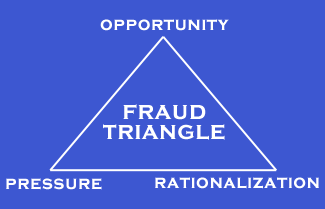
Why Fraud Occurs: The Fraud Triangle

Pressure, opportunity and rationalization. Those are the three factors that must be present for a person to commit fraud in workplace.

I’ve written a lot about the effects of fraud, the cost of it to the US economy and how to prevent it. But why is there so much fraudulent activity going on every day?

Criminologist Dr. Donald Cressey asked the same question in 1950. Cressey, who is considered the founder of the modern study of organized crime, became fascinated with embezzlers and wrote his dissertation on them for his Ph.D. in criminology. He was puzzled because most people who commit fraud are not criminals. They are generally “good” people. So what happens?

He interviewed 250 criminals who must have accepted a position of trust in good faith and must have violated that trust. His research was published in Other People’s Money: A Study in Social Psychology of Embezzlement in 1953. His theory on why fraud occurs eventually became know as the Fraud Triangle and is still the classic model to explain why people commit fraud in the workplace.

Cressey wrote that all three factors of the fraud triangle must be in place for an employee to commit fraud.

fraud7Pressure/Incentive

The thief is initially motivated because he or she has some type of non-sharable financial pressure or incentive. They may be involved in gambling, have a drug addiction or possibly took on more debt than they can handle. Or they could have a desire for material goods beyond their means, such as designer clothes and handbags or a new car. Sometimes an employee feels unfairly treated by a company and this is their way to get back.

The non-sharable aspect is an important distinction because the person generally feels shame or embarrassment over the situation or is concerned about potential disgrace. These are generally crimes committed in secret.

Amy Wilson was a respected office manager when she was caught for embezzling $345,000 and sent to jail. Now out and reformed, she speaks about what she did to help businesses prevent fraud. The first time she embezzled, ironically, was to hire a lawyer for her 18-year-old son, who had been charged with a felony and put in jail. When she was caught, not even her husband knew of her crime.

Opportunity

The second factor is opportunity. The criminal has to see what he perceives to be an opportunity and one that he can keep secret. He has gained the knowledge and has the authority to circumvent internal controls and devises a scheme to exploit those.

Amy’s company had no internal controls and as the office manager, she had access to all the bank accounts and computers. “For me, stealing money was as easy as printing checks in the accounting software test module and forging the vice president’s signature,” she says. “I then paid my personal credit card account with a company check.”

Rationalization

Most people who commit fraud in the workplace have no criminal past. They are first-time offenders and despite stealing from their companies, believe themselves to still be honest and decent people. To continue along the path of denial, they come up with ways to justify their crimes to themselves. These include: I was stealing to provide for my family; I am underpaid at work and deserve to have this money; I was going to eventually pay it back; everyone else at work steals things like office supplies and no one seems to care.

Amy worked long harder and longer hours, one of the ways she was able to justify her theft to herself. “Somehow, this made me feel less guilty and less shameful about my behavior,” she says. “I vowed to find a way to pay back the money I’d ‘borrowed.’”

There are great lessons to learn about how to handle fraud by looking at the fraud triangle and the behavior of people like Amy. Read next week’s column to find out what the fraud triangle tells us about how to handle fraud in the workplace. What works, and what doesn’t?

Sharing My War Stories

I’ve always known that reaching a major goal takes a lot of work. Completing my new book, “How Not to Hire a Guy Like Me: Lessons Learned from CEOs’ Mistakes,” was no exception.

It took me decades of work in the turnaround field to experience all the stories that are contained in the book, many of which would be difficult for me to believe if I hadn’t been there myself. Who gets shot at – twice – while working in this industry?

There are a lot more stories, although they don’t generally involve gunfire. One involves a knife – brandished by a son at his mother after he got fired. You’ll also read about church ladies stealing, CEOs cheating, CFOs lying, and a multi-million dollar company that rationed toilet paper for its employees.

One reader familiar with my industry commented, “You even figured out a way to work sex into a book about the turnaround industry.”

The first newspaper article about my new book appeared last week, and I’d like to thank the reporter, Bobby Tedder, for interviewing me and writing the story below. I’m not sure whom the headline about Titans refers to, though. I never played football for Tennessee. But I like the alliteration and the phrase Turnaround Titan would look nice on a business card.

Note: I’ll be interviewed this Tuesday on WREK, FM 91.1, the radio station at Georgia Tech in Atlanta, on the “Let’s Talk Business” show from 12:30 to 1:00 p.m. 

Business Turnaround Titan Pens Book of Wisdom

By Bobby Tedder, btedder@neighbornewspapers.com

Lee Katz, whose reputation as a company fixer precedes him, is finally offering a bound volume of words of wisdom for public consumption.
The Katz-penned “How Not To Hire a Guy Like Me: Lessons Learned From CEOs’ Mistakes” recently hit the market.

“It’s written for anyone. … Any business owner can benefit from it,” he said.

The Sandy Springs resident product has specialized in turning firms of varying sizes and covering a broad range of industries around. His crisis management career, including stints working with public and private companies, spans three decades.

He called the book the culmination of discussions with his many clients and friends.

“They told me I have so many great war stories to share,” he said.

That group of confidants reads like a virtual Who’s Who list from the business realm.

That would include former Home Depot co-founder Bernie Marcus, whose endorsement of Katz’s book is found on the back cover.

“Read it. Learn from it. Benefit from Lee’s many years as the Turnaround Authority,” Marcus wrote.

Among the many topics Katz tackles in the book are the elements of solid leadership and detailed advice on how to recognize and respond to internal fraud.

“People keep asking me what took me so long to come out with a book,” said Katz. “The answer is that I’ve been working 60- and 70-hour weeks all these years.”

The Georgia Tech alum’s tome could gain added traction beyond the business elite considering its content is not on the esoteric side.

The book is written in a language that is accessible to the average reader — or “folksy,’’ as Katz put it.

“Those people who have read it say it [reads] like me talking. … It’s very straightforward,” he said.

© neighbornewspapers.com 2013

Admit Your Mistakes

“The CEO of Apple says a leader should admit when he’s wrong.”

“That won’t work for me because I’m never wrong. The best I can do is admit when other people are wrong.”

“That sort of misses the point.”

“Well, I humbly admit you’re wrong.”

— A Dilbert cartoon by Scott Adams

A friend was interviewing a woman for a high-level position in his company and asked a fairly typical question. “What was a mistake you made and how did you handle it?”

“Well, I’ve never made a mistake,” she said.

I would have ended the interview right there. With those six words, that woman revealed that she is not someone I want to hire. She let me know that she did not recognize her mistakes and that when things do go wrong, she’ll either deny them or blame someone else.

Every person and every company makes mistakes. The important part, and the way to judge someone’s integrity and business savvy, is what they do next.

imgres

Steve Jobs would admit when Apple made mistakes. “But we learned from it,” he would say.

I encourage the executives I work with to admit their mistakes. The first chapter of my new book, “How Not to Hire a Guy Like Me,” starts with my encouragement of presidents, CEOs or owners of businesses to admit their mistakes. While my book is based on lessons learned from CEOs’ mistakes, my readers can’t begin to handle the problems facing their own companies until they admit their mistakes.

When Steve Jobs introduced the iCloud in 2011 in one of his famous keynotes, he dealt with the elephant in the room — Mobile Me — straight on and with humor. Everyone in the room knew that Mobile Me had been a failure and had been clobbered by its competitors. The iCloud was the new product Apple was introducing in its place.

As he was introducing iCloud, he said, “You might ask, why should I believe them? They are the ones that brought me Mobile Me. It wasn’t our finest hour — let me just say that. But, we learned a lot.”

Many people, perhaps men in particular, worry that admitting their mistakes will make them look stupid. Well, what happens when they don’t admit their mistakes and they get found out? Then they look foolish and deceptive.

But if you admit your mistakes, people will trust you and respect you as a leader. And trust and respect are important to building strong business relationships with your employees and customers.

I tell a story in the book about a CEO that refused to admit when he made a mistake, choosing instead to gloss it over. That refusal ended up costing the company $8 million. See what I mean about learning from CEOs’ mistakes? That one was a doozy.

We are all going to make mistakes. They can actually be turned into opportunities. As Albert Einstein said, “Anyone who has never made a mistake has never tried anything new.”

The most important part is admitting the mistake and then to follow Steve Jobs’ example: learn from it. And move on.

How Not to Hire a Guy Like Me

I’ve had a lot of memorable moments in my career. Some are good: like telling a CEO we can save his company millions of dollars or telling a business owner his company doesn’t have to fail.

Others are memorable in a bad way. Like getting shot at, twice. (They missed, twice!) Or watching a grown man attack his mother with a knife.

Today is one of my most memorable moments. A very good one. Today I announce the publication of my first book, “How Not to Hire a Guy Like Me.”

After working in the turnaround business for 30 years, I’ve gained a lot of knowledge about how successful businesses work and how to fix them when they aren’t working so well. And I’ve seen a lot of mistakes made that caused businesses big problems. That’s why the subtitle of my book is “Lessons Learned from CEOs’ mistakes.

HowNotCoverUsing real-life examples, I offer advice on how to avoid making those same mistakes. As one of my endorsers, Rafael Pastor, CEO of Vistage International wrote, “Lee Katz covers what they didn’t teach you in business school— how to avoid the land mines and what to do if you happen to step on one.”

That is one of the reasons I wrote this book: to educate people. This book is for business owners, C-level people, entrepreneurs or anyone who operates in the business world. They can all benefit from the tips in the book.

In addition to learning from the mistakes of others, a major lesson I’d like readers to take away from the book is that admitting your own mistakes and then moving forward is much better than denying or ignoring them. In fact, the title of the first chapter is “Check Your Ego.” Running a successful business is not about your ego and what you want. It’s about how to work with other people as a team toward a common goal. A one-man company doesn’t survive.

Other chapters include advice on confronting your harsh realities, how to be a proactive leader, how to make your banker your partner and how to prevent fraud.

Another reason I wrote the book is that it’s a way for me to give something back to the business community, where I’ve worked for more than 30 years. It’s the same reason I do a lot of pro bono work for organizations I believe in. I enjoy using the benefit of my knowledge to help others.

I’ve been lucky enough to work with some of the best business people in the country and they were generous enough to endorse my book. Bernie Marcus, Chairman of the Marcus Foundation and co-founder of The Home Depot wrote, “What you are about to uncover inside this book can help ensure that you, as a leader, also avoid pitfalls. Read it. Learn from it. Benefit from Lee’s many years as The Turnaround Authority.”

Alex Gregory, Chairman of the Board and President of YKK Corporation of America wrote, “You name it, Lee has done it. Fortunately, Lee has shared his invaluable experiences with us in this extraordinary book. We can learn from the mistakes of others, through the wizardry and humor of Lee Katz.”

You can purchase the book by clicking on the book cover on the right, or on Amazon.com. Yes, that’s my smiling face you see on the cover. It’s an easy read, and I hope you’ll benefit from the advice it contains. As Bernie Marcus wrote, “That way, the only time you will ever see Lee’s face is either on this cover, or smiling across the table at a philanthropic endeavor.”

Enjoy it, benefit from it. And let me know what you think. Even if you’ve never been shot at or the victim of fraud, I’d love to hear your stories. Email me at Lee@TheTurnaroundAuthority.com.