Testimonial Magic: Know All the What You Want, But Don’t Neglect the Who

When being retained as an expert witness, generally the other side tries to undermine your credentials or experience in order to either discredit your answers or, in extremes, not allow your testimony at all. The opposing side also tries to undermine one’s credibility by investigating whether you’re always a plaintiff or defendant side witness – or if you only represent creditors and not debtors. It’s a game that we’ve all seen on Law and Order or Perry Mason.

The Pledge

For my first case as an expert witness, I was hired to testify to the feasibility of a cash collateral order in a bankruptcy case. As I took the stand my lawyer introduced me and gave my background.

Now, I knew what I was talking about, but we were all still confident that the other side was going to absolutely skewer me. It’s not that I had a shady past, but because 25 years ago I’d only done a few turnarounds. The question was, Was I really an expert at this point?

Now I’m The Turnaround Authority and I have the experience to prove it, but back then, well, there just wasn’t enough gray hair on my head yet.

The Turn

The opposing counsel introduced herself to me as she prepared to elaborate on my experience, or supposed lack thereof. However, as soon as she called me “Mr. Katz,” the federal judge took notice, looked down at me from the bench over the rim of his glasses and said, “Katz? Are you related to Israel Katz?”

I replied, “Yes, your honor. He’s my father.”

At which point the old judge bellowed jovially, “How’s old Israel doing? Did you know that in 1967 your father was head of the Democratic Party in Dekalb County, and in the late 40s he filed the first Chapter 11 case in this district? I know him well but haven’t seen him in a long time. Please give ol’ Israel my regards.” Then turning to the opposing counsel, who had reared back on her haunches, ready to pounce, said, “Oh, sorry, counsel. It’s your witness – please proceed.”

The Prestige

Having been totally flustered but regaining her composure and straightening up, she answered, “No questions, your honor. Mr. Katz is an acceptable witness.”

And that’s how I got through my first case as an expert witness without any trouble. Sometimes it’s not just what you know but who you know that counts.

Now, with my history of workouts I don’t ever worry what the opposing counsel will say – indeed, in a recent case the lawyer already knew me and asked why my side would “bring out the big guns when a pea-shooter would do” – but back then this was a lucky break.

I’m even proud to say that after this case I became friendly with the opposing counsel who has since retained me for a number of client cases over the past twenty or so years.

Have you ever been to court over business issues? What were your experiences?

Cash is King (I), A Fact in Three Parts and guest post by Vic Taglia

As managing partner of GGG and the Turnaround Authority, I get the pleasure of providing guest posts by our other partners. The following post is by our newest Partner, Vic Taglia.


Cash is King, and every other business consideration is merely a poor pretender to the throne of a troubled company.

When a company is in trouble, its management needs to focus like a laser on cash, asking these questions:

1. How much do we have?

2. How do we get more?

3. To whom must we give it?

These three questions should form the basis of every decision the management of a troubled company makes.

Stop worrying about market share, profit margins, sales trends, capital expenditures, etc. – except as they are directly related to cash. You have to survive before you can worry about these more traditional business issues.

We Need Cash, STAT!

Think of your troubled company as a patient in the emergency room. The ER doctors start with the ABC of survival: airway, breathing and circulation. They don’t look for broken bones; they make sure the patient has a clear airway, is breathing and isn’t bleeding out.

Now think of cash as your troubled business’s oxygen and blood.

1. Your first step is to clear obstructions to your cash picture. How much is in the bank? How much are your held checks? Are there any customer checks not in the bank?

2. Check your company’s breathing. Is there cash coming in? Are there leaks in the windpipe? Are your customer checks getting to the bank quickly? Are you getting immediate credit for your deposits?

3. Finally, is your cash leaking out?  Are your expenses/cash disbursements going on the floor? Can you apply a tourniquet to the wound and staunch the leaks?

And consider hiring a specialist to help you.  When you go to the Emergency Room, you see ER specialists, not the family doctor.

Once management identifies these first critical answers, it needs to expand its analysis by applying some time measurements and adding some details to its cash picture, both current and projected.

That, we’ll talk about in next week’s post – so stay tuned!

What are your experiences with your business and cash flow? Any questions?

Want to learn ways to avoid being bitten by the alligators and keeping cash at the top. Check out this classic post.

Dealing with Vendors, Suppliers, Bankers and Other Creditors, a guest post by Vic Taglia

As managing partner of GGG and the Turnaround Authority, I get the pleasure of providing guest posts by our other partners. The following post is by our newest Partner, Vic Taglia.

When dealing with vendors, suppliers, bankers and creditors, tell the truth. Do not be deceitful. Ultimately, deceit will only work against you.

It is ok to give them the Heisman maneuver. If you don’t follow college football, visit http://www.heisman.com/history/trophy_history.php to see the Heisman trophy. Pretend you are the running back, cash is the football, and your creditors are trying to force a fumble. Hold onto the football.

It is not ok to use the Arpege stratagem (“Promise her anything, but give her Arpege” was the slogan on their television ads many years ago.) This may work for a week or two, but you will quickly find yourself with no product and no credibility. It didn’t work with your wife; it won’t work with your creditors.

It is ok to negotiate – hard – with your creditors. Offer partial payments, cash on delivery, payments on past invoices if they continue to ship current product—whatever it takes to keep your business running. But keep in mind the first rule, always tell the truth.

Be aware that some of these practices may become preferential payments if you end up in bankruptcy court. This will most likely become the recipients’ problems, not yours. A full discussion of preferences is best handled with your bankruptcy counsel, and our goal is that you never have to meet him.

Conditional Promises

You can make conditional promises. “We can pay you Friday since I expect Customer A (don’t name them), to pay $XX (don’t name the amount either) on Thursday. If Customer A doesn’t pay on Thursday, we can only pay (some other, lower) amount.” Be sure to call your creditors if Customer A doesn’t come through and you’ll miss your promise.

In fact, call your creditors even if Customer A does pay you. (You can always give him your check number and the exact amount of the check. Credit managers love writing the check number and amount—it shows they are doing their jobs.) He’ll be happy to get some good news, and he’ll want to know how much you’ll pay him next week. This communication will help re-build the trust between you and your creditor. Remember rule number one.

You want to be specific about your plan, but vague about which customers hold your lifeblood in their hands. You absolutely don’t want your creditors to start talking to your customers.

A Warning

Don’t be bullied by collection agencies. They are experts in collections—smart, well-trained, smooth-talking and persistent. If you are dealing with lots of collection agencies, you will feel overwhelmed, and it may be time to call in some expert help.

There is such a thing as lender fatigue. Sometimes both you and your suppliers’ collections managers are just sick and tired of each other. It is ok to ask to speak to supervisors, managers, the company president, owner, etc. You may be able to get more understanding (and a key shipment) from a new listener. But remember rule one.

It is ok to look for new vendors, suppliers, bankers and other creditors. Generally, serious problems seem to quickly become common knowledge, though, so don’t be disappointed if there aren’t lots of folks offering product on open account or new bankers offering unsecured working capital lines of credit at LIBOR plus 10 basis points.

And always remember rule number one—Tell the truth.

Has a lie with a creditor ever gotten you in hot water? Please share in the comments below.

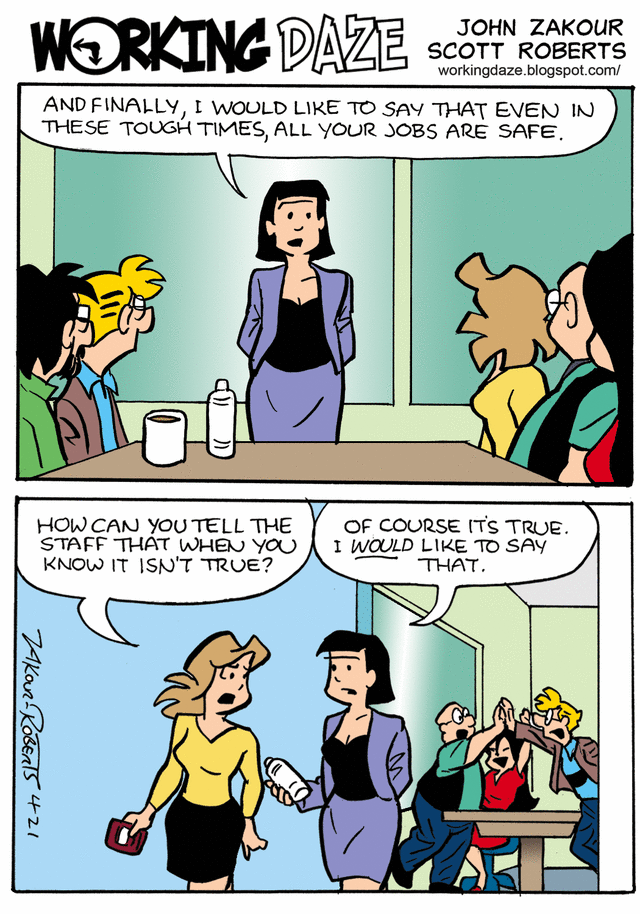
“I Would Like to Say That Your Jobs Are Safe”

To a lot of people out there, this is no laughing matter (though thank you for the chuckle, Working Daze). Their jobs are on the line or long gone. They’re out of work, looking for work or at least brushing up their resumes.

If you’re one of these people, it’s hard to give you concrete advice that’s going to yield employment soon. Yes, we’re hearing that the economy is improving and that unemployment is creeping down (however slowly), but in my opinion, these numbers are a bit doctored. Not in any particularly malicious way, but at the end of the day, I believe that unemployment is flat and will hold where it is for a while (if it doesn’t get worse…).

So what can you do?

As someone who has – and I’m sorry this is so – had to lay off a lot of people in his day, I know how horrible it is to see people put out of work. But for every job I have to end, five are saved along with a company that would otherwise have collapsed under the weight of divisions and personnel that it didn’t need. Not many laid-off people take solace in this knowledge, but there’s no manager, CEO, president or leader who wishes to lose good people.

Stand Up and Stand Out

If you’re in a division or business that’s getting downsized or eliminated, you need to do your best to stand out as someone who is indispensable. You may have heard in the past that if you are so good at your job that no one else could do it then you can never move up because you can’t be done without where you are. True as that may be in great times, these aren’t those, and you’re going to need to stand out as exemplary and someone without whom things will not run well.

You can do this by bringing ideas to management, both right above you, and if it’s called for, higher up the ladder. When I go into a business to restructure it, I often promote from within, seeking the best talent and those who understand the inner-workings of the business, those who have seen what works and what doesn’t and have ideas for improvement in efficiency and quality. I ask current managers for recommendations, and I leave my door open to all – often including letting people know where I’m staying so that they can come to me with greater anonymity if need be.

In a bad economy with high unemployment, don’t squander an opportunity by laying low. Put in the extra time, make yourself and your good ideas known and heard. Consider getting additional education to bolster your current perceived value. Leverage your network to create business for your business – those who bring in business are rarely let go. Even if I have to lay off someone who seems valuable because my hands are tied, I look for where else I can use him. But if I have no idea who you are or why you’re useful, I have to let you go and not worry too much about it.

Are you out of work? How are you seeking employment? Have you saved your job recently? How did you stand out to do so?

Assumptions, Assumptions – Who Has My Assumptions?

If you look at the history of big obstacles in understanding our world, there’s usually an intuitive assumption underlying them that’s wrong.
– Jeff Hawkins

You may have learned in your college economics class that controlling for all factors is necessary when trying to understand a task or a problem, but the real world rarely allows us to do that. Thus, we must make assumptions.

What are assumptions? In mathematics, an assumption is something taken for granted, based on which theories are formed. In the business world, we don’t and shouldn’t have such a firm view of our assumptions. Things rarely, if ever, work as we assume they will. Indeed, in business, assumptions are not facts; they are closer to educated guesses – and, since we’re preparing for them, hopes.

From the moment you wake up, you begin making assumptions. Some assumptions, when they are wrong, will not hurt you as much as others. Assuming you can arrive at the office in 30 minutes in rush hour traffic may make you late for a meeting, while overestimating the demand for a new product even slightly may require you to adjust revenue forecasts significantly.

The ability to make well-reasoned assumptions in the business world can make you very successful – if they’re right.

So, the question becomes, what do we do with assumptions? The answer: contingency plans. If assumptions prove wrong, we need contingency plans (and we often still need those contingencies when assumptions are right, too).

Contingency plans may be the ability to run a factory 24 hours for a week, a cash reserve, property that’s ready to sell or any number of things, but knowing your options and keeping lines of communication open with others who affect these plans is all part of being a good leader.

Wherever there are assumptions there must be contingency plans.

How do you make assumptions? Do you often go with your gut or do you strive to gather every piece of information you can before making an assumption?

Life’s Lessons and Surprises: 18 Months at Life University

Life is full of surprises, and as a business leader, you can’t let those surprises turn your business upside down. If you learn to manage them as part of your business, expecting that they will be there and creating contingencies for them like emergency cash, a fully stocked resume and interview line should you need some fast hires, good networking, a solid relationship with your banker and so on, then you will likely survive when they surprise.

In 2003/4, I did a turnaround for Life University, the award-winning chiropractic institution in Atlanta, GA. Life had a lot of lessons about the power of surprises.

Life’s Problem

After achieving an all-time high enrollment rate and setting the standard of excellence in contemporary health for its chiropractic undergraduate and masters degree programs, Life University was challenged with a loss of accreditation and defaulted on $35 million in secured bond debt.

Our Solution

Upon becoming the Director of Refinancing and CFO, we redid the budget based on declining attendance and negotiated a forbearance agreement with the Trustee and Bondholders. We also sold assets and refinanced others while the board searched for a new president.

The Outcome?

Within 18 months Life University’s cash flow was stabilized, accreditation was granted and the bond debt was refinanced. As part of the long-term plan, the school retained a President and Chief Financial Officer from a competing school. Victory was ours, and we won the Non-profit Turnaround of the Year Award in 2004 from the Atlanta Chapter of the Turnaround Management Association (TMA).

What I Learned from Life?

Professionals need to hire consultants and advisors who have different skill sets than their own. When professionals go outside their sweet spots they often make mistakes or don’t consider all the issues. Business is not the forte of all professionals – and it doesn’t have to be. Bring in business people to do business.

Life Always Has Surprises!

There are always surprises and things you didn’t account for. At Life, the CFO had a heart attack and bypass surgery, and without him we couldn’t find all of the documentation or understand the cash flow budget.

This created issues with the bondholders because a key member of the management team had been changed. Then, six months in, the president was gone, too.

A new president and a new CFO do not breed confidence to lenders.

What You Can Learn from Life

Be prepared for unfortunate events: heart attacks, death, personal tragedy, community strife. These things are part of life, and as a business leader, you have to have contingency plans in place to know how you would operate should the unthinkable occur.

Ultimately, in this case – and many others – communication solved these problems. Through extensive meetings, we got support in a forbearance agreement, which gave us time to hire a new president and to show results from fund-raising efforts.

Always have open communication.

The spirit of the chiropractic staff was great. They were committed to their university and seeing it survive. Anything I needed from them I got. Being part of a team that believes in the cause is a great thing, and in a crisis it’s very important to return to core values and purpose and to be able to lean on them.

Parting Words of Wisdom

This was a wonderful, award-winning turnaround. In turnaround management – as in business – there are always surprises. It’s your job not to let those surprises undermine your goals, but to deal with them as part of a business day.

What surprises have you encountered in business? How did you deal with them?

“Know Thyself” and Know Thy Weaknesses, Too

Growth begins when we start to accept our own weakness.

  • Jean Vanier

There’s little I find as useful in business as knowing my weaknesses. This applies to me as a person just as it applies to my business, GGG, and any business that I am leading or involved in.

It is in weaknesses that I find opportunities for growth or increased stability and future success.

As a human being, my partner in life – my wife – makes me a better person. I know my weaknesses, and I know that with and because of her, I will grow into a stronger person. I like to flatter myself by imagining that she feels the same about me, and that many healthy, enduring and strong relationships include this dynamic.

As a business leader, I find that it is best to surround myself with those who can do what I cannot. Whenever Grisanti, Galef & Goldress brings on a new associate or partner, we ensure that this person has skill sets and areas of expertise that are outside of what we already know, do and provide. In that way, our business and its services grow and evolve and we get stronger as a company.

Successfully bringing on someone who fits this bill begins with understanding our weaknesses as a company.

Similarly, when I am brought in to lead another company, I want to know where the weaknesses are. Considering the crisis situation a company is in when I’m brought on, no doubt the immediate weaknesses are apparent to me – as they are to others. However, it’s an analysis of everywhere else that the company is weak – and therefore vulnerable – that allows me to start shoring up those holes and preventing further and future catastrophe.

For instance, if I’m brought in to manage a cash crisis, but discover that a company’s key products have not evolved in two decades and are now competing in a saturated market, that’s a weakness that needs to be addressed and is no doubt linked to the cash crisis – or will be one day. If I learn that we have a Big Gorilla as a client, then I’m going to see how that potential crisis can be mitigated early as well. It’s knowing these weaknesses that help with current problems and stave off future ones.

Knowing your weaknesses allows you to address them and grow as a person, company and business leader. Face the harsh reality.

Want to learn the kinds of questions you should be asking yourself to face your harsh reality and learn where your weaknesses might be? Then read my 3 Part series (Part 1, Part 2, Part 3) and find out!

What are your weaknesses? How do you plan to deal with them?

What Napoleon Can Teach Business Leaders

A leader is a dealer in hope.
– Napoleon Bonaparte

This is a lesson I learned on one of my earliest turnarounds, and though I’ve talked about it before, it’s worth reiterating to emphasize the point.

A very large cheerleading supply company was having huge problems and needed to be brought through a Chapter 11 restructuring. So, they brought me in.

I realized more than anything during this project that nothing pulls a team or company together like having hope, and I hardly think that any company could have taught me this lesson quite like a cheerleading supply company.

When you think about cheerleaders, you realize that they’re cheering hardest when their team is down and needs a big score (or three) to win the game. It’s the cheerleaders job to keep the crowd on its feet and not to let the fans’ silence and dejected feelings infect the team. The worse the situation is, the louder cheerleaders cheer.

So when it was a cheerleading company restructuring through a Chapter 11 bankruptcy, you could imagine that they knew how to cheer for themselves and keep the hope alive.

After 18 months we came out the other side of this restructuring, and at the hearing, I gave everyone pompoms, including the judge.

To this day I still have my pompoms in my office to remind me that no matter how bad things get in a turnaround, as the appointed leader, it’s my job to be a dealer in hope. It’s my job to tell everyone that we will get through it and that we have to work harder than ever to pull us out the other side.

If I don’t do that, I’ve done nothing.

As a business leader, no matter what level of management you’re at, it’s your job to deal out the hope, whether the chips are down or up. No one can fight or work or play if they don’t have hope that what they’re trying to accomplish is possible.

Be a leader who deals in hope.

How do you bring hope to your team or business?

Honor the Month of April: Become Financially Aware & Reduce Stress

Last month was National Fraud Awareness month. This month is important, too. First, it’s Financial Literacy Month, and second – and I think quite complimentary – it’s Stress Awareness Month.

On top of both of these issues, April 18th is also Tax Day (yes, it’s usually April 15, but due to a Washington DC holiday, we can all enjoy an extra weekend to squirm over our taxes).

As you think about becoming aware of and learning to reduce your stress this month, I want you to also think about the role that finances have in your life – and your stress level.

Most people stress about their finances, and much of that stress, I believe, comes from a lack of awareness about their financial situation and where it’s going.

In business, if you don’t know where you are at every moment financially, you can’t move forward successfully in the long-term.

I think this also holds true in one’s personal affairs, and I have no doubt that with financial knowledge comes a reduction in stress – or, if finances are bad, at least the ability to predict and therefore manage that stress with greater ease.

In honor of both of these months – and taxes coming due – I encourage all of my readers and clients to do a few things this month, both in their businesses and their personal lives.

1. Make a budget or do some financial planning.

This need not be professional consulting with a financial manager (though that’s always nice). Just get a better understanding about how much you’re spending and on what you’re spending it. You never know which areas of your spending could easily be trimmed. Though you may not “need” the extra money you free up, it certainly could be nice to put it towards that vacation you were looking to take, right?

If you don’t know how to make a budget or you need some financial tips, consider financial magazines like Money (by CNN) or Kiplingers. If you are savvy with your financial management and awareness, make sure you’re passing these values along to your children (and/or employees) effectively. If you’re a business owner, consider offering a financial management and planning seminar for your employees.

2. Do something to de-stress yourself.

If you’ve already done your taxes, great, and even if you haven’t, reward yourself with something de-stressing afterwards like a massage, weekend trip or a day off. Becoming aware of our stress is the first step to reducing it, and with reduced stress comes a greater quality of life. Better financial knowledge and management almost always reduce stress.

What will you do to raise financial awareness in your life this month? What will you do to de-stress?

6 Questions to Ask Yourself to Face Your Business’s Harsh Reality, Part 3

For the last two weeks we’ve been discussing the questions you should ask yourself to confront your business’s harsh reality. Read about Part 1 HERE and Part 2 HERE. This week, we’re going to ask ourselves the next two questions your should be asking.

5. Am I protecting the financial integrity of my company during downturns so that I am prepared to profit during better times?

Bad financial times prompt too many managers to take the turtle mentality. Don’t put your head in your shell until things turn up. Take the opportunity to see what is inefficient in your business by eliminating loss leaders and reducing inventory, and increasing marketing and sales expenses in high profit-margin areas. By shoring up problem areas during a downturn, you prepare your company to run lean and mean at all times.

This is not an excuse to avoid monitoring, evolving and preparing during good times, though. Many companies ride the wave of what’s working and worry about problems after the wave crashes on the shore. That’s the wrong approach. As long as you know it’s a wave, you know it will end. Come smoothly onto the shore, long since ready for the next wave. Companies that ignored this advice (not that they asked me) were satellite TV companies and Blockbuster. They both road their waves until they crashed into the shores of cable television and Netflix.

Speaking of crashing, if all of your assets and capital are invested in one area, and a problem occurs, operations will grind to a halt. If you have a Big Gorilla – one client, customer or product that accounts for 25% of more of your sales – you need to rethink what you’re doing. Along these lines, don’t bet the ranch on other opportunities; remain grounded in your decision making. In our experience, Big Gorillas are one of the top five reasons companies experience crises.

As above, consider the advantages of protecting your company’s financial integrity for more profitable times. There are always competitors who have issues, and if you keep cash or credit lines available then you can take advantage of someone else’s mistakes, acquiring new product lines or growing old ones.

6. Do our financial departments have sufficient controls and a fraud awareness policy?

75% of the fraud I discover is from first time offenders. That means the people who ultimately commit the fraud are not those who will come up in criminal background checks. Therefore, when working with your auditor, integrate sufficient checks and balances.

As the CEO you have to have a constant feel for your business financially. Walk the company and manufacturing floors – be hands on. Don’t let your guard down by taking your tie off and lounging in your office. Stay involved.

I once had a BBQ at 1 a.m. for a production crew at a company that ran 24/7. While doing this I discovered a multi-million dollar fraud. Do what would be considered out of the ordinary, and you never know what you’ll find.

One thing I recommend without exception is making your CFO/Controller take a two week vacation once a year. Don’t even let him in the building. Sit at his desk, or have someone else do it, and see what happens. You’ll be surprised every time as you find duplicate expenses, continued payment on cancelled leases or sold equipment, and perhaps personnel that don’t exist.

Conclusion

I hope these 3 posts about the 6 Questions to Ask Yourself to Confront the Harsh Reality of Your Business have been helpful. I’d love to know the answers to any of them if you care to share or questions that you would add to the list and that help you confront your harsh reality. Please share in the comments section below.