
3 Tips on Enjoying Thanksgiving When You Own a Family Business

Norman Rockwell's "Freedom From Want."

Norman Rockwell’s “Freedom From Want.”

Everyone wants a Norman Rockwell Thanksgiving, the one depicted in his famous 1941 painting “Freedom From Want.” The painting shows a happy family seated around the table waiting for the turkey to be carved.

For many Americans, this is far from reality. Thanksgiving becomes something to dread, more of an endurance test and something to survive rather than to enjoy. And when you own a family business, there are even more topics that can cause conflict and tension.

I saw an ecard recently that read, “My favorite thing about Thanksgiving is when we all pass out and stop talking to each other.” Here are a few tips for how to enjoy Thanksgiving dinner when you run a family business, before you’ve reached that point.

  1. Make your desire to keep family business off the table known prior to dinner.

You can take a lighthearted approach to this if you are the host. When issuing the invitation, say something like, bring your favorite side dish and bottle of wine, but leave business matters at the office for the day. Or you may remind family members during a meeting or through a memo that Thanksgiving is a day off from the business.

  1. Plan an if/then scenario.

This tip comes from the Wall Street Journal article, “How to Have Thanksgiving Dinner Without a Family Blowup.” Author Elizabeth Bernstein recommends you coach yourself on how you might respond should a certain topic come up despite your request to not talk about the business. Let’s say one son blames the other son for thefts from the warehouse, and makes a snide comment as he passes the gravy. How will you handle it? One suggestion may be to quickly table it by saying, “Let’s be sure to address that Monday morning at our weekly meeting.”

  1. Privately enlist the help of the person most likely to start the drama.

Your brother Fred is typically the one to bring the tension, generally by referencing some long-ago conflict. Call Fred before the dinner and tell him, “Fred, I really need your help this year to have a more peaceful gathering. If you see any conflict start to develop, can I count on you to change the subject? Maybe tell us about your last fishing trip.”

Fred will be flattered you asked for his help, and eager to share his story. Problem solved.

If all this fails, there’s always TV. As comedian Craig Ferguson said, “I like football. I find it’s an exciting strategic game. It’s a great way to avoid conversation with your family at Thanksgiving.”


The Top Trait Every CEO Must Have

You can’t run a successful company without it. I can’t do my job turning companies around without it. And once it’s lost, it can be almost impossible to get it back.

I’m talking about credibility. Every CEO must have that – with his employees, his board, his customers, his investors and his employees. And he must guard and protect it as a valuable asset.

As Warren Buffett said, “It takes 20 years to build a reputation and five minutes to ruin it. If you think about that, you’ll do things differently.”

I urge every CEO I work with and every company’s senior management to maintain a high level of credibility. The consequences if they don’t can be catastrophic.

I once replaced a very smart man, who was CEO of a company that manufactured electronics parts. Despite the fact he had a PhD, he wasn’t too smart when it came to running his business. Upon reviewing his numbers one day he found some cost accounting discrepancies and realized he was selling his primary widget under cost. Instead of having a $1 million profit as anticipated, the company actually had a $2 million loss.

Rather than admit his mistakes, he just adjusted his prices. His customers weren’t thrilled with the unexpected and unexplained 50 percent price increase he put on that widget and fled. Faced with more losses, the bank soon noticed he wasn’t able to repay his loans and gave him the boot as well. We were brought in late in the process, and were able to sell the company and repay the lender and creditor. But the business lost $8 million in equity.

Had the CEO come clean about the mistake, been honest with his bank and his customers, he could have avoided the losses his ego cost him. He wasn’t. And he didn’t. His credibility was shot.

Through no action of my own, I almost suffered the same fate at a company I has hired to assess prior to becoming the director of reorganization. The president of that company didn’t like the fact I was doing an assessment of the company and wanted me to keep out of his business. So he decided to destroy my credibility.

How did he do that? The chairman of the board gave me specific people to speak with about certain issues. So the president told senior staff members I had already made up my mind about how I would restructure each of their divisions. That was untrue, of course, as I always speak openly with people and listen to their thoughts before making any decisions. But in their minds I was just wasting their time.

Thankfully, with the help of another senior staff member, I was able to salvage that situation.

An article in Forbes, “The Three Qualities a CEO Must Have to Success” addresses the issue of credibility and how critical it is to success.

“CEOs who lose credibility can never regain it. When you communicate, do people believe that you are telling them the objective truth? If they do, then you have credibility. To maintain credibility, you have to tell the truth 100 percent of the time. Telling the truth 90 percent of the time is not much better than telling the truth 10 percent of the time. It only takes a few instances of delivering non-credible statements to totally lose your credibility. Once you lose your credibility, you cannot lead successfully.”

My book, How Not to Hire a Guy Like Me: Lessons Learned from CEO’s Mistakes, is now available as an ebook.

Funny, But True: Having a Blast

Well, at least some people thought it was funny. I didn’t happen to be one of them.

I was in a staff meeting of a steel company where I was the chief restructuring officer. The company was not doing well for multiple reasons and was facing a huge cash crisis.

We had decided our only option at this point was to reduce the 2,500-person workforce by at least 10 percent to keep the company competitive, a tragic outcome for those 250 workers and their families. We were also going to have to reduce union employee benefits, which we had discussed the day before with the union representative.

All of a sudden, I hear BAM! BAM! BAM! BAM! In shock, I quickly hit the floor, only to find I was the only one there. When I got back up, the other senior staff at the table were laughing at me.

I was right to duck – those were shotgun blasts that smashed into the windows. But none of them made it through the bulletproof windows the company had installed 20 years previously. It seems shotgun blasts were a frequent means of expression for unhappy union members.

So here’s some free advice. If your workers are routinely so unhappy they are shooting at senior staff, rather than spending money installing bulletproof windows, spend time thinking about rethink how you are managing the company.

My book, How Not to Hire a Guy Like Me: Lessons Learned from CEO’s Mistakes, is now available as an ebook.

5 Tips to Maximize Your Company’s Most Valuable Resource


You may be watching your company’s financial situation with an eagle eye, being careful to budget wisely and cut out waste. But what are you doing to maximize one of your company’s most valuable resources, one that is often overlooked on the balance sheet?

I’m talking about time. More specifically, time spent in meetings. Research has shown an organization spends about 15 percent of its time in meetings every year. According to “How Much Time Do We Spend in Meetings? (Hint: It’s Scary)” people in upper management can spend up to 50 percent of their time in meetings.

Here are a few scary facts from that article:

– There are 25 million meetings in the US every day

– More than $37 billion is spent on unproductive meetings

– Executives consider more than 67 percent of meetings to be failures

You may be reading this in a meeting right now, as 92 percent of people surveyed said they multitask during meetings.

So how do you stop wasting your company’s time and make those meetings more effective?  Here are some tips for making meetings add to your company’s bottom line, not take away from it.

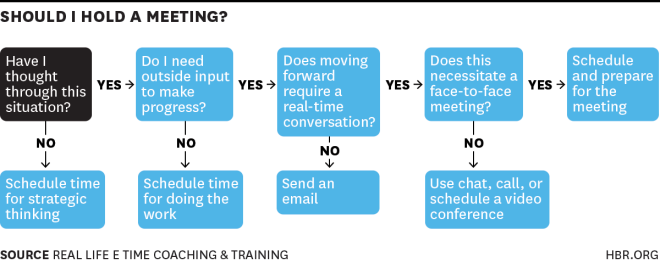
  1. Make sure you need to meet in the first place

Does this communication need to be in a meeting, or can it be adequately handled with a group email or text? If you’re just looking for a status update or feedback on a project, you probably don’t need to meet. Have a clear purpose in mind. What do you want to accomplish with a meeting?w150317_saunders_shouldholdmeeting

  1. Always have an agenda

To keep meetings productive, focused and on track, always have an agenda. Decide what your goal is and what input you need from attendees to accomplish that goal. Send the agenda far enough in advance to let the attendees have time to prepare if necessary.

If you find the meeting getting off track, reign it back in by moving back to your agenda and tabling important issues that are raised for a separate discussion or follow up.

This step can actually help with step #1. If you are trying to create an agenda and find there isn’t much you need to meet about, cancel the meeting and send an email.

  1. Make the meeting the right size to accomplish your goal

Only invite people whose attendance is necessary. Ask yourself who will have the input necessary for you to achieve the stated goal of your meeting. Who would be most affected by its outcome? Who do you need to implement the decisions you make?

You can also invite people to the meeting if their input is needed for just one part, then allow them to leave when that section of the meeting is over.

Some people use the 8-18-1800 rule to decide how big a meeting should be.

  • To solve a problem or make a decision, invite no more than eight people.
  • For brainstorming, go as high as 18 people.
  • If you need status updates, and everyone present is providing an update, go as high as 18.
  • If you’re meeting for a pep talk or morale booster, bigger is better. Go for 1,800 or beyond! 
  1. Phones down, heads up

You’ve carefully determined your goal, planned your agenda and invited the necessary people to the meeting. But now everyone has their heads down, looking at their phones.

Consider asking all personal devices be switched off and put away. Sounds drastic, I know, but you need people’s full attention and concentration.

  1. Follow up with key decisions made and action items.

We’ve all attended a meeting and started a discussion only for someone to ask, “Didn’t we already make a decision on that? Who was following up?”

To make sure the meeting is productive, have someone send a follow-up email with what key decisions were made and what is going to be accomplished by what date and who is doing what tasks.

That email will serve as documentation of the decisions you made and hold people accountable for what needs to be accomplished.