Testing Just One Part of Hiring Process

I’ve taken a few personality tests. One was on how I negotiate and I thought the results didn’t really reflect how I go through that process. But everyone else thought the test had totally pegged me. When I took the Myers-Briggs Type Indicator it pretty much nailed my personality.

I thought about these tests when I read a discussion on www.wsj.com on the percentage of companies that use some sort of tests during the hiring process. Nearly 20 percent of employers use personality tests in the hiring or promotion process, according to a survey done in 2011 by the Society for Human Resource Management of 495 human resource managers.

When you get to hiring for and promoting into top positions, the amount of testing and assessments of candidates understandably goes way up. According to an article in the Wall Street Journal, “Employers Put Executive Job Candidates to the Test,” 72 percent of the 516 companies polled used assessments to make decisions on promoting executives, more than double three years ago.

These assessments can include psychological interviews, role-playing and simulations. For example, candidates may be told to pretend they are dealing with a frustrated customer who starts yelling at them.

Not surprisingly, Google has identified the qualities and skills it desires in people who fill their top positions and has created an algorithm to predict each candidate’s success.

While I do think these tests have some validity, I believe they should be treated as just one indicator of whether a person can handle a high-level position. Testing should be just part of the process.

A key part of the process for me is just spending time with the person and getting to know him or her. After being in the turnaround business for more than 30 years, I’ve done a lot of hiring and firing. Luckily, one of the skills I’ve developed along the way is the ability to read people, a skill that is useful in just about every area of life.

It’s a skill that the legendary coach Bear Bryant had, according to people who worked with him. Bruce Arians, the Cardinals head coach, was his assistant for two years and called him “a master of personnel, of people.” It’s undoubtedly one of the skills that helped him win 323 games as coach of the University of Alabama football team.

(I also adhere to one of his hiring policies. “I don’t hire anybody not brighter than I am,” he said. “If they’re not smarter than me, I don’t need them.”)

If you want to improve your ability to read people and learn more about them than what they are telling you, here are a few questions to ask from an article by Anthony K. Tjan on the Harvard Business Review blog, “Becoming a Better Judge of People.”

• How does this person treat someone he doesn’t know? If you meet in an office, how did he treat the receptionist? If you go out to a meal, is she polite to the waiter?

• Does the person feel authentic? Did your BS detector go off at any time? Are they trying too hard?

• Is this person an energy-giver or taker? We’ve all known people that give off a negative energy. Does this person have a positive view of the word or tend to react negatively?

And one of the most important questions to consider: Is this person self-aware? A good understanding of your strengths and weaknesses is key to being a good leader.

Testing candidates can tell you a lot about their qualities, skills and values. But spending time with them and observing how they behave can tell you even more. 

Tips for Handling the Coddled Family Member on the Job

You hired your cousin Peter as the sales manager for your family business. He has not been meeting his quotas, and even worse, doesn’t seem to think it’s important, and the company is suffering. Or you hired your daughter right out of college as Director of Merchandising because you were desperate to fill that position and she needed a job. But she’s far more interested in how the packaging looks than in working with manufacturers and customers.

In my last post, “The Peter Principle at Work in Family Businesses,” I wrote about how the principle that employees tend to rise to the level of their incompetence is often true in family businesses. This often happens because a family member has been coddled at the business. The column included a quiz so you could tell if you are in this situation.

So you took the quiz and may have determined that you do have a family member who has been enabled, and you now understand that situation is damaging to your business. So what do you do about it?

You have three options:

1. Provide training or education

If the family member truly does care about the business and its success and wants to continue in his position, providing additional training so he can perform better could be your solution. Your brother may have been promoted to a management position but has never had to manage people before. Let him know you are interested in helping him grow professionally and part of that involves getting more training.

Ask him to find some classes or seminars he can take to sharpen his skills as a manager. If he truly does want to succeed, he will be happy to take advantage of your investment in his future.

2. Reassign the family member to another more suitable position

Sometimes a family member is just not suited to handle her job responsibilities. In the case of the daughter in the merchandising area, her major was in graphic design and she really has no interest in setting budgets and developing the skills she would need to be successful in merchandising. She is unhappy in her position because she doesn’t have the skills and really has no interest in acquiring them. To keep someone in a position that they have no interest in and can’t handle is a disservice to both the employee and the company.

If you have a design department and could use her help there, then discuss the situation and reassign her. If there is not a position available, you can suggest she go to work for another company to gain valuable experience, then return to yours when you do have a space for her. Make sure to let her know you do have her interests at heart and want her to be happy.

3. Terminate the family member

Sometimes it becomes clear that the family member is just not going to work out, for whatever reason. He isn’t motivated, she doesn’t want to be there in the first place, he is unable to acquire the skills necessary to work in the family business. It’s a tough call, but often it’s the only course to take if the first two options aren’t a possibility.

Firing a family member is a delicate process. You’ll want to consider giving the family member a generous severance, allowing him to save face by “resigning” and possibly funding out placement services so he can find a new position.

For more tips on how to do this, please read my post, “How to Fire Grandma and Still Get Invited to Sunday Dinner.”

It is possible work with family members that have been coddled or enabled and turn them into an asset, rather than a liability for your company. But if that doesn’t work, the best thing for everyone is to terminate them.

The Peter Principle at Work in Family Businesses

Perhaps nowhere is the Peter Principle more prevalent than in a family business. Lawrence J. Peter and Raymond Hull wrote about the principle in their 1969 book “The Peter Principle,” which stated simply is “Employees tend to rise to the level of their incompetence.”

I thought about the Peter Principle when I was reading an article on the Harvard Business Review Blog Network about the effect enabled family members could have on a business. Keeping incompetent or unskilled family members as employees can be devastating to a business and can ultimately cause it to fail.

I’ve seen it so many times. Uncle Joe runs a division of the company because he invested a couple thousand of dollars when the business was formed 20 years ago but he doesn’t have a clue what he’s doing. A couple starts a business and their son takes over and runs it when they retire. But he’d spent most of his time playing golf and traveling, stopping by occasionally to pick up a check and flirt with the women in the sales department. The only thing he knows how to manage is his account at the country club.

Even if they don’t know how to do their present jobs, they sometimes continue to be promoted. And the business suffers.

The authors of the article, Josh Baron and Rob Lachenauer, co-founders of Banyan Family Business Advisors, included a quiz so you can determine whether you are coddling a family member. If you answer yes to four or more of these questions, then you probably are overindulging him or her. Here are their questions:

1. Has a family member worked exclusively in the family’s business?

2. Has he reported within his parent’s span of control for most, or all, of his career?

3. Has she never received 360 feedback on her performance?

4. Is the family member paid above the market-based compensation for his position?

5. Has the family member been promoted beyond his capabilities?

6. Is the family member’s behavior often outside the boundaries of acceptable value-based behavior of the company?

Do these scenarios sound familiar to you? Coddling a family member does no good for anyone. The business suffers if someone is incompetent to handle his or her job. The individual often knows he or she is not performing the job the way it should be done and is ashamed or may be embarrassed. Morale at the company suffers when the other employees witness the family member receiving preferential treatment and not handling their job responsibilities.

In a previous column I gave five tips for successful family businesses. If you have a suspicion you may be coddling a family member, I suggest you pay particular attention to one of these suggestions: Put the right people in the right jobs. I don’t care if Uncle Joe gave you seed money to start a division of your company. If he doesn’t know how to manage a department don’t put him in charge of it. Don’t let the Peter Principle be at work in your family business.

For tips on how to handle the situation of a coddled relative, please read my next post. 

Qualities to Look for in a CEO

The Wall Street Journal reported this week that the pace of CEO changes is picking up again and almost 20 major companies are searching for a replacement in the top position. These include Microsoft, J.C. Penney Co. and Toys ‘R’ Us. Martha Stewart Living Omnimedia Inc. has been searching since late last year to replace Lisa Gersh.

What should these search committees be looking for?

A study done by Russell Reynolds Associates found nine attributes that differentiated CEOs from other top executives. The study assessed areas like communication skills, relationship skills and decision-making approaches. These nine attributes fell into three areas: willingness to take calculated risks, bias toward action and the ability to efficiently read people.

I can agree with these attributes as being critical to those taking over management of a major company. Having hired, fired and served as a CEO for several companies, I suggest they look for CEOs who have these qualities as well.

1. A person who is willing to admit his or her mistakes

This one is so important that Chapter One of my book, “How Not to Hire a Guy Like Me: Lessons Learned from CEOs’ Mistakes,” is about checking your ego.

A CEO must be willing to admit his mistakes, learn from them and move on. Covering up mistakes can not only lead to bigger problems, when you are found out you risk losing the respect of all those who work for your company as well as those that do business with you.

Making mistakes is not usually the major cause of a company’s failure. It’s covering them up or adhering to the mistakes that can lead to major issues.

2. A person who isn’t afraid to hire people smarter than himself

A CEO has to be able to leverage the talents of others. When I am acting as Interim CEO I am always happy when I am surrounded by people smarter than I am. I am the catalyst to get a job done and that is easier to accomplish when the people around me are smart and capable.

3. A person who doesn’t back down from the realities of a bad situation

I devoted a chapter in my book to this as well, called “Confront Your Harsh Realities.” One of the biggest mistakes CEOs make is refusing to recognize challenging situations. Whether it’s an issue with a vendor, problem employees, financing difficulties, a changing marketplace — whatever the issue, a good CEO needs to recognize when a bad situation is brewing and be prepared to handle it.

4. A person who is proactive, not reactive

A good leader needs to head off potential problems before they occur, preventing crises if possible. If a leader is proactive he will have the people, ideas, tools and other resources in place to handle anything that comes along.

5. A person who communicates openly and regularly

A company grows and thrives on open communication in good times. And in bad times, a staff that feels fully informed about what is happening is better able to pull together and weather the harsh periods. And CEOs that keep lines of communication open across all levels in a company can learn a lot from those on the front lines.

I thought of the bias toward action attribute when I read a story about Stephen Elop, who may be Microsoft’s next CEO. According to an article on UsNews.NBCnews.com, when Stephen was a college student in the 1980s he didn’t like the data-sharing methods available. So he bought some Ethernet cable and ran 22 miles of cable around the campus from building to building, creating one of the first Internet networks in Canada.

That’s the kind of man you want leading your company.

How They Got Caught

Continuing our series on corporate fraud, today’s topic is how people who steal from their companies get caught. In addition to all helping themselves to money that doesn’t belong to them, they have something in common. They never thought they’d get caught. Here are some stories on how they did.

As a fraud deterrent I’ll always advise people to tell your CFO to take two consecutive weeks of vacation a year. Take that opportunity to sit at his desk, open his mail and talk to his secretary. You may be surprised at what you learn.

I did just that for a company where I was Interim CEO. I found that the CFO was having his Cayman Island bank account statements sent to his office, clearly detailing the money he was stealing from the company. Another time I suspected a CFO of fraud so I poked around on his computer. I found a spreadsheet detailing all the money he had stolen, dated and tracked. I love organized thieves. They make my job so much easier.

2010.07.28m3You never know how you’ll find fraud. I once had a potential client that found the controller had siphoned $3 million from the payroll account over the period of four years by creating dummy employees. The company hired a new CEO who determined that the headcount didn’t match. I never got them as a client. Once the bank found out, it decided it couldn’t trust the balance sheets and called the loan. The company had to shut its doors.

And here’s a story that literally takes the cake. Tom Murphy started the hugely popular Murphy’s restaurant more than 30 years in Atlanta. He wrote a lot of checks and had huge statements so he hired a Georgia State grad to help out as a bookkeeper. He knew Murphy’s was taking in a lot of money but he never seemed to have enough to cover his expenses.

So he looked over the bank statements himself one day. In just one month he found the bookkeeper had written checks for $3000 to himself. Going back through older statements, Tom found the guy had stolen $35,000 over the past year.

He called the guy who said he had “borrowed it” because he was getting married, planned to pay it back etc. Back in his more naïve days, Tom believed him. As he writes in his book, Murphy’s: 30 Years of Recipes and Memories, “Lesson learned: After you find someone stealing from you, chances are good he is lying when he says he will pay you back.”

The guy didn’t show up for work the next day so Tom called the police. Turns out he hightailed it to Mexico and eventually landed in Texas.

Here’s the fun part. Two weeks later the guy’s sister called Tom and said her brother was in town and she was having a going-away party for him. “Would you make the cake?” she asked.

“Of course,” he said and got the address. Then he called the chief of police to arrange a special delivery. Now that’s a surprise party where everyone was surprised.

So there’s a lesson for would-be thieves. While you may be justifying your crime to yourself, as we discussed in a previous column when I wrote about rationalization as part of the fraud triangle, you’ll have a lot harder time justifying it when you get caught. And you most likely will.

Lessons from the Fraud Triangle

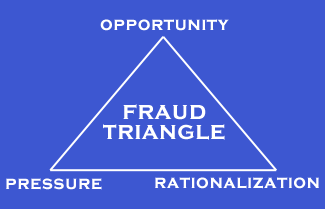
Fraud can occur when three elements are present: pressure, opportunity and rationalization. That’s the premise of the Fraud Triangle that I wrote about in last week’s column, “Why Fraud Occurs: The Fraud Triangle.”

So what lessons can we learn from these three elements of the Fraud Triangle? With a better understanding of why fraud occurs, what can we do in our businesses to prevent it?

The Fraud Triangle needs to be the basis of any effective fraud-deterrence program and should address its three elements.

1. Pressure

While some employees steal due to financial pressure, they may also be stressed due to difficult circumstances at home or addiction issues. Remember the example of Amy that I wrote about last week, the office manager who embezzled $345,000 from her company over a four-year period. She began stealing because her son had been arrested and she used the money to hire a lawyer to defend him.

Other than paying employees fairly, there is not a lot a company can due to relieve many sources of pressure, financial or otherwise. But it can train managers to recognize employees that seem to be under unusual stress. In some cases the HR department can point them to resources to get help.

fraudhandcuffs2. Opportunity

This is the area where a business can be most effective and should focus its efforts. Every company needs to have an effective fraud prevention program with strong internal controls and management oversight.

Most employees steal only when they perceive no chance they will get caught. Remember, it’s only the people you trust that will steal from you. If you don’t trust them, you’ll make sure they don’t have the opportunity to steal. Trust no one implicitly.

For tips on preventing fraud, please see my previous columns, including “The High Cost of Fraud and How to Prevent It,” “My Number One Tip for Fraud Prevention” and “13 Fraud Prevention Tips.”

3. Rationalization

Like pressure, this element is harder for an employer to deal with as it is done internally and no one may know that the employee feels it’s okay to “borrow” the money from the company or is owed it because he is feeling overworked. Amy the office manager began working harder and longer hours to justify the money she was stealing from the company, telling herself that she was really earning it.

Rationalization lets a person continue to commit a crime while telling himself that he is really not a criminal; he is still an honest person. Make sure every employee knows that fraud will not be tolerated in your business and it will be prosecuted.

I also recommend you follow Lee’s Fraud Policy and post it in the employee manual and reinforce it verbally: If you steal, I’ll put your butt in jail!

Because it is more difficult for a company to deal with an employee feeling pressured and his ability to rationalize crime, the majority of efforts should be focused on the most effective way to prevent it in the first place — by not providing any opportunity for thieves to steal. That way, all your employees truly can remain honest.

Why Fraud Occurs: The Fraud Triangle

Pressure, opportunity and rationalization. Those are the three factors that must be present for a person to commit fraud in workplace.

I’ve written a lot about the effects of fraud, the cost of it to the US economy and how to prevent it. But why is there so much fraudulent activity going on every day?

Criminologist Dr. Donald Cressey asked the same question in 1950. Cressey, who is considered the founder of the modern study of organized crime, became fascinated with embezzlers and wrote his dissertation on them for his Ph.D. in criminology. He was puzzled because most people who commit fraud are not criminals. They are generally “good” people. So what happens?

He interviewed 250 criminals who must have accepted a position of trust in good faith and must have violated that trust. His research was published in Other People’s Money: A Study in Social Psychology of Embezzlement in 1953. His theory on why fraud occurs eventually became know as the Fraud Triangle and is still the classic model to explain why people commit fraud in the workplace.

Cressey wrote that all three factors of the fraud triangle must be in place for an employee to commit fraud.

fraud7Pressure/Incentive

The thief is initially motivated because he or she has some type of non-sharable financial pressure or incentive. They may be involved in gambling, have a drug addiction or possibly took on more debt than they can handle. Or they could have a desire for material goods beyond their means, such as designer clothes and handbags or a new car. Sometimes an employee feels unfairly treated by a company and this is their way to get back.

The non-sharable aspect is an important distinction because the person generally feels shame or embarrassment over the situation or is concerned about potential disgrace. These are generally crimes committed in secret.

Amy Wilson was a respected office manager when she was caught for embezzling $345,000 and sent to jail. Now out and reformed, she speaks about what she did to help businesses prevent fraud. The first time she embezzled, ironically, was to hire a lawyer for her 18-year-old son, who had been charged with a felony and put in jail. When she was caught, not even her husband knew of her crime.

Opportunity

The second factor is opportunity. The criminal has to see what he perceives to be an opportunity and one that he can keep secret. He has gained the knowledge and has the authority to circumvent internal controls and devises a scheme to exploit those.

Amy’s company had no internal controls and as the office manager, she had access to all the bank accounts and computers. “For me, stealing money was as easy as printing checks in the accounting software test module and forging the vice president’s signature,” she says. “I then paid my personal credit card account with a company check.”

Rationalization

Most people who commit fraud in the workplace have no criminal past. They are first-time offenders and despite stealing from their companies, believe themselves to still be honest and decent people. To continue along the path of denial, they come up with ways to justify their crimes to themselves. These include: I was stealing to provide for my family; I am underpaid at work and deserve to have this money; I was going to eventually pay it back; everyone else at work steals things like office supplies and no one seems to care.

Amy worked long harder and longer hours, one of the ways she was able to justify her theft to herself. “Somehow, this made me feel less guilty and less shameful about my behavior,” she says. “I vowed to find a way to pay back the money I’d ‘borrowed.’”

There are great lessons to learn about how to handle fraud by looking at the fraud triangle and the behavior of people like Amy. Read next week’s column to find out what the fraud triangle tells us about how to handle fraud in the workplace. What works, and what doesn’t?

The Red Flags of Fraud

In a continuing series on fraud, this week’s column is about how to spot the signs that an employee may be engaged in fraudulent activity. Please see last week’s column, “Employee Tips Key to Fraud Preventionfor tips on decreasing fraud in your company.

It happens every day. Employees are caught stealing from their companies. Then the messy business of uncovering the amount of money stolen, how it was taken and how to prevent it in the future begins.

Fraud not only hurts businesses financially — an estimated $9 billion a year is lost to fraud in the US annually — but it takes a toll on the company in other ways. Employees are demoralized and time is lost to dealing with the results of the fraud.

A strong fraud prevention program is critical. Part of that program should include managers being trained to be on the lookout for red flags that employees may be involved in fraudulent activity. Here are just a few of those red flags.

imgres1. Refusal to take vacation and rarely taking personal or sick days

Isn’t that great to have such a dedicated employee? Except that often the employee who never takes off is not dedicated to the company. That employee is dedicated to continuing to perpetrate the fraudulent activity he or she has begun, and doesn’t take off work because of the risk the activity may be uncovered.

I’ve mentioned dear Aunt Tess in this column before. She was the beloved payroll clerk who showed up the day after she had major surgery to hand out the paychecks. In 25 years she hadn’t missed a payroll and a little thing like an appendectomy wouldn’t keep her away.

Turned out she had to show up to handle the paychecks for her non-existent employees whose creation had allowed her to steal around $100,000 year from the company.

Be wary of the employee who never takes off work.

2. Getting annoyed at reasonable questions or offering unreasonable explanations

If a simple question about how an invoice is handled, or who double checks the list of vendors or changes to payroll evokes a defensive or irritated response, don’t back down until you get an answer. The same is true if the responses don’t make sense or sound unreasonable. Guilty people will act defensive when questioned about why they do things a certain way.

3. An employee wants to remain in his or her current position

Staying in the same position is not necessarily a bad thing, and many people enjoy staying in a job that they feel comfortable with for years. But if that person turns down opportunities to advance or otherwise better his or her situation in some manner, that can be a warning sign that they are afraid of being unable to continue their fraudulent activity or that it may be uncovered if they leave or change their position.

4. An employee that exhibits behavioral changes, undergoes a sudden change in lifestyle or has financial difficulties

If an employee starts talking about his new lake home, wearing an expensive watch or driving a new car with no explanation for his new-found wealth, that may be worth a closer look. If she starts acting more stressed at work for no discernible reason and claims all is fine at home, that could be a sign that engaging in the fraudulent activity is causing stress.

Having financial difficulties can be a precursor to fraudulent activity. A law student in Atlanta was arrested for stealing more than $100,000 of jewelry at his part-time job at a department store. When he was caught, he said he did it because he had so much debt in student loans.

5. An employee has unusually close relationship with vendors

Friendships do develop in the business world when we deal closely with each other and are often a source of pleasure in our work environment. However, an employee that seems to spend a lot of time with a vendor could indicate a kickback scheme that involves vendor overbilling.

Be on the lookout for these red flags at your company. To learn more about why fraud occurs, read my next column later this week about the Fraud Triangle.

Employee Tips Key to Fraud Prevention

The simple slogan, “If You See Something, Say Something ™” was first used by The New York Metropolitan Transportation Authority to raise public awareness about terrorism, and later licensed by the Department of Homeland Security (DHS) for a national campaign.

You may have seen some of their public service announcements that urge people to report suspicious activities to local law enforcement or in the case of an emergency, call 911.

I urge companies to institute a similar campaign to help them fight fraud. According to the Association of Certified Fraud Examiners (ACFE), the most common way internal fraud is detected is receiving a tip from someone. While many of these are received from employees, some come from customers, an anonymous person or even outside vendors who notice something not quite right. Just over half of internal frauds are detected with tips, according to the ACFE’s 2012 Report to the Nation on Occupational Fraud and Abuse.

if-you-see-something1In my career as the Turnaround Authority, I’ve uncovered fraud in all types of ways — through audits, following up on suspicions I had, or in one memorable case, installing fake cameras (until the company could afford real ones) to stem the problem of inventory walking out the door. But employee tips have also helped me uncover millions of dollars of fraud.

When I am working with an out-of-town company, I assure the employees that no one will lose their jobs for sharing information with me. Later I will drop into casual conversation the name of hotel where I’m staying. Then I ask them for restaurant recommendations around that hotel. I do this so they know where they can find me outside of the office if they wish to share sensitive information.

Once, in the middle of the night someone pushed a bunch of USB drives under my floor. The drives detailed where the company’s money had gone. I’ve also had file folders with documents with valuable inside information pushed under my door. Some people in hotels just wake up to a USA Today and a bill. I never know what surprises I may get!

Companies should have fraud awareness training for managers and employees. The ACFE recommends these programs include what actions constitute fraud, how fraud hurts everyone in the company and how to report any suspicious activity.

Frequent communication is critical to letting employees understand that the company is dedicated to fraud prevention. This can be done at meetings, in newsletters and on the company website. It is also important to let them know, as I always make a point of doing, that employees will not lose their jobs if they report something suspicious. They must feel protected from retaliation.

Many companies successfully use hotlines where employees can make anonymous calls. They can also set up an online reporting system.

Early detection is crucial to cutting the cost of fraud. The ACFE reports that the average fraud scheme lasts about 18 months before discovery and that U.S. businesses lose more than 6 percent or revenues each year due to fraud.

In my next column, I’ll talk about the behavioral red flags that are often associated with fraudulent conduct. What should you be looking out for?

Putting the CEO in Time-Out

Angered at rumors that the co-founder of Specialty Medical Supplies was shutting down its factory near Beijing, the workers took the next logical step: they locked him in his office.

Despite his claims that employees are not losing their jobs when he moves part of the operations of the company to India, around 80 of his 110 employees have blocked entrances and locked Chip Starnes in his office for a week, according to an article in the Wall Street Journal.

While I don’t condone such drastic action, I will admit to having been tempted to put some of the CEOs I’ve dealt with as a turnaround authority in time-out. Just for a while so they could consider their less-than-desirable behavior.

There was the guy whose ego was so large he refused to admit that he has missed some major errors in cost accounting and tried to cover up the cash shortfall, which led to a series of problems with the business that ultimately cost it $8 million in equity. The bank called the loan and he lost his fortune.

Or the CEO who changed his sales manager’s commission structure after exceeding yearly goal for the following year so wouldn’t make more money than he did. The sales manager went to work for his competitor and the CEO was fired.

I once worked with a CEO who was convinced that people would respond to solicitations at a higher rate if they were mailed from within their home town. So he spent about $400,000 a year having trucks drive the solicitations all over his company’s territory to get a local postmark on them, despite the fact there was no evidence to support that theory.

Perhaps the CEO that may have saved his company and his marriage if he put himself in time-out for a bit was the one who was married, yet managed to have a photo of him and his girlfriend having a grand old time on a yacht on the cover of a national magazine.

A nice payback for the CEO and his wife who ran a multi-million dollar company but rationed toilet paper and caffeinated coffee to their employees would have been for them both to spend a few days confined somewhere. Without it.

There are stories like this happening every day. You can read plenty more of my stories of CEOs behaving badly in my new book, “How Not to Hire a Guy Like Me: Lessons Learned from CEOs’ Mistakes.”

If only these CEOs’ employees could have locked these guys up for a bit and fed them a continuous diet of General Tso’s chicken until they came to their senses, would the outcome have been different?

There’s no way of knowing and it probably wouldn’t be good for my business to be known as the guy who recommends locking up CEOs.

I’ve seen no evidence that Mr. Starnes has done anything wrong, other than suffer a communication problem with his Chinese employees. But, he weathered the confinement okay, despite three meals a day of sweet deep-fried chicken.

And he did do one thing every CEO needs to do: think ahead and expect the unexpected. When he constructed his office, he had the foresight to put a toilet in.