What Business Are You Really In?


He started as a book salesman in the late 1880s. To entice people to buy his books, David H. McConnell gave away free perfume samples. Those proved so popular, he abandoned the books and founded the California Perfume Company in 1886. That company eventually changed its name to Avon in honor of Shakespeare’s hometown. Last year, Avon’s revenue was $1.6 billion.

That’s just one example of successful companies that were founded with one business model, then pivoted to a different business. They thought they were in one business, but the market led them to change their business, either by choice or because their potential for increasing market share vanished.

Nokia started as a paper mill in Finland.

Nokia started as a paper mill in Finland.

Twitter is an example of a forced pivot. It started as Odeo, a network for people to find podcasts. It was a bad day for Odeo when iTunes announced it would include a built-in platform for podcasts in every one of its iPods, pretty much obliterating their business overnight. So, the company got to work, hosting hackathons to come up with a new idea. The concept for a microblogging platform was hatched, and Twitter was created in 2006. It’s now worth over $10 billion.

One of my favorite pivot stories is about the American food company Wrigley. William Wrigley Jr’s father was a soap manufacturer, so as a teenager William became a soap salesman. To encourage shop owners to stock his soap on their shelves, William offered free gifts. Baking powder was the most popular, so he dropped selling the soap to focus on that. In 1892, as an incentive, he began offering two packages of free chewing gum with each can of baking powder. Once again, the giveaway was more popular than the actual product he was selling, and he moved to selling chewing gum. Wrigley sold to Mars in 2008 for $23 billion.

Did you know Nokia started as a paper mill in Finland in 1865? It moved to creating rubber goods and telecommunications devices, and a mobile phone in 1992. That year the company sold off all its other divisions to focus on mobile devices. Sadly, it failed to make a successful transition to the smartphone industry, and sold its devices and services division to Microsoft in 2013.

We associate the name Nintendo with Super Mario Bros, Game Boy and Wii. The company was founded in 1889 in Japan by Fusajiro Yamauchi to sell playing cards. Unsuccessful expansion attempts by his great-grandson in the 1960s included getting in the taxi business and “love hotels.” Then one of their engineers began developing electronic toys, which led to video game development, and its large market share of the mobile gaming space. While profits had been in decline, Nintendo seems to be on the upswing based on the potential of the value of its intellectual property.

In addition to knowing how to maximize profits for your company, knowing what business you are actually in allows you to expand and grow in the right direction.

When you aren’t clear what business you are in, efforts to innovate and expand can go astray. As Ty Montague writes in inc.com, “The lion’s share of innovation mistakes still come from companies funneling their efforts into extending the life of some existing platform, instead of spending time getting clear on what business they are really in and then constantly looking for opportunities to apply that definition to new technologies and new markets. Companies that do this will grow robust businesses that can be hard to describe in conventional terms.”

An example he gives is Tesla, which he says isn’t in the car business, but rather in the electric mobility business, so in addition to building cars, it builds infrastructure to support the mobility of electric vehicles.

Every business goes through a metamorphosis of product lines in response to marketplace pressure and technology, and a smart CEO needs to continue to monitor that so he can remain in business by moving forward.

Take a step back and think about your own business. What business are you really in?

 

3 Tips on Enjoying Thanksgiving When You Own a Family Business

Norman Rockwell's "Freedom From Want."

Norman Rockwell’s “Freedom From Want.”

Everyone wants a Norman Rockwell Thanksgiving, the one depicted in his famous 1941 painting “Freedom From Want.” The painting shows a happy family seated around the table waiting for the turkey to be carved.

For many Americans, this is far from reality. Thanksgiving becomes something to dread, more of an endurance test and something to survive rather than to enjoy. And when you own a family business, there are even more topics that can cause conflict and tension.

I saw an ecard recently that read, “My favorite thing about Thanksgiving is when we all pass out and stop talking to each other.” Here are a few tips for how to enjoy Thanksgiving dinner when you run a family business, before you’ve reached that point.

  1. Make your desire to keep family business off the table known prior to dinner.

You can take a lighthearted approach to this if you are the host. When issuing the invitation, say something like, bring your favorite side dish and bottle of wine, but leave business matters at the office for the day. Or you may remind family members during a meeting or through a memo that Thanksgiving is a day off from the business.

  1. Plan an if/then scenario.

This tip comes from the Wall Street Journal article, “How to Have Thanksgiving Dinner Without a Family Blowup.” Author Elizabeth Bernstein recommends you coach yourself on how you might respond should a certain topic come up despite your request to not talk about the business. Let’s say one son blames the other son for thefts from the warehouse, and makes a snide comment as he passes the gravy. How will you handle it? One suggestion may be to quickly table it by saying, “Let’s be sure to address that Monday morning at our weekly meeting.”

  1. Privately enlist the help of the person most likely to start the drama.

Your brother Fred is typically the one to bring the tension, generally by referencing some long-ago conflict. Call Fred before the dinner and tell him, “Fred, I really need your help this year to have a more peaceful gathering. If you see any conflict start to develop, can I count on you to change the subject? Maybe tell us about your last fishing trip.”

Fred will be flattered you asked for his help, and eager to share his story. Problem solved.

If all this fails, there’s always TV. As comedian Craig Ferguson said, “I like football. I find it’s an exciting strategic game. It’s a great way to avoid conversation with your family at Thanksgiving.”


The Top Trait Every CEO Must Have

You can’t run a successful company without it. I can’t do my job turning companies around without it. And once it’s lost, it can be almost impossible to get it back.

I’m talking about credibility. Every CEO must have that – with his employees, his board, his customers, his investors and his employees. And he must guard and protect it as a valuable asset.

As Warren Buffett said, “It takes 20 years to build a reputation and five minutes to ruin it. If you think about that, you’ll do things differently.”

I urge every CEO I work with and every company’s senior management to maintain a high level of credibility. The consequences if they don’t can be catastrophic.

I once replaced a very smart man, who was CEO of a company that manufactured electronics parts. Despite the fact he had a PhD, he wasn’t too smart when it came to running his business. Upon reviewing his numbers one day he found some cost accounting discrepancies and realized he was selling his primary widget under cost. Instead of having a $1 million profit as anticipated, the company actually had a $2 million loss.

Rather than admit his mistakes, he just adjusted his prices. His customers weren’t thrilled with the unexpected and unexplained 50 percent price increase he put on that widget and fled. Faced with more losses, the bank soon noticed he wasn’t able to repay his loans and gave him the boot as well. We were brought in late in the process, and were able to sell the company and repay the lender and creditor. But the business lost $8 million in equity.

Had the CEO come clean about the mistake, been honest with his bank and his customers, he could have avoided the losses his ego cost him. He wasn’t. And he didn’t. His credibility was shot.

Through no action of my own, I almost suffered the same fate at a company I has hired to assess prior to becoming the director of reorganization. The president of that company didn’t like the fact I was doing an assessment of the company and wanted me to keep out of his business. So he decided to destroy my credibility.

How did he do that? The chairman of the board gave me specific people to speak with about certain issues. So the president told senior staff members I had already made up my mind about how I would restructure each of their divisions. That was untrue, of course, as I always speak openly with people and listen to their thoughts before making any decisions. But in their minds I was just wasting their time.

Thankfully, with the help of another senior staff member, I was able to salvage that situation.

An article in Forbes, “The Three Qualities a CEO Must Have to Success” addresses the issue of credibility and how critical it is to success.

“CEOs who lose credibility can never regain it. When you communicate, do people believe that you are telling them the objective truth? If they do, then you have credibility. To maintain credibility, you have to tell the truth 100 percent of the time. Telling the truth 90 percent of the time is not much better than telling the truth 10 percent of the time. It only takes a few instances of delivering non-credible statements to totally lose your credibility. Once you lose your credibility, you cannot lead successfully.”

My book, How Not to Hire a Guy Like Me: Lessons Learned from CEO’s Mistakes, is now available as an ebook.

5 Tips to Maximize Your Company’s Most Valuable Resource


You may be watching your company’s financial situation with an eagle eye, being careful to budget wisely and cut out waste. But what are you doing to maximize one of your company’s most valuable resources, one that is often overlooked on the balance sheet?

I’m talking about time. More specifically, time spent in meetings. Research has shown an organization spends about 15 percent of its time in meetings every year. According to “How Much Time Do We Spend in Meetings? (Hint: It’s Scary)” people in upper management can spend up to 50 percent of their time in meetings.

Here are a few scary facts from that article:

– There are 25 million meetings in the US every day

– More than $37 billion is spent on unproductive meetings

– Executives consider more than 67 percent of meetings to be failures

You may be reading this in a meeting right now, as 92 percent of people surveyed said they multitask during meetings.

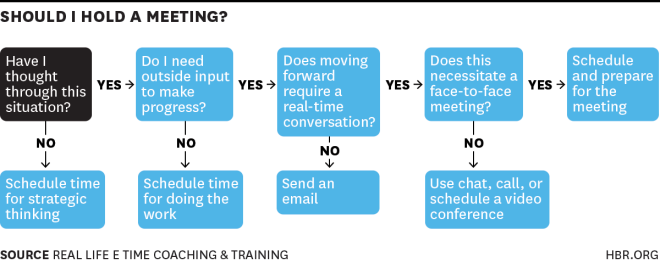
So how do you stop wasting your company’s time and make those meetings more effective?  Here are some tips for making meetings add to your company’s bottom line, not take away from it.

  1. Make sure you need to meet in the first place

Does this communication need to be in a meeting, or can it be adequately handled with a group email or text? If you’re just looking for a status update or feedback on a project, you probably don’t need to meet. Have a clear purpose in mind. What do you want to accomplish with a meeting?w150317_saunders_shouldholdmeeting

  1. Always have an agenda

To keep meetings productive, focused and on track, always have an agenda. Decide what your goal is and what input you need from attendees to accomplish that goal. Send the agenda far enough in advance to let the attendees have time to prepare if necessary.

If you find the meeting getting off track, reign it back in by moving back to your agenda and tabling important issues that are raised for a separate discussion or follow up.

This step can actually help with step #1. If you are trying to create an agenda and find there isn’t much you need to meet about, cancel the meeting and send an email.

  1. Make the meeting the right size to accomplish your goal

Only invite people whose attendance is necessary. Ask yourself who will have the input necessary for you to achieve the stated goal of your meeting. Who would be most affected by its outcome? Who do you need to implement the decisions you make?

You can also invite people to the meeting if their input is needed for just one part, then allow them to leave when that section of the meeting is over.

Some people use the 8-18-1800 rule to decide how big a meeting should be.

  • To solve a problem or make a decision, invite no more than eight people.
  • For brainstorming, go as high as 18 people.
  • If you need status updates, and everyone present is providing an update, go as high as 18.
  • If you’re meeting for a pep talk or morale booster, bigger is better. Go for 1,800 or beyond! 
  1. Phones down, heads up

You’ve carefully determined your goal, planned your agenda and invited the necessary people to the meeting. But now everyone has their heads down, looking at their phones.

Consider asking all personal devices be switched off and put away. Sounds drastic, I know, but you need people’s full attention and concentration.

  1. Follow up with key decisions made and action items.

We’ve all attended a meeting and started a discussion only for someone to ask, “Didn’t we already make a decision on that? Who was following up?”

To make sure the meeting is productive, have someone send a follow-up email with what key decisions were made and what is going to be accomplished by what date and who is doing what tasks.

That email will serve as documentation of the decisions you made and hold people accountable for what needs to be accomplished.


3 Tips to Help Ensure Your Company Recovers from Bankruptcy

“Capitalism without bankruptcy is like Christianity without hell,” said US astronaut Frank Borman and former Chairman and CEO of Eastern Airlines.

While I understand where he is going with that, I wouldn’t explain bankruptcy quite that harshly. True, like hell, no one wants to go there. But there is an escape and it doesn’t have to feel like you are stuck in eternal flames. Or whatever your version of hell may be.

Sometimes the best option to preserve your company is to file bankruptcy. Your business can emerge strong, with happy employees and your reputation intact. Here are three tips on how to accomplish that.

  1. Keep a positive attitude 

I learned this from one of my first turnarounds, a story I tell in my book, “How Not to Hire a Guy Like Me: Lessons Learned from CEOs’ Mistakes.”  Cheerleader Supply, a $65 million a year company with 750 employees, made cheerleading uniforms and supplies and directed camps nationwide. It fell on hard times and I was called in to see it through a Chapter 11 restructuring.

That CEO taught me the value of being a cheerleader in your company as he keeps a positive attitude throughout. When the home team is down, the cheerleaders get up and motivate the crowd, right? They don’t head to the nearest Starbucks and call it a night.

When a company is going through bankruptcy, employees are scared and nervous, which leads to lower productivity. You need your team to be on top of their game. And that requires pep talks. You need to keep your team inspired and motivated so they will keep working hard for you.

I’m happy to report that Cheerleader Supply successfully emerged from Chapter 11 bankruptcy, and I learned that a positive attitude from the leader is crucial.

  1. Be transparent with your employees about what is going on

Another way to keep your employees motivated is to be transparent with them about what is happening. If you and your senior management are meeting behind closed doors and not communicating with your employees, you are fueling the panic and the rumor machine.

People can handle a lot if you are honest with them. What they can’t handle is lack of information. If you don’t let them know what is happening, they will spend a lot of time filling in the blanks themselves, time they could have been working to help your company.

  1. Keep your reputation by communicating with your investors, vendors and customers

To follow up on #2, you also need to communicate with your other constituents, including your investors, vendors and customers.

United Airlines filed for bankruptcy in 2002, then the largest bankruptcy filing by any airline. Prior to filing, the CEO flew to Chicago to meet with employees, while top executives flew to other hub cities. Then after they filed for bankruptcy, the company took out full-page ads in major newspapers around the country explaining the situation and what they were doing about it.

By being open and communicating with all its constituents, United Airlines came out of bankruptcy with its reputation intact a little more than three years later. Its reported net income last year was $4.5 billion.

Back to that quote about hell. Maybe filing for bankruptcy does feel like that. But remember what Winston Churchill said. “If you are going through hell, keep going.”

Funny, But True Stories: Keep Your Girlfriend Out of the Picture

Cheating on a spouse has been the downfall of many a business owner or CEO. Some of these stories aren’t too surprising. Consider the case of the founder of the famously hacked website Ashley Madison, created specifically to make it easy for people to cheat on their spouses. At one time the cheaters’ website claimed earnings of $115 million and a membership of 39 million around the world.

So can anyone feel surprised when it was revealed that founder Noel Biderman had cheated on his own wife, despite his claims to have a strong marriage? He called himself the King of Infidelity and in June 2014 when asked if he had ever cheated on his wife, he said, “Not yet.”

He got outed by the hackers, as did thousands of others whose extra-curricular activities were uncovered. Many divorces and some suicides have been linked to the hack.

Obviously it’s not good for anyone to cheat. Not on their taxes, not on their spouses. But it’s even more critical when you’re a CEO or business owner. You stand to lose a lot more than your marriage.

Yet, it happens. All the time. Take the case of the married president of a pipe manufacturer I worked with. In addition to running his business, he wanted to craft a racer with an innovative design.

He was successful and was asked to be on the cover of a prestigious industry magazine. Sounds great, right? Except when the photographers came to shoot the cover, his girlfriend was there, in her revealing bikini. Did he ask her to make herself scarce for a bit? He did not. And who shows up in the background on the cover with him? Yep, the girlfriend in the bikini.

It didn’t take long for his wife to figure out what’s up. And oh yeah, her husband had started the business with her father’s money. She filed for divorce and he lost control of the company. I’m not sure what he did with that magazine cover, or whether he got to keep that racer or not.

5 Reasons CEOS Wait Too Long to Address Problems

The worst cases in my career in the turnaround industry are when I work with businesses that could have been saved. If only we had been called in earlier. Those are the ones that really bother me, because these business failures didn’t have to happen. Had we been brought in earlier, we could have determined where the problems were and had many more options to fix them.

But often we are like firefighters who are called in after a home is in ashes, rather than at the first sign of smoke. Then all we can do is sift through the ashes.

Sometimes the best we can do is to get the most for a business in bankruptcy or through a fire sale, pun intended. And I always think, “If only they had called us earlier.”

The saying we have is “If the alligators are snapping, it’s too late to drain the swamp.” You have to pay attention when things are going wrong and fix them early on, before they become larger problems later, possibly even insurmountable.

If you catch a problem early, you have options. You can drain the swamp. But if you wait too late and the alligators have moved in, well, now you have to face them head on. Those alligators aren’t going to just relocate and find food elsewhere.

So why do CEOs and business owners wait until it’s too late to ask for help? Here are five reasons:

  1. Hoping the situation will change

Your sales manager isn’t meeting his quota and he is experiencing a lot of turnover in his department. He keeps promising he’ll hire more sales reps and “we’ll exceed our quota next month!” But he doesn’t and the competition is taking over your accounts. He should have been fired or refocused and now your competition is taking your accounts.

  1. Thinking you can fix it yourself

When I get time, I can focus on the problems in our accounting system, you think. It’s not working correctly and you aren’t getting the financial information you need to make the best decisions for your company. If you could only take a day to focus on where the problem is and what you need to do to solve it. Every day comes and goes, each with its own set of priorities, and you never do get around to focusing on the issues with accounting. And your business is suffering.

  1. Not wanting to admit mistakes

Sometimes with big jobs comes big egos. And an unwillingness to admit that you’ve made a mistake. Larry, the CEO of seminar company, hated change and would not admit to mistakes. He firmly believed that people were more likely to respond to the hundreds of thousands of mailings he sent if they were posted from their home states. So he had trucks driving hundreds of miles so mailings would carry a local postmark, to the cost of around $400,000 a year.

Fortunately, I was called into this company in time, and despite the fact their EBITDA was -$4 million, I was able to pull off a successful turnaround.

  1. Reluctance to ask for help

Some people see it as a sign of weakness to ask for help. As reported in the article “Why is Asking for Help So Difficult” in the New York Time, “There is a tendency to act as if it’s a deficiency,” said Garret Keizer, author of ‘Help: The Original Human Dilemma.’ “That is exacerbated if a business environment is highly competitive within as well as without. There is an understandable fear that if you let your guard down, you’ll get hurt, or that this information you don’t know how to do will be used against you.”

  1. Denial of the problems

It’s the head-in-the-sand tendency. “Calvin and Hobbes” creator Bill Watterson said, “It’s not denial. I’m just selective about the reality I accept.”

The sooner you accept your reality, the quicker you can get help. You don’t want to come face to face with those alligators.

New Answer for Mental Illness in the Workplace

In my professional career I’ve unfortunately had to deal with a suicide, attempted suicide, several major heart attacks and strokes of C-level executives. The level of stress business owners and CEOs deal with can have serious repercussions on not only the financial welfare of their businesses, but their health as well.

I’ve worked with companies where the CEOs were suffering from depression and unable to make the best decisions on the direction of the company, even to the point their businesses failed completely. I’ve been in negotiations for the sale of a company where a bipolar owner refused to sign the papers for a deal he had agreed to, only to change his mind and ask me later why we didn’t do the deal.

The mental health of CEOs and employees at all levels is a serious business, and one I need to be cognizant of at all times. It should be a concern for anyone running a business, as untreated mental illness costs companies $44 billion a year in lost workplace productivity, according to the University of Michigan Depression Center and reported in an article in the Wall Street Journal, “Tackling Worker’s Mental Health, One Text at a Time.”

It’s not just that people are missing days of work, with people suffering from depression costing the company 27 days of work a year. They are also less productive when they are at the office.

Some companies have instituted Employee Assistance Programs to help workers who may be suffering from anxiety, depression or some other form of a mental condition. These programs usually involve giving workers free counseling sessions on the phone. But some people are still reluctant to pick up the phone.

They may perceive a stigma to seeking treatment and worry about losing their jobs.  Managers are not sure what to do to help them, according to the article “Mental Problems in the Workplace” on the Harvard Health Publications website.

According to Kent Bradley, former chief medical officer at Safeway as reported in the article “Overcoming Stigma Around Mental Health Services, “71 percent of U.S. adults with depression won’t contact a mental health professional. They figure that they’ve got to work it out themselves.” He points out barriers that include not being aware of their condition, not being open to learning more about it or seeking care for it, the cost of counseling and medications, and difficulty with access to the right health care provider.

So some businesses are seeking to provide help through access to apps that help with their employees’ mental health. Rather than pick up a phone and call for a counseling session, employees can text or video chat with a therapist who can also connect them with a health coach, reports the article.

The app Ginger.io offers “personalized care for stress, anxiety and depression from a team of experts.” Users download the app and are assigned a health care coach, who coordinates their care with a team of specialists and checks in on them if they haven’t heard from the user in a few days. The user can schedule a video chat with a therapist, share information about medication needs with their physician and continue to personalize the plan until they find the right care for them.

Addepar, a financial services tech firm purchased access to the new app for its 200 employees. So far, 50 people have signed onto it.

Sprint has tried another app from Castlight Health for its 42,000 employees and dependents. Once a user downloads the app and enters health information, the app can identify who might need help by reviewing the employees’ medications and health claims and directs them to help.

Let’s say something about an employee indicates they may be suffering from anxiety. They may get a message asking if they are feeling overwhelmed and suggesting they take a questionnaire to determine if treatment is indicated.

Sprint invested a bunch of money in the app – $2.1 million. But the hope is that in addition to helping its employees, the company actually saves money on what it spends on behavioral health treatments.

However you choose to handle it, it makes sense for your company to have some policies in place to address employees who may need treatment for mental health issues.

Want People to Work for You? Make Them Feel Heard

They have 14,000 employees. And more clamoring to come on board.

Under Armour was recently included on LinkedIn’s U.S. list of Top Attractors, the top 40 companies at attracting and keeping the best employees. In an article referencing the inclusion, “To Thrive at Under Armour, You Have to Answer Kevin Plank’s Three Questions,” I found out one of the reasons why more people want to join the ranks at the sports clothing and accessories company with close to $4 billion in revenue.

The three questions management is encouraged to ask after every meeting or conversation are:

  • This is what I heard
  • This is what I think
  • This is what we are going to do

The goal of the questions, Kevin said, is to make sure you heard and understood what people said. With this method you don’t waste time on miscommunication, you facilitate buy-in and people feel their ideas have been heard, a huge factor in employee morale and retention.

My favorite method for clear communication is the whiteboard. I’m a huge fan of the whiteboard, even writing a whole chapter on its use in my book, “How Not to Hire a Guy Like Me: Lessons Learned from CEOs’ Mistakes.”

For more reasons I love the whiteboard, please read my post “The Value of the Low-Tech Whiteboard in a High-Tech World.” Good luck with your new and improved communication.


We Are Not Family in the Workplace

You hear it all the time – “I love my job. We’re like family there.” It’s true that a workplace setting may sometimes resemble a family. You spend a lot of time together. You have parties together, go out to lunch, celebrate successes. Sometimes people in the office even get nicknames like Aunt Betty.

But there are big differences between a family and a business. Here are just two: a business has the goal of making a profit. And it can choose who gets to stay and who goes. With family members, for better or worse, you’re just stuck with them.

This family mentality, while it may sound inviting to outsiders and help with employees’ morale, is actually not what you want to encourage in a workplace. Yes, you can keep your parties and celebrations and encourage good relations and positive morale among co-workers. But the overall goal is to build a high-productivity team – not a happy family.

Let’s take a look at Netflix.

Netflix has 81 million subscribers and grew its revenue from $1.2 billion in 2007 to $6.8 billion. This pioneering company has changed the entertainment industry. Its history, place in our society and future is fascinating. You can read all about it in the New York Times Magazine article this past weekend, “Can Netflix Survive in the New World It Created?”

But there was a point early on when the company’s survival was in question. In 2001, after the internet bubble burst, Netflix had to lay off 50 of its 150 employees, cutting its staff by one-third. And what happened? The people who were left had to work harder, but were actually happier.

Founder and CEO Reed Hastings and former head of HR Patti McCord thought it was because they “held onto the self-motivated employees who assumed responsibility naturally.” They said office politics disappeared overnight.

Since then the company strives to maintain what Hastings calls its “high performance” culture. A lot of companies pay lip service to that value, but at Netflix, they mean it.

Netflix captured its culture in a slideshow the company produced in 2004. (And that has been viewed 14.5 million times.) This 124-slide, simply produced show includes the company’s philosophy of hiring, And firing.

“Like every company we try to hire well.”

“Unlike many companies, we practice: adequate performance gets a generous severance package.”

“We’re a team, not a family. We’re like a pro sports team, not a kids’ recreational team. Netflix leaders hire, develop and cut smartly, so we have stars in every position.”

The analogy of the kids’ recreational team versus the pro sports team is perfect to capture the mentality I’ve seen so often in my practice with GlassRatner. I mention a few stories in my book, “How Not to Hire a Guy Like Me: Lessons Learned from CEOs’ Mistakes.”

There was the company where the CEO’s grandmother was on the payroll, but whose primary responsibility seemed to knit the CEO socks. There was the beloved “Aunt” Tess who handled payroll, helping herself to the salaries of several non-existent employees every two weeks.

I’ve seen many companies that run more like a kids’ recreational team. Everyone gets a trophy and we love the ladies who brings the snacks!

But in real life, people who don’t perform get cut from the team. And the job of CEOs and senior management is to field the best team possible. Netflix does that early on by recognizing mediocre talent and paying them to get off the team.

Zappos has a similar philosophy for cutting people quickly who aren’t going to be the best team members. They famously use “The Offer,” giving new employees the opportunity to receive $2,000 to leave rather than starting the job.

Last year, Zappos had a large increase in turnover when 18 percent of the company took buyouts, an extension of “The Offer.” Zappos was unfazed, according to this article in The Atlantic, “Why Are So Many Zappos Employees Leaving?”

“We have always felt like however many people took the offer was the right amount of people to take the offer, because what we really want is a group of Zapponians who are aligned, committed, and excited to push forward the purpose and vision of Zappos.”

That’s the kind of team you want to build. A pro sports team. Team members who don’t perform can and will be cut.