6 Questions to Ask Yourself to Face Your Business’s Harsh Reality, Part 2

Last week we discussed the first 2 questions you should ask yourself to confront your business’s harsh reality, which you can read about HERE. This week, we’re going to ask ourselves the next two questions your should be asking.

3. Am I leading by example and delegating to the right people?

Employees follow the example of a company’s leadership. A huge part of being a good leader is knowing how to share responsibility and credit, and ensure that your managers are setting good examples for those who work with them.

All CEOs have egos. How they survive a troubled situation depends not only on their work ethic and ability to set those egos aside, but also the perception by others of these factors. If employees see you put cash straight from the register into your pocket, they will consider that acceptable. If they hear you bad mouthing clients and customers, they will consider that the company’s attitude – and follow suit.

Part of leading by example and delegating is recognizing that, at some point, all entrepreneurs need to either hire a professional manager or become a professional manager in order to reach the next level of success. Typically, entrepreneurs that don’t make this leap are those who ultimately call upon turnaround management professionals.

4. Am I constantly reacting to business issues, or am I being proactive to minimize problems?

Being a reactive business manager won’t work in the long run. You’ll be distracted and putting out fires rather than creating value. You need to be proactive about your product line, financial state, management challenges and business. If you see obsolescence of your main product line and don’t look for substitutes in order to stay profitable, then you’re not a good manager.

Consider the case of General Motors. They allowed their car lines to get stodgy and produced something the consumer didn’t want. Rather than proactively changing the way things were being done at GM, the company didn’t face the harsh reality of its situation and reacted by filing bankruptcy.

On the other hand, there’s Apple. They evolved their product line even before they saw obsolescence with existing products. They invest heavily in R&D, a very proactive approach.

Be proactive – not reactive.

Get ready for next week, when we’ll learn the final 2 Questions we should be asking ourselves in order to face the harsh realities of our business’s situation. Until then, share the kinds of questions you ask yourself about your business in the comments below.

What Texas Hold ‘Em Can Teach You about Business

All business proceeds on beliefs, or judgement of probabilities, and not on certainties.

  • Charles W. Eliot

If that isn’t the truth, I don’t know what is. My business is driven by businesses that believe that business is certain.

Business is Not Certain

I won’t go so far as to say that business is a gamble, because business is no roulette wheel. Roulette is entirely a game of probability. And when you add 0 and 00 onto the wheel it becomes probability that’s stacked against you every time.

Business is more like poker. You know what’s in your hand (King-4 suited, let’s say), and that hand is playable.

As the game proceeds and cards come out, you have a better idea of the conditions, like your assets, customer base, and so forth.

However, there are also things you can’t affect – though you can make educated predictions – like what’s in your opponent’s hand. In business that would translate to prevailing market conditions, natural disasters that disrupt supply lines (can anyone say Japanese Tsunami?), and so on.

Beliefs, Judgments & Probabilities

People who play poker purely based on the mathematics believe that, if they look at and comprehend everything on the table and what their opponents could be holding, poker is a game of probability.

However those who play Hold ‘Em know that they also have to follow their guts and use their instincts, taking subtle clues from the situation around them. How long did their opponent take to check, bet or raise? What was that raise and how does it compare to the blinds and the pot? Did you perceive a tell and are you sure that is his tell? What’s the pot at? Is he bluffing? Should I bluff?

The answers to all of these questions are, to some degree, unknowns, and our opponents are thinking comparable things (remember, in the analogy, poker opponents aren’t our business competitors – they’re larger issues we don’t know a lot about).

It is due to these questions, our gut feelings about their combination of possibilities and effects, and sheer probability, that we make decisions and act, both in poker and in business.

The Illusion of Certainty

Nothing is certain because we don’t know beyond a shadow of a doubt what’s in another person’s hand.

When businesses make spreadsheets and predictions, they fail to understand that they haven’t accounted for everything. There are unknowns and spreadsheets are based on assumptions. Spreadsheets are almost always wrong. And try as we might to act based on spreadsheets and these assumptions, an opponent’s better hand is still going to beat us.

But if you’re a good player, and you consider as much as you can, and act in accord with what you’ve considered – and you face your harsh reality (i.e. what’s in your pocket and what comes out on the table as it comes) – then you can act intelligently.

If you lose a hand – and you will – that’s okay. As long as there are still chips in your stack – which we’ll call your contingency plans, something every business should have – you’ve made it to fight another day, and play another hand.

Summary

Remember, the business lesson to learn from Texas Hold ‘Em is that nothing is certain in business. As Charles Eliot says, everything is based on belief, judgment and probability. It’s understanding that fact, and acting based on it and those beliefs, judgments and probabilities, that will make you a good business leader.

And don’t forget, you only get knocked out of Texas Hold ‘Em when you go all in.

Do you play poker? How do you apply it’s lessons to business? What other games in life help you learn about business?

6 Questions to Ask Yourself to Face Your Business’s Harsh Reality, Part 1

Over the course of the next few weeks we’ll be fleshing out 6 questions that every business leader should be regularly asking himself or herself.

These questions will help you to confront the harsh realities that all businesses and their owners face, thereby allowing you to protect and grow your business more safely, efficiently and profitably.

1. Am I adjusting to the New Norm or am I being complacent with business as usual?

The New Norm, as you may have heard, is the result of the downturn in the economy in the last 3 years. Some pundits predict a flat economy for as much as 3-7 years as we absorb severe decline in real estate value, credit card debt, unemployment, high energy costs, foreclosures and more. As the leader of your company, it’s your job to adjust your business accordingly.

In order to avoid complacency and being lulled into a false sense of security, take concrete steps towards streamlining your business to operate most profitably. Consider fewer fixed assets and more variable ones. For instance, leased or rented assets, instead of purchased ones, can make your business more flexible. On the other hand, if you can take advantage of competitors’ mistakes by acquiring equipment or inventory for $.20 on the dollar or of the tremendous amount of excess rental, warehouse and manufacturing space all over the country, this might be a great opportunity to do so.

As you think about these issues, consider your business plan and model. Should it be updated based on the New Norm? The answer to this isn’t always “yes” but it does deserve consideration.

2. Am I leveraging my banking relationship to enhance my business’s future?

Know your banker, and be prepared to call on him during difficult times. Establish credit by borrowing and repaying loans consistently, even when you don’t need the money. This way, you’ll avoid having to establish a new banking relationship or credit when you really do need a loan. In addition, it reflects well on your character to establish this credit, inducing your banker to work with you.

Don’t borrow to supplement negative cash flow. Borrow to facilitate operational needs and to establish your credit. The money from a loan could help you take advantage of a great opportunity, like acquiring equipment at a low multiple, or taking advantage of and buying out a failing competitor.

Just make sure to leverage your banking relationship now for banking issues that occur in the future.

Next Wednesday we’ll talk about the next 2 Questions we should be asking ourselves in order to face the harsh realities of our business’s situation. I’d love it if you shared the kinds of questions you ask yourself about your business in the comments below. Read Part 3 HERE.
Not Owning Up to Your Mistakes Is a Huge Mistake

“It is only an error in judgement to make a mistake, but it shows infirmity of character to adhere to it when discovered.”

– Christian Bovee

When was the last time you made a serious mistake? How did you react when you realized the error?

In our success and efficiency-oriented world, people often think of making mistakes as something to be ashamed of, as something to ignore or hide. When realizing their mistakes, many leaders in the business world focus more on burying the error and coming up with an explanation than trying to fix the problem they created.

I am here to tell you: these leaders are wrong.

Of course, the perception of our mistakes as leaders can be wisely managed (it’s called PR). However, we must know that while making mistakes can be harmful to our companies and uncomfortable for us personally, it is also an opportunity for us to exercise true leadership.

Own Up to Your Mistakes

Think of mistakes as an opportunity to show strength during a crisis.

Aside from the practical implications of admitting our mistakes (whether to ourselves, others or both), as people of integrity we know it is the right thing to do. Only when we take responsibility for our mistakes can we start properly fixing them. And, owning up to our mistakes is the only viable long-term solution to correcting them and learning from them.

More often than not, mistakes are discovered. Wouldn’t you rather be seen as an upstanding leader, who acknowledged the flaw in his actions and proactively did something about it, rather than one who is confronted with the mistake, which he initially denies until facts prove he has been lying?

We make decisions every day. We weigh the set of options and opportunities available to us and make what we think is the most optimal choice. These choices are often based on assumptions. Assumptions are often incorrect, and circumstances change – and sometimes we can be wrong. Sometimes we will be wrong.

So, in short, here is my advice:

  1. Accept that we all make mistakes, but don’t be afraid to take wise risks because you are afraid of making mistakes
  2. If you make a mistake, own up to it should it become known by others. Use the opportunity to grow and act like a leader.
  3. Under all conditions, be proactive in finding a solution after you have made a mistake and in avoiding future comparable mistakes.

What have you learned from your past mistakes? Let me know in the comments below

The Power & Pain of Social Media

When our clients call us, they’re in trouble and need help immediately; they call for triage, not plastic surgery.

If you’re taking the time to read this, I assume you aren’t in dire straights right now (and hopefully you never will be), and that’s exactly why this proactive message about avoiding huge headaches may also help strengthen your relationships with customers and reinforce your brand. I’m talking, of course, about social media.

Many businesses scoff at the notion of employing a “Community Manager” to set up and maintain LinkedIn, Twitter, Facebook and other social media, but if there’s anything we’re learned and understand, it’s that – no matter what business you’re in – your customers and employees are using these media – and you need to understand them.

Don’t believe me?

Over 35 million tweets are sent every day (a tweet is a message sent using Twitter). There are over 500 million Facebook profiles. If you don’t think social media are important or that your employees and customers aren’t using them, think again.

Have a Social Media Policy

Even if you don’t want to utilize social media for the good they can do, you definitely need to have internal policies in place to mitigate the potential havoc they can wreak when left unattended and unchecked. Make sure your employees all know the Social Media Rules of your business.

Ask yourself, are employees permitted to use social media at work? Can they mention your company on Twitter, Facebook, LinkedIn or anywhere else? If so, are they allowed to do anything more than list your business as their place of employment?

If they say anything else, your employees may be perceived publicly as official representatives. If employees say anything negative you could have a nasty situation on your hands. After all, if someone robs a bank in a Wal-Mart uniform, that’s bad for business, and it’s on the news. If employees can mention your business, make sure they do so in a consistent and positive way.

The Consequences of Ignoring Social Media

If you opt to ignore social media, that’s your prerogative, but know that your business may have profiles and pages on either LinkedIn or Facebook just by virtue of employees listing your business as their place of employment. Others who don’t work for you might be claiming they do if these pages go unregulated.

Having someone within your company monitor these pages may prevent problems from arising in the future – if they haven’t already.

Granted, these issues may seem minor, but none of us wants the hassle. Monitoring social media and implementing policies is part of being proactive rather than reactive. As you start to see their power and value – especially when harnessed together – you may even want to use them to your advantage.

Have you had any unfortunate social media challenges? Which social media do you use and how do they affect your business?

What Cheerleaders Can Teach Us about Big Business


Last night I did a radio interview (that I’ll post when the podcast becomes available), and I was asked a question that I thought I’d share my answer to with you here.

I was asked about my guiding principle – one that helps me lead my firm and other companies that hire me as their CEO.

My Guiding Principle: Be Proactive, Not Reactive.

I live by this motto, give speeches about it, and I’ve mentioned it here before.

All businesses have problems. Nothing goes as you expect it to. But if you’re proactive in your leadership, decision making and planning then you’ll have the tools, people, and ideas in place to handle much of what comes at you.

On the contrary, if you’re constantly reacting to everything, you’ll never get your feet underneath you long enough to resolve your problems.

I’ve also found that honest communication goes a long way. People try to lead secretly, and that doesn’t work. Yes, leaders run businesses, not committees, but if leaders are honest with those involved, especially key stakeholders like boards, banks and creditors, there is a much greater chance for success.

Ra Ra Ra!!!

My initial turnaround success was a Chapter 11 restructuring at a company called Cheerleader Supply, a $50+ Million revenue business with over 1000 employees. As their name suggests, they made cheerleading uniforms, pompoms, etc., and they sent kids to summer camp to learn how to become cheerleaders.

It was the spirit of Cheerleader Supply that helped get it through Chapter 11 restructuring, and I learned a serious lesson about attitude from them.

Think about football games. When your team is down, the cheerleaders cheer harder – they don’t get dejected. Seeing that attitude – embodied by everyone at Cheerleading Supply – inspired me and allowed me to be the best catalyst for big change that I could be and ultimately brought that company through Chapter 11.

I’ve applied that attitude to everything going forward. To this day I still have a pompom in my office reminding me of this original successful turnaround and the importance of cheering harder and having the right attitude even when things seem their darkest.

What You Can Do

I encourage you to go forward with this attitude, which goes hand and hand with being proactive instead of reactive.

The proactive leader is cheering constantly for his company by saying that nothing is going to stop it from being successful – especially not his own complacency when it seems like he’s up by four touchdowns and can just coast (are we good with the football metaphors?).

Learn from the cheerleaders and be a proactive leader.

What’s your guiding principle? How do you think these notions can help you in your life and business?

“Good Times, Bad Times, You Know I’ve Had My Share”

If matters go badly now, they will not always be so.

– Horace

Business is cyclical, and the ups and downs are unavoidable. You have limited control over the corporate environment you operate in, and it’s often hard to exert immediate influence even within your own company.

But understanding this should help rather than hurt the way you manage your business affairs.

What you can control is the way you anticipate and react to the circumstances that cause periods of growth and decline. Always be aware of what factors influence the success of your business most strongly, and try not to be too phased when times are tough.

One of the most common mistakes I see amongst leaders of failing companies is that they re-act instead of take a proactive attitude towards their business.

Learn from their mistakes.

Don’t rely on the numbers you’re given. Don’t become complacent. Don’t believe projections. Have contingency plans. Have checks and balances. Face the harsh reality of your situation. Develop alternatives to your primary model and product offerings. Walk the floors of offices and manufacturing facilities.

Take Blockbuster, for example. Since its founding in 1985 until recently, things had been going well for the video and gaming rental giant. The company found a combination of products and services that were in high demand and it grew nationally as a result. But they failed to proactively seek an opportunity like their now main competitor, Netflix.

Now Blockbuster corporate strategists spend most of their time reacting to the evolutions of the movie rental marketplace that Netflix overwhelmingly controls. The company filed for Chapter 11 bankruptcy in September, 2010. Your company, like Blockbuster should have done over the years, needs to keep evolving whether the times are good or bad.

It is true that the biggest battleships are most difficult to turn around, but there isn’t a battleship too big to sink.

Keep Your Business Healthy

There are a few very important things to keep in mind to keep your business afloat and healthy:

1. You need to focus on overcoming the turtle mentality in your company. When things are going  badly, many people have a tendency to try to hide from and ignore the problem. Make sure that through an open communication policy, people feel comfortable sharing their concerns regarding the business. Wouldn’t you rather know if there is a problem that needs your attention while it can still be fixed?

2. Remember, it is not only your own perceptions and attitude you need to manage. Keep a positive attitude even during hard times. People look to you as an example, and they often jump to conclusions based on your behavior. You need to communicate with your colleagues and employees. If the business is in bad shape, be honest, but engage and reassure everyone in the process to make things better. Ask for their ideas and opinions, especially if they are key stakeholders.

Once, acting as CEO at a company with 24 hour operations, I decided to hold a barbecue for those working the night shift. At 1 am, I began cooking on the grill and talking to the team members. As a result, I discovered a multi-million dollar fraud case. Act out of the ordinary and you never know what you’ll find.

No matter how tough things are in the business, you have power. If you take steps to be a proactive leader, keep a policy of open communication with your employees and colleagues and maintain a positive attitude, you will likely land smoothly when a wave comes, rather than crashing onto the beach.

What bad times have you experienced? How did they end?

How to Keep Your Business Relevant and Growing

Sometimes it is more important to discover what one cannot do, than what one can do.

– Lin Yutang

I was recently asked in an interview how I grow my business, because the interviewer believed that this would help people garner some insight into what they could do to grow their businesses.

What came to mind is what I’ve been doing for years – and bear in mind that this applies to us in large part due to our nature as a firm, but it can no doubt be applied to many business types.

To grow my business – and stay relevant – I’m constantly evolving GGG. When I say evolving it means that I’m adding to the list of services we offer. For instance, we’ve recently added federal and state receiverships as part of our product mix – in addition to our standard turnaround services.

I keep us evolving not only by maintaining my qualifications and continually learning, but by hiring people who have different skill sets than my own and who thrive in different ways. It is this differing talent – and recognizing what I can’t do – that keeps GGG growing and evolving.

So how does this apply to your product-based business?

Evolve your offerings.

Don’t keep selling the same old things. Don’t be a one trick – or ten trick – pony. Diversify. Add new products and widgets. It helps, of course to make sure that these products are relevant to your market and that they are in accord with your brand, but pending those things, add and evolve.

Next, pitch them to your current client list. Offer a nice discount at the beginning if you want to move enough product to test its relevance.

See what kinds of new clients you can attract with this new product, skill, widget or offering. Perhaps these new clients also need some of the products and services you’ve always offered, but would never have found you had you not evolved by adding these new products and services.

An Evolutionary Example

I’ll give you a quick example. A company that sells Seat Belt Extenders was selling this product alone – in one color and one length. When sales started to dwindle a bit, they realized they needed to evolve. Of course they needed to kick it up on the advertising and they needed to streamline their processes and become more efficient, but they also needed to add products to their mix.

Not only did they diversify by adding different colors and lengths to their seat belt extender offerings – a great move and an easy way to evolve – but they also added a handful of related products, all of which were highly relevant to their existing market and clientele (for instance, seat belt adjusters, bags to hold the extenders, etc.).

Your evolution doesn’t have to be complicated and it doesn’t have to cost you a lot. Instead of thinking about what you’re already doing well, think about what you don’t do well and bring in the people with the skills or the products and services that will evolve your business and round out its offerings.

I would prefer to hire people who are smarter than I am, pay them more than I make, and let them have fancier titles. Don’t let egos get in the way when you bring on those who do what you can’t.

How do you keep growing your business? How do you evolve? What products and services have you added?

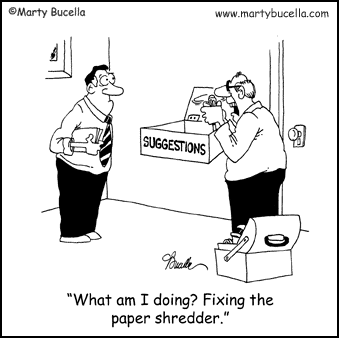
Read the Suggestions in the Suggestion Box

This cartoon makes me chuckle because it makes me think about all those companies that I go into where the CEO or President isn’t listening to anyone in the entire organization – and that’s to his detriment.

You have to have good communication up and down the line or you won’t know about the myriad ways that you could be improving your organization.

One of the first things I do when I go into a distressed company is reassure the employees that everything will be handled and that I will do my best to make sure they’re informed and taken care of as they deserve. It’s safe to say that many CEOs are not operating with this mentality.

The other thing I do is scour the organization for overlooked talent. I always need a new management team, and there are often great people on the inside with a profound understanding of the organization. If you are in upper management, utilize the talent beneath you. Listen to  people. Don’t overlook their suggestions.

One of the key markers of a successful company is that it’s a place that all employees are heard about their issues and thoughts. It is very demotivating to be an employee and to know that you aren’t being heard.

Today, listen to someone’s thoughts who you haven’t heard before and see what they can do for you.

What ideas have you gotten from people lower down in your organization?

Prepare for Change: The Tale of K-Mart the Big Gorilla

Everything changes but change itself.

– John F. Kennedy

Little rings truer to me than this statement by President Kennedy.

I was speaking to a CEO group just last week and I was telling them: change is coming, change is here, change is staying. What does that mean? It means that everything changes but change itself.

Conditions will never remain the same, and as a business person you have to prepared for that. Be ready for the future and be ready for change.

Let me give you an example, that I like to call the Big Gorilla example.

A while back I was CEO of a manufacturing company that made t-shirts and sweatshirts. We did good, steady work, and one day K-Mart came to us and started placing huge regular orders. A big change!

They asked us to change our manufacturing capabilities to suit their needs. We did. Another big change that seemed worth it because they ordered so much so regularly.

Then one day, after we produced a million dollars worth of merchandise branded explicitly for K-Mart, they told us not to ship their order, that they were having some financial issues. That was $1 million of merchandise!

This was unwelcome change, and this is the power of the Big Gorilla. The Big Gorilla changes your customer mix; it changes your business; then it changes its relationship with you.

When K-Mart told me to destroy the merchandise and that I couldn’t sell it anywhere – I just had to eat it – I was pretty perturbed. I, of course, didn’t listen, and sold the merchandise overseas at enough to break even. When K-Mart eventually found out (an executive was vacationing in the area and noticed the locals wearing the merchandise), the company terminated its relationship with us, changing the nature of our business again. We had lost our Big Gorilla.

Two lessons come out of this story. The first is: Be Wary of the Big Gorilla. It’s nice to get a big buyer but when someone controls that much of your customer pie, change is always on the horizon.

And that brings us to the second lesson: Change is the Only Constant. Believe it and prepare for it by staying aware, recognizing that all projections have holes and flawed assumptions, being proactive rather than reactive and having controls in place.

What change has caught you by surprise? How do you prepare for change? Have you ever had a Big Gorilla – what happened?