“Good Times, Bad Times, You Know I’ve Had My Share”

If matters go badly now, they will not always be so.

– Horace

Business is cyclical, and the ups and downs are unavoidable. You have limited control over the corporate environment you operate in, and it’s often hard to exert immediate influence even within your own company.

But understanding this should help rather than hurt the way you manage your business affairs.

What you can control is the way you anticipate and react to the circumstances that cause periods of growth and decline. Always be aware of what factors influence the success of your business most strongly, and try not to be too phased when times are tough.

One of the most common mistakes I see amongst leaders of failing companies is that they re-act instead of take a proactive attitude towards their business.

Learn from their mistakes.

Don’t rely on the numbers you’re given. Don’t become complacent. Don’t believe projections. Have contingency plans. Have checks and balances. Face the harsh reality of your situation. Develop alternatives to your primary model and product offerings. Walk the floors of offices and manufacturing facilities.

Take Blockbuster, for example. Since its founding in 1985 until recently, things had been going well for the video and gaming rental giant. The company found a combination of products and services that were in high demand and it grew nationally as a result. But they failed to proactively seek an opportunity like their now main competitor, Netflix.

Now Blockbuster corporate strategists spend most of their time reacting to the evolutions of the movie rental marketplace that Netflix overwhelmingly controls. The company filed for Chapter 11 bankruptcy in September, 2010. Your company, like Blockbuster should have done over the years, needs to keep evolving whether the times are good or bad.

It is true that the biggest battleships are most difficult to turn around, but there isn’t a battleship too big to sink.

Keep Your Business Healthy

There are a few very important things to keep in mind to keep your business afloat and healthy:

1. You need to focus on overcoming the turtle mentality in your company. When things are going  badly, many people have a tendency to try to hide from and ignore the problem. Make sure that through an open communication policy, people feel comfortable sharing their concerns regarding the business. Wouldn’t you rather know if there is a problem that needs your attention while it can still be fixed?

2. Remember, it is not only your own perceptions and attitude you need to manage. Keep a positive attitude even during hard times. People look to you as an example, and they often jump to conclusions based on your behavior. You need to communicate with your colleagues and employees. If the business is in bad shape, be honest, but engage and reassure everyone in the process to make things better. Ask for their ideas and opinions, especially if they are key stakeholders.

Once, acting as CEO at a company with 24 hour operations, I decided to hold a barbecue for those working the night shift. At 1 am, I began cooking on the grill and talking to the team members. As a result, I discovered a multi-million dollar fraud case. Act out of the ordinary and you never know what you’ll find.

No matter how tough things are in the business, you have power. If you take steps to be a proactive leader, keep a policy of open communication with your employees and colleagues and maintain a positive attitude, you will likely land smoothly when a wave comes, rather than crashing onto the beach.

What bad times have you experienced? How did they end?
How to Keep Your Business Relevant and Growing

Sometimes it is more important to discover what one cannot do, than what one can do.

– Lin Yutang

I was recently asked in an interview how I grow my business, because the interviewer believed that this would help people garner some insight into what they could do to grow their businesses.

What came to mind is what I’ve been doing for years – and bear in mind that this applies to us in large part due to our nature as a firm, but it can no doubt be applied to many business types.

To grow my business – and stay relevant – I’m constantly evolving GGG. When I say evolving it means that I’m adding to the list of services we offer. For instance, we’ve recently added federal and state receiverships as part of our product mix – in addition to our standard turnaround services.

I keep us evolving not only by maintaining my qualifications and continually learning, but by hiring people who have different skill sets than my own and who thrive in different ways. It is this differing talent – and recognizing what I can’t do – that keeps GGG growing and evolving.

So how does this apply to your product-based business?

Evolve your offerings.

Don’t keep selling the same old things. Don’t be a one trick – or ten trick – pony. Diversify. Add new products and widgets. It helps, of course to make sure that these products are relevant to your market and that they are in accord with your brand, but pending those things, add and evolve.

Next, pitch them to your current client list. Offer a nice discount at the beginning if you want to move enough product to test its relevance.

See what kinds of new clients you can attract with this new product, skill, widget or offering. Perhaps these new clients also need some of the products and services you’ve always offered, but would never have found you had you not evolved by adding these new products and services.

An Evolutionary Example

I’ll give you a quick example. A company that sells Seat Belt Extenders was selling this product alone – in one color and one length. When sales started to dwindle a bit, they realized they needed to evolve. Of course they needed to kick it up on the advertising and they needed to streamline their processes and become more efficient, but they also needed to add products to their mix.

Not only did they diversify by adding different colors and lengths to their seat belt extender offerings – a great move and an easy way to evolve – but they also added a handful of related products, all of which were highly relevant to their existing market and clientele (for instance, seat belt adjusters, bags to hold the extenders, etc.).

Your evolution doesn’t have to be complicated and it doesn’t have to cost you a lot. Instead of thinking about what you’re already doing well, think about what you don’t do well and bring in the people with the skills or the products and services that will evolve your business and round out its offerings.

I would prefer to hire people who are smarter than I am, pay them more than I make, and let them have fancier titles. Don’t let egos get in the way when you bring on those who do what you can’t.

How do you keep growing your business? How do you evolve? What products and services have you added?

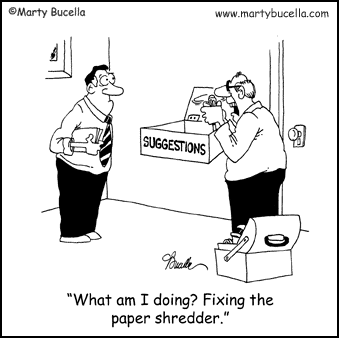
Read the Suggestions in the Suggestion Box

This cartoon makes me chuckle because it makes me think about all those companies that I go into where the CEO or President isn’t listening to anyone in the entire organization – and that’s to his detriment.

You have to have good communication up and down the line or you won’t know about the myriad ways that you could be improving your organization.

One of the first things I do when I go into a distressed company is reassure the employees that everything will be handled and that I will do my best to make sure they’re informed and taken care of as they deserve. It’s safe to say that many CEOs are not operating with this mentality.

The other thing I do is scour the organization for overlooked talent. I always need a new management team, and there are often great people on the inside with a profound understanding of the organization. If you are in upper management, utilize the talent beneath you. Listen to  people. Don’t overlook their suggestions.

One of the key markers of a successful company is that it’s a place that all employees are heard about their issues and thoughts. It is very demotivating to be an employee and to know that you aren’t being heard.

Today, listen to someone’s thoughts who you haven’t heard before and see what they can do for you.

What ideas have you gotten from people lower down in your organization?

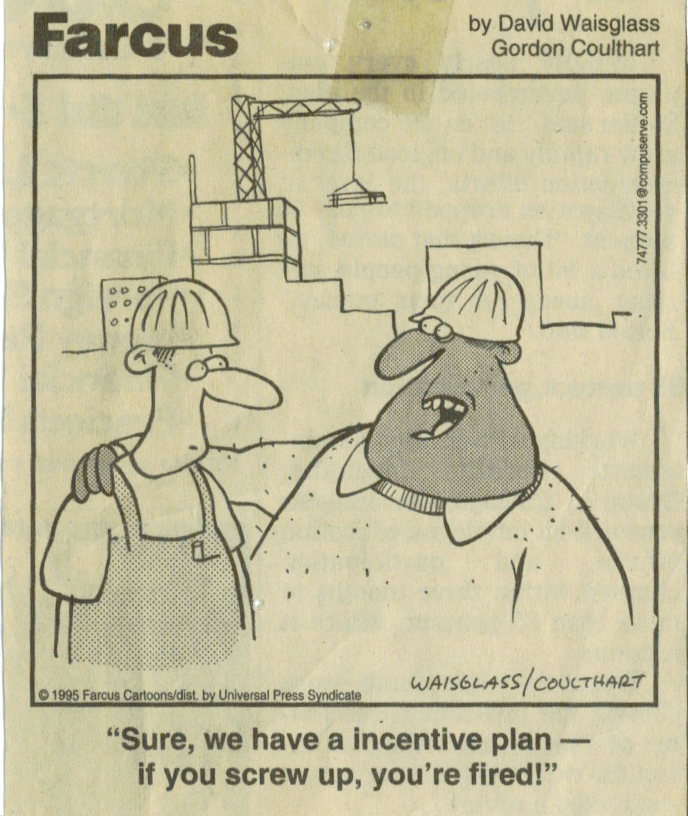
The Incentive Plan? Don’t Screw up or You’re Fired

I love this cartoon. This is another one of those that’s been hanging in my office for a decade and a half.

This is NOT my mindset – that if you screw up you’re fired. I think it’s a shame when things are that way.

However, as someone who’s been a part of hundreds of businesses, often trying to figure out how to keep morale up and motivate employees, ensuring that they’re on board for whatever big changes and overhauls I have to implement to keep sinking ships afloat, I certainly understand the sentiment.

What’s your favorite business cartoon?

Prepare for Change: The Tale of K-Mart the Big Gorilla

Everything changes but change itself.

– John F. Kennedy

Little rings truer to me than this statement by President Kennedy.

I was speaking to a CEO group just last week and I was telling them: change is coming, change is here, change is staying. What does that mean? It means that everything changes but change itself.

Conditions will never remain the same, and as a business person you have to prepared for that. Be ready for the future and be ready for change.

Let me give you an example, that I like to call the Big Gorilla example.

A while back I was CEO of a manufacturing company that made t-shirts and sweatshirts. We did good, steady work, and one day K-Mart came to us and started placing huge regular orders. A big change!

They asked us to change our manufacturing capabilities to suit their needs. We did. Another big change that seemed worth it because they ordered so much so regularly.

Then one day, after we produced a million dollars worth of merchandise branded explicitly for K-Mart, they told us not to ship their order, that they were having some financial issues. That was $1 million of merchandise!

This was unwelcome change, and this is the power of the Big Gorilla. The Big Gorilla changes your customer mix; it changes your business; then it changes its relationship with you.

When K-Mart told me to destroy the merchandise and that I couldn’t sell it anywhere – I just had to eat it – I was pretty perturbed. I, of course, didn’t listen, and sold the merchandise overseas at enough to break even. When K-Mart eventually found out (an executive was vacationing in the area and noticed the locals wearing the merchandise), the company terminated its relationship with us, changing the nature of our business again. We had lost our Big Gorilla.

Two lessons come out of this story. The first is: Be Wary of the Big Gorilla. It’s nice to get a big buyer but when someone controls that much of your customer pie, change is always on the horizon.

And that brings us to the second lesson: Change is the Only Constant. Believe it and prepare for it by staying aware, recognizing that all projections have holes and flawed assumptions, being proactive rather than reactive and having controls in place.

What change has caught you by surprise? How do you prepare for change? Have you ever had a Big Gorilla – what happened?

Is Optimism Essential? Yes – But Bolster It with Realism

Optimism is essential to achievement and is also the foundation of courage and of true progress.

– Nicholas Murray Butler

I certainly can’t disagree with the value of optimism. You need to believe that what you’re doing is going to work or it’s going to be very hard to do anything. So, yes, be optimistic.

At the same time, though, all optimism must be supported by realism. Be optimistic by feeling good about a well thought out Business Plan, but make sure you have appropriate contingency plans. That’s realistic.

Some say, but contingency plans imply that you don’t believe in your primary plan, and that means you’re not optimistic it will work.

Untrue.

Contingency plans are part of the main plan. Having contingency plans should make you optimistic about your primary Business Plan because you know that in the event that life doesn’t work out to 100% of your projections – and it never does – you will not fail. You will have next steps ready to go.

So, yes, Butler is right that optimism is essential for progress, but bolster all optimism with realism.

What do you think about Butler’s words? Do you have a favorite quote?

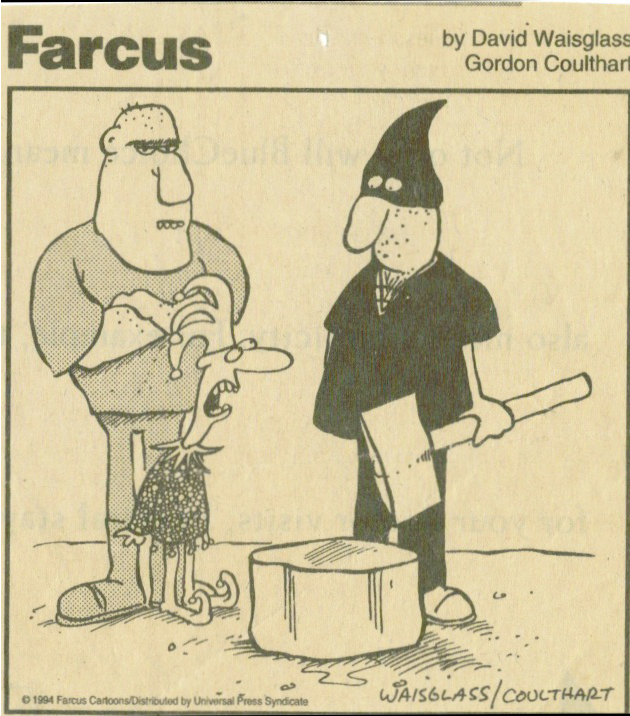
Never Ask about Severance Pay

Never ask about severance pay

This is a hilarious Farcus cartoon that I cut out of the paper 17 years ago and have stuck up in my office.

Every time I look at it I laugh.

Sometimes, and I hate to be the one doing it, I have to give people – and entire divisions – the ax. That’s never my preference, but if I have to cut off a limb to save a body I’m going to do it.

Farcus just puts the harsh reality of those moments in cartoon form.

What do you think? Do you have a favorite business joke or cartoon? Share it with us in the comments.

Cooking the Books & Other Stuff I’ve Seen Lately

You wouldn’t believe what some people do. Well, I’m sure you would, but I’ve got to say that I’ve been seeing some crazy stuff these days.

In one case I’m working on, the guy “running the show” has been stealing everything but the robe off his cold grandmother.

Every time I think I’ve seen every possible type of fraud there is, I’m introduced to a new one.

So far due to the actions of one crooked CEO I’ve seen and experienced the following:

~ Cooked Books

~ 6 Million Stolen Dollars

~ A self dealing CEO setting up a new business and paying old vendors for support

~ Getting my access cut off internally despite my appointment by a court of law to be doing what I’m doing

~ Offloading merchandise that had “no value” and was therefore disappearing

~ Selling one company’s products through another company and brand, which is detrimental to the value of the original company

~ Literally, taking the cash from sales – taking the cash, like a petty thief!

~ Plans to remove computers and file cabinets to “preserve” records for tax purposes.

~ Destruction of papers and documents

Holy cow!

I can’t believe all that this crooked guy is doing. I’ve seen a ton of fraud in my day, but one person doing so many different things. If he put this much effort into running the business effectively he would surely be making as much. It’s just craziness!

Have you been at a job and experienced fraud? Share your story in the comments below.

“If the Alligators are Biting, It’s Too Late to Drain the Swamp”

You may have heard this saying before:

“If the alligators are biting it’s too late to drain the swamp.”

Keep this in mind while running your business. Doing so can affect not only profitability but also your very survival.

Here are a few examples of when the alligators start biting:

1. Consider the sales manager who is not producing what you’ve come to expect from him; you notice a decline in sales and even a disruption to the team. He should either be refocused or fired. Now your revenue and profits are down. If he handled your largest accounts and the competition has now stolen them from your company, you’ve been bit by alligators.

2. Your CFO is constantly late with financial statements, and the bank is growing concerned. You then discover after months of frustration that he has personal problems that have affected his performance.  Now the bank is concerned about your ability to run your business. You’ve been bit by alligators.

3. The classic survival story involves fraud. Almost half – thats 50% – of our clients have encountered some kind of fraudulent situation. When the CFO/controller has been systematically stealing, the bank’s knee-jerk reaction can leave you scrambling to find another bank. That’s not so easy in this economic climate. You’ve been bit by alligators, and your company may be devoured.

The key here is to put safe guards in place with the assistance of your auditors. Don’t let the CFO set the testing limits above the limit he’s stealing. Let your auditors run the process. Also, as the CEO or key manager, you should periodically sign every check for a month that would normally be a “one signature” check handled by the CFO/Controller. This control is one great way to start draining the swamp.

How to Avoid Being Bitten by Alligators?

Be proactive instead of reactive. Drain the swamp before the alligators take up residence and start chomping.

As your company grows and you start delegating work, make sure that you keep yourself embedded in enough of the processes to have proper control. Don’t delegate and forget.

If you have auditing processes, don’t stick to limitations (e.g. we’ll look at all transactions over $5000). Mix things up and be unpredictable, so that no one can take advantage of your complacency or your routines.

Ask a lot of questions of your key people. Learn about your cash flow, your payables, and your company’s projections. Don’t believe what you’re told. Follow up on the details and have an auditor check out those projections. That’s prudent business practice.

I’m not suggesting that you don’t trust your CFO or that you don’t believe anyone. I’m just saying you need to question what’s happening and check up on things for yourself.

This may not be draining the swamp, but it is keeping the water level down. This is being proactive – not reactive – and it will always cost you less time and money.

Until next time, don’t get bit by the alligators.

The CEO’s 10 C’s of Borrowing

Bankers and business owners can have trouble communicating because their mind-sets are different.

As someone who began his career as a banker and who has spent the last 30 years doing interim-CEO turnaround management, I understand the banker’s mindset while having profound insight into what makes businesses run successfully from the top. Most of my day is spent playing “Let’s Make a Deal:” negotiating with lenders, creditors and bankers in order to get CEOs and their businesses new terms that allow continued operations.

In my experience, it’s particularly difficult for these two groups – business leaders and bankers – to understand each other because they’re coming from such different places and have seemingly different priorities.

Part of the process is helping both sides see that they’re in a partnership. Both bankers and business owners want to see the business continue to run because that’s the most likely way for the bank to recoup its loans and eventually see profits, and its the only way that the business will turn from debt to profit.

Thus, as a business owner, you should strive to understand how your banker thinks – and why he thinks that way. This can have a positive effect on your relationship and make it easier to get money when you need it. I present to you, then, “The CEO’s 10 C’s of Borrowing,” which will help you become a better borrower, enhance your relationship with your banker and make money more available when your business needs it most.

1. Character is of the utmost importance to bankers.

Bankers need to know you’ll do the right thing when your company is in distress. If they can’t trust you, they can’t put money in your hands. That doesn’t mean fake good character – it means have and demonstrate good character.

2. Carelessness comes down to poor record keeping.

Carelessness can also hurt your bank by causing it to write-off loans needlessly or even lose its federal loan insurance such as SBA Guarantees. Run your shop well, which includes good book-keeping practices, regular audits, competent comptrollers, and mixing up your monitoring practices. Not being careless also means verifying for yourself the details of your business’s financial situation.

3. Complacency is not an asset.

Banks are interested in how you react to tough situations. Don’t just tell them what you’re legally required to when they ask; keep them updated to avoid surprises. Bankers hate surprises. This is all a part of the larger principle of being proactive rather than reactive. Proactive business owners keep their banks apprised of the situation, which makes their banks more likely not to react to unfortunate circumstances by demanding payment on loans.

4. Contingency Plans are key for orderly succession if something happens to you.

Bankers value stability, and even though many business owners think they’re invincible, history has proven otherwise. If your bank knows what will happen in the event that something bad happens to you – like disability or death (God forbid) – that’s comforting to them. If they know what will happen to your business in the event of various catastrophes, they’ll continue to work with subsequent leadership. It’s also wise to introduce your banker to the future generation of leaders at your company. Have contingency plans. Nothing works out like your spreadsheets suggest.

5. Capital is your net worth (assets minus liabilities).

Bankers want an extra cushion of equity so they can be more flexible with your company in case it has a bad year. A CEO and a banker need to balance one another’s needs in order to maintain sufficient capital. I sometimes find that telling entrepreneurs, owners and CEOs to keep extra capital around is like telling a dog to save part of his dinner for later, but if you can show your banker that you’re capital-wise, he’ll be more likely not to call your loan after a bad year.

6. Collateral is a bank’s leverage and makes bankers feel more comfortable.

Collateral does not repay a loan, as many entrepreneurs think when they pledge their assets, but again, it does ease the banker’s mind.

7. Capacity is your ability to repay.

Bankers check to see if you have champagne tastes but a beer wallet. If you seem like you can repay what you’re asking for – which is to say, a reasonable sum and not your dream loan – you’re more likely to see the money. Shoot for the stars in life, but a bank loan is a different matter.

8. Competition works to your advantage.

Banks are concerned about their competitors’ interest rates, collateral packages and guarantees. You can use this to your advantage by doing your homework when seeking a loan and making that clear to your banker (though no one likes to feel threatened, so be courteous about this). Knowing about your bank’s competition can also let you prepare for a quick capital search should your banker pull out.

9. Controls are your built-in monitors.

Bankers want to know about your company’s controls. Do you have checks and balances for payroll clerks, controllers, CFOs, and inventory personnel? Do you watch the back door? Outline the steps you take in your plans and conversations with your banker; ask for his recommendations. If you find an issue, correct it and then update your banker that you’ve fixed the problem.

10. Communication is essential.

Almost every one of these tips hinges on communication. Don’t keep things from your banker. If he knows what’s happening he can work with you instead of against you. Work with your banker for the best relationship.

With “The CEO’s 10 C’s of Borrowing” in mind you’ll be better equipped to understand where your banker is coming from and not get frustrated when things don’t seem to go your way. Talk with your banker and try to understand him. It will only be to the benefit of your business.

Which of these have you found useful or true in your experience? Let us know in the comments.