
Wishing you a joyous holiday season and a happy and prosperous new year. Thanks for reading The Turnaround Authority.

Wishing you a joyous holiday season and a happy and prosperous new year. Thanks for reading The Turnaround Authority.
I know a CEO of a large security services company who began a tradition when his company was first founded. Every year he wrote a card to each employee during the holidays, expressing his appreciation for that person’s contribution to the success of his company.
As the company grew larger and larger, he kept up the tradition. He had to start earlier in the year, and may have enlisted others to address the envelopes, but he never quit writing those cards.
 I’m sure some of you are shaking your head already. “Why should I thank them for doing their jobs?” you may be thinking. Or, “We thank all our employees twice a month. It’s called a paycheck.” Or you may think that no one thanks you, so why should you be bothered to thank others?
It’s true that criticism is much more prevalent in the workplace than appreciation. It’s partly human nature to point out the negative and leave positive actions unrecognized. And a lot of managers don’t believe in showing gratitude or just feel awkward about it.
Jack Welch is the former Chairman and CEO of General Electric, now an author and founder of the Jack Welch Management Institute. One of the tenets of his leadership philosophy is “Lead by Energizing Others, not Managing by Authority.”
He believes in making people passionate about their jobs and prefers inspiration to intimidation. Part of this leadership lesson includes letting others know exactly how their efforts are helping the organization and sending handwritten thank-you notes to colleagues and customers.
There are even sound business reasons for doing so. Ones that contribute to your bottom line.
In a recent article in the Wall Street Journal online about showing appreciation at the office, it was reported that more than half of human-resource managers say showing appreciation for workers cuts turnover, and 49 percent believe it increases profit.
Dr. Noelle Nelson, a consultant and clinical psychologist, wrote a book called “Make More Money by Making Your Employees Happy.” In the book, she cites a study from the survey research consultancy Jackson Organization, (since acquired by Healthstream, Inc.), that shows, “Companies that effectively appreciate employee value enjoy a return on equity and assets more than triple that experienced by firms that don’t. When looking at Fortune’s ’100 Best Companies to Work For,’ stock prices rose an average of 14 percent per year from 1998-2005, compared to 6 percent for the overall market.”
Increased profit, less turnover and a more pleasant, positive work environment. All from showing employees a little appreciation.
One way to express appreciation is with a personal handwritten note sent to the employee’s home address. In the note, cite a few of that person’s contributions over the past year.
If that isn’t possible, at least consider rewarding all the employees at your company. Take an example from Apple. In 2011, the new CEO, Tim Cook, gave all the employees paid vacation during Thanksgiving. In a memo he wrote, “In recognition of the hard work you’ve put in this year, we’re going to take some extra time off for Thanksgiving. We will shut down with pay on November 21, 22 and 23 so our teams can spend the entire week with their families and friends.”
You may not be able to shut your entire office for three days to show your appreciation, but consider an afternoon off or treat the office to lunch one day, any time of year.
In fact, any gestures of appreciation you make at times other than holidays often get more attention.
Joey Reiman, CEO and founder of BrightHouse, gives all his employees March 4 off every year. He calls it, “the day to March Forth on our dreams.”
Voltaire was probably not talking about company profits with this quote, but it is appropriate in an office setting too: “Appreciation is a wonderful thing. It makes what is excellent in others belong to us as well.”
“I have not failed. I’ve just found 10,000 ways that won’t work.”
— Thomas Edison
I recently read an editorial in the New York Times called “The Power of Failure,” in which the writer addresses how nonprofits are tempted to hide their failures while some for-profit industries have accepted that failure is part of the process.
Sarika Bansal quotes Wayan Vota as saying, “In Silicon Valley, failure is a rite of passage. If you’re not failing, you’re not considered innovative enough.” Mr. Vota is a technology and information expert who recently organized a conference in Washington called FAIRFaire that focuses on lessons learned from projects that failed.
As a turnaround expert, my career is focused on working with companies that are experiencing failure. If a company is thriving, they don’t need me. I’m brought in when things aren’t so rosy.
 I don’t really want any company to be failing to the point where I’m called in to turn the company around.
On the other hand, I don’t think it’s best for any company to enjoy a straight line of success. There are so many lessons to be learned from failure and if CEOs and business owners don’t learn how to deal with failure, they won’t know how to handle it when it inevitably happens.
A few years ago NPR correspondent Eric Weiner traveled the world to investigate where people are the happiest. He wrote the bestselling book “The Geography of Bliss: One Grump’s Search for the Happiest Places in the World.”
One of the fascinating things he uncovered was that people in Iceland are generally happy, which he attributes in part to the fact that failure doesn’t carry a stigma in Iceland. It’s totally normal for a person to have a résumé reflecting multiple careers — from journalist to executive to theologian — failing at some junctions and continuing on a different path.
For a company to grow and flourish, it has to be innovative and creative. Along with that comes a certain amount of failure. As a CEO or business owner, you want to encourage that innovation, while not stigmatizing any failure that may result from trying something new.
Take a lesson from Thomas Edison. “Negative results are just what I’m after. They are just as valuable to me as positive results.”
Confucius said, “Greatness is not achieved by never falling but by rising each time we fall.” Will Rogers said, “To avoid failure is to limit accomplishment.” Jack Welsh said, “I’ve learned that mistakes can often be as good a teacher as success.”
One of my favorite perspectives on failure comes from basketball superstar Michael Jordan and I urge you to take it to heart if you’re dealing with a setback at your business: “I have taken more than 9,000 shots in my career. I have lost almost 300 games. Twenty six times I have been trusted to take the game winning shot and missed. I have failed over and over again in my life; and that is why I succeed.”
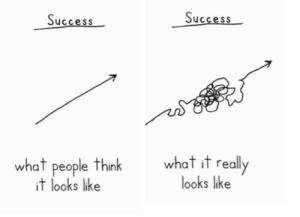
I love the drawing by comedian Demetri Martin about what people think success looks like compared to what it really looks like. Success is not a straight line. But the important point is to keep your company on an upward path, no matter how many times it takes a backward step.
If you’ve made a mistake or failed at something at your business, admit your mistake. Learn from it. Encourage your employees to do the same.
A friend of mine learned to water ski by watching another friend as he desperately tried to rise up out of the water, but instead took a face plant into a wave every time. A guy in the boat was coaching him with each effort. My friend listened, and when it was her turn, got up on the first try.
 I’m a big believer in learning from others mistakes. In fact, I’ve written a book about it. My new book, “How Not to Hire a Guy Like Me: Lessons Learned from CEOs’ Mistakes,” will be available in early 2013.
There’s another new book that anyone in business would enjoy, particularly if you have a family business. “Bitter Brew: The Rise and Fall of Anheuser-Busch and America’s Kings of Beer” is a fascinating account of the infamous Busch family. Author William Knoedelseder recounts the story in all its lurid, scandalous detail of how Adolphus Busch, a German immigrant, came to the United States before the Civil War, and with the purchase of a beer recipe from monks in a Bohemian village called Budheis, founded Budweiser.
The company, which became Anheuser-Busch Cos, was sold in a takeover to InBev, a Belgian-based holding company, in 2008 for $52 billion amidst flattening stock prices and a drop to a number 2 position.
Although Busch family members walked away with hundreds of millions, America lost a $19 billion a year Fortune 500 company and 1,000 people in St. Louis lost their jobs. Anheuser-Busch was the last remaining independent beer company, still owner and operated by the founding family.
There are so many lessons to learn from their mistakes. I’ll talk about two.
1. Not picking the best successor for the company.
Rather than analyze who would be best suited to take over the company, as I discuss in a recent post, responsibility for running this huge company was automatically passed from father to first-born son. The board of directors ignored most of the proper successor analysis and genes were selected over ability. Not a formula for long-term success.
August IV, commonly known as “The Fourth,” was the sixth in the Busch family to run it and was CEO in 2008 when the company was taken over.
His qualifications included several drunken driving accidents, including one in which a young woman was killed; leading police on car chases and taking young women along with him on business trips. His father, August III, had seized control of the company from his father, known as Gussie, in a boardroom coup in 1975. Hardly an ideal method of succession.
2. Not paying attention to the competition and changes in the marketplace.
In 1969 the tobacco giant Philip Morris bought Miller Brewing Company. Gussie was in control of Anheuser-Busch at the time and failed to see the threat this acquisition posed to its market share. The seemingly insignificant beer company rose to become the number 2 brewer in the United States.
Early in the 21st century beer sales began to fall. In 2000, beer accounted for 55.5 percent of alcohol sold in the United States. In 2006, that percentage had dropped to 50.7 percent. And In 2007, Anheuser-Busch’s two main competitors, SABMiller and Molson Coors, merged, putting the company in an even more vulnerable position.
I often reference the saying, “If the alligators are biting it’s too late to drain the swamp.” The alligators were definitely making a meal out of Anheuser-Busch.
Ironically, in a speech The Fourth made in 2006 while accepting an award, he said, “Mistakes will happen, mistakes are inevitable, but in failure there is learning and in learning there is experience. That’s how you improve and grow.”
I agree with his sentiment. If only he had taken it to heart.
I deal with a lot of crises in my business as a Turnaround Authority: bankruptcies, family feuds, failing businesses, gun-toting union members, just to name a few. So I’m always interested in reading articles about the topic of emergency situations — particularly about those who regularly deal with crises as part of their job.
Dr. Thomas Frieden knows a thing or two about handling emergencies. As head of the Center for Disease Control and Prevention, Dr. Frieden deals with public health crises all over the world while also leading 11,000 employees in 50 countries and overseeing an organization with an $11 billion budget.

Sometimes it takes more than a Band-Aid to fix problems in your business. Know when to call in a professional.
In a recent interview with Sunday Business Editor Henry Unger in the Atlanta Journal-Constitution, Dr. Frieden said one thing that I wish every CEO or business leader who is in a crisis situation would read.
When asked if the top leader of a business or organization should manage the crisis, he was quite clear.
“No,” he said. “The CEO should not be the person running the day-to-day crisis response. That would be a mistake … If a CEO tries to manage every aspect of an emergency, he or she is going to mess it up. Other things are happening and the CEO will never be able to focus as much energy as you need to.”
It’s a smart CEO who knows when to call in an outside professional like me.
As a turnaround guy, I am like an ER doctor. The patient is in an emergency situation and I first have to stabilize the patient and prevent shock. Then I can perform the necessary surgery to save the patient.
Unfortunately, many CEOS in crisis think they can handle their emergencies themselves. They are bleeding from the jugular and think they can slap a Band-Aid on and stop the bleeding.
As Dr. William Osler, considered the father of modern medicine, said, “The doctor who treats himself has a fool for a patient.”
You’re not going to cut your own appendix out, right? You hire someone with years of experience doing just that. So if you’re facing a crisis, why not hire someone who has years of experience handling crises?
I am used to skepticism on being hired to turnaround a company. When I’m discussing conducting an initial assessment with a client I often hear, “Our business is failing. We can’t afford to hire you.”
I always respond, “How can you afford not to?”
Then I tell them, “If I don’t save you five to ten times what you pay me in the first year, I’ll give you your money back.”
I’m not saying I’m smarter than any of these CEOs. I’ve just been doing this a long time and have seen just about every situation. And one of the reasons that I have the ability to succeed where CEOs faced by crises do not is because it is not my business. It’s not my company, my employees, my money, my wife, or my life. That allows me to keep a clear head and an objective perspective where the CEO does not have one.
Personal involvement compromises the CEO’s ability to understand what’s important and what is not; the facts and information that manifest themselves during an assessment and what ultimately resolves a turnaround are rarely the same facts and information that the CEO initially deemed relevant.
If your company is in crisis, do yourself a favor. Hire a professional.
More than a trillion dollars. That’s how much fraud is costing companies in the US each year.
The Computer Evidence Specialists LLC released the “2011 Report on the Cost of Fraud in the United States” earlier this year. The goal was to put a figure on the total cost of fraud in the United States from six industries: corporate, securities, financial, mortgage, healthcare and insurance.
Here was their conclusion: “Through our research, compiled from the most recent data available on the subject, we conservatively estimate that fraud annually costs victims $1.32 trillion.”
The figure is conservative, as a lot of fraud is underreported by victims or not reported at all.
Shocking, isn’t it? The truth is that no company is immune to the cost of fraud and you need to be vigilant in your efforts to prevent it.

The Woodruff Arts Center this week learned that a former employee embezzled $1.48 million over the course of five years.
The arts community in Atlanta was saddened this week to learn that $1.48 million was embezzled from the Woodruff Arts Center, the largest cultural institution in Atlanta.
Seems a mid-level administrator, who wasn’t even in a finance-related job, figured out a way to set up a fake company. Over a period of five years, the man regularly submitted invoices from the fake company and raked in big bucks. He wasn’t caught until after he left, for unrelated reasons, and someone took note of suspicious invoices.
A simple set of checks and balances would have caught the thief before he collected his first check.
Here are some key things to remember when considering your own system of checks and balances. Remember that any place money or goods exist or move is a place where theft or fraud could occur.
• Remember that anyone can commit fraud. Family member, long-time employee, revered CFO. Don’t consider anyone above suspicion. I worked with a company once where the son was stealing from the family business after his dad died. He felt he wasn’t being paid enough and stealing was his way of claiming his inheritance.
• Always poke around your books. No matter how large your company gets, take some time to peruse the checkbook or QuickBooks. Ask where the money is going. In the case of the Woodruff Arts Center, the fake company was one of only 13 that were regularly paid. How long would it have taken to do a Google search on the fake company or question someone about the services supposedly being rendered?
• Monitor and review monetary trends. Determine what types of numbers are most meaningful to your company—the cost of goods or services, employee expenses for example—and determine the acceptable range for those numbers. Graph the data for those numbers and pay attention if any numbers fall outside of that range.
• Change the standard by which you review transactions. For example, if your company only reviews expense reimbursement requests that are above $1,000, regularly review those at around the 80 percent level. I’ve found that seems to be a favorite spot for thieves. The Woodruff Arts Center thief got away with his fraud for so long because even though the amounts that were paid to the fake company increased over time, they remained under the limit that may have drawn attention.
• Trust your instincts. If something in your company seems a little off, investigate further. Don’t feel guilty about asking questions. You’re in charge.
Don’t let fraud cost money at your company. Tighten up those checks and balances.
Read more about fraud prevention in my upcoming book, “How Not to Hire a Guy Like Me: Lessons Learned from CEOs’ Mistakes.” The book will be available on Amazon in early 2013.
“Feeling gratitude and not expressing it is like wrapping a present and not giving it.”
~William Arthur Ward
In the spirit of expressing gratitude during this Thanksgiving week, I want to thank a few CEOs and companies that get it right and for whose policies I am thankful:
• Delta CEO Richard Anderson, who is bringing back the traditional values of the airline company and says that we need to recognize that only companies that have a sense of integrity survive. He has a bell on his conference table and during meetings anyone who thinks a rule is being broken can ring the bell.
• David Siegel, CEO of Westgate Resorts, who before the presidential election warned his 7,000 employees that they could face layoffs if Obama was re-elected. Instead he gave everyone a five percent raise.

Ninety-three billionaires have taken The Giving Pledge, including (clockwise from top left) Warren Buffett, Bill Gates, Ted Turner, George Lucas, Larry Ellison and Mayor Bloomberg.
• The department store Von Maur because it refused to bow to the Black Friday madness and is staying closed on Thanksgiving Day so its employees can enjoy the time with their families.
• TOMS shoes for donating a pair of new shoes to a child in need for every pair the company sells. To date the company has given away two million pairs of shoes in 25 countries.
• Warren Buffet and Bill Gates for starting The Giving Pledge, a campaign to encourage very rich people to give most of their money to philanthropic causes. Ninety-three people have taken the pledge, representing untold billions of dollars of wealth that will go to do good in the world.
• Southwest Airlines for not charging those rip-off change fees.
• Retired CEO of Xerox Corporation Anne Mulcahy. Although the company’s stock dropped 15 percent the day her appointment as CEO was announced in 2001, she led the turnaround of a company that was $18 billion in debt, on the verge of bankruptcy and facing an investigation by the SEC. Anne spent her first 90 days flying around all the country just listening to peoples’ perspective on what was wrong. By 2005, Xerox earned $978 million on $15.7 billion in revenue and had no core debt by 2006.
Here’s a quote from Anne that CEOs in the midst of trying to salvage failing companies should take to heart:
“By the time I stepped down as Xerox’s CEO in 2009 — and as chairman in January 2010 — Xerox had become the vibrant, profitable and revitalized company that it still is today. What made the difference was a strong turnaround plan, dedicated people and a firm commitment from company leaders.”
Lastly, I am thankful for all the businesses that hired me and allowed me to make a difference for companies and their employees.
And it’s thanks to them and all the lessons I’ve learned during my decades of experience that I have plenty of material for my soon-to-be-published book, “How Not to Hire a Guy Like Me.”
Office politics. There’s an app for that. In the new iPhone app “Office Master: Backstab,” players work their way up the corporate ladder by backstabbing as many of their co-workers as they can, kind of a cubicle whack-a-mole. “To the people who have suffered and endured in the world of office politics, we dedicate this game to you,” wrote one of the creators. That’s a lot of people.
In my last post I talked about the high cost of office politics, which has been estimated to cost more than $300 billion a year in the U.S. in lost productivity. There are other costs as well, including the difficulty of recruiting and keeping people in a toxic office environment.

Players on the iPhone app Office Master: Backstab work their way up the corporate ladder by stabbing co-workers in the back.
I was chatting with a young woman once who had filled in as communications manager for an arts organization for a few months. She described the situation as a viper’s pit.
There was no one person running the company, weekly meetings were one long complaint session, and the box office computer was running on ancient software that barely functioned.
But it wasn’t updated because the box office manager was the only one who knew how to use it and thought it gave her job security. When this young woman was trained on it, the box office manager promptly changed the password and declined to share it.
When she was offered the job on a permanent basis, she politely turned it down. Wonder why? That was an office brought almost to a standstill by office politics.
Office politics is not going away. But here are a few of my tips to minimize its negative impact on productivity in your company.
1. The CEO sets the example. Treating everyone internally and externally with respect goes a long way towards decreasing office politics.
2. Have clear, well communicated company policies and follow them. Employees are happier when they understand what the office policies are and that everyone adheres to them.
3. Maintain an atmosphere of openness where people feel they can make their concerns known. When senior managers don’t feel they can bring topics up, problems in the company may stay hidden until a small problem escalates into a big one.
4. When you see that some employees are not working in the best interest of the company, speak to them directly. Explain that everyone needs to work as a team and work toward the same goal: the success of the company. If they are directing their efforts elsewhere, it may be time to move on.
You want people working hard for your company. Not virtually stabbing their co-workers in the back.
Politics is expensive. Just through late October, the top two candidates spent close to $2 billion vying for that fancy oval office and comfy bed on Air Force One. A report Wednesday stated that between the two candidates, they spent $1 billion on TV ads alone.
But let’s talk about the cost of another type of politics. If you’re like me, you’re probably campaign-weary too. My favorite Tweet from Election Day was by Larry Sabato, the Director of the University of Virginia Center for Politics. “Some call it Election Day. I call it Negative Ad Liberation Day.”

NASA managers knew there were issues with the O-rings on the Challenger and had been warned by engineers that it was too cold for the launch. But the organizational culture was such that people were scared to report the problems. It was launched on January 28, 1986 and broke apart 73 seconds later with six astronauts and a school teacher on board.
I want to talk about office politics. I don’t care whether you’re involved in your church’s flower guild, your condo association or a multi-million dollar company — every organization has politics. You’ve heard the definition of a dysfunctional family, right? One that has more than one member. Pretty much can be said of a group that has to deal with politics.
Everyone has an agenda. Fred in accounting may be sucking up to the boss, hoping for a promotion while Sue tries to avoid any type of controversy and sticks to her cubicle. I’m not concerned here with these type behaviors.
I’m talking about what takes place at the senior level, where playing politics can have the most devastating and costly consequences, even to the point that senior level managers can paralyze the operations of a company. Or worse.
I once worked with a large company where the directors were in a dispute over the direction of the company. Some old directors wanted to continue in the manufacturing business, believing they could salvage some of the company’s remaining resources, while others wanted to morph into a licensing company and focus resources on what they saw as a more promising path.
The problem was that the transition to a licensing company had already begun and the politics among these officers resulted in a six-month loss of time — not to mention millions of dollars — before the company pulled together on the project that would save them.
I’m not saying disagreement among managers is a bad thing. It can be a healthy way to flesh out the best ideas. Problems arise when one person or a group of people tries to undermine the process of normal negotiations and discussions by currying the favor of senior management or board members, and skew assumptions and strategies towards their desired outcomes. I’ve seen numerous companies disintegrate for these reasons.
The problem with politics is that not everyone has the best interests of the company in mind.
Let me give you a more deadly example. After the space shuttle Challenger explosion in 1986, Ronald Reagan formed the Rogers Commission to investigate what happened. Their findings were chilling.
NASA managers knew that there was a potentially catastrophic flaw in the O-rings and had known it for years, but NASA’s organizational culture was such that the people working closely on the project were too scared to bring it up.
Managers also disregarded warnings from engineers about launching in the low temperatures that morning, fearful that a delay might hurt the image of the space program. Seven people died as a result.
One of the largest barriers created by politics is that the CEO is unable to get the right answers and information he needs quickly enough to act, particularly during a crisis.
Another problem with an overly politicized office is that morale among employees is generally low and productivity is lowered. And unhappy employees have a harder time doing their jobs. Gallup reported that lost productivity due to employee disengagement costs more than $300 billion in the U.S. annually.
What is office politics costing your company?
Tune in for the next post when I address what you can do about office politics.
In honor of election day tomorrow, I wanted to share a column I wrote that appeared in the Atlanta Business Chronicle last year. When I wrote this column, in August 2011, we still had eight people vying to be the Republican nominee. But it doesn’t matter that Mitt Romney finally clinched the nomination a year later, or even who wins the election tomorrow, if we don’t start running this country like a business.
* Extra credit if you can name all eight that participated in the August 11, 2011 Presidential Debate. Answer below.
The United States is a capitalistic society, so I often wonder why the government isn’t run like a business. We had a surplus 12 years ago, but now our debt is astronomical: nearly 14 and a half trillion dollars. This isn’t a political issue. It’s a business one — or at least it should be. When my clients have problems with cash flow, they don’t print money. They either raise money, close plants, lay off people or cut spending; they tighten their belts to survive.

No matter who wins the election this week, the only way we’re going to resolve this country’s financial crisis is by treating the government like a business.
When a business finds itself in this much debt relative to its capacity to repay, the bank, board of directors or shareholders say, “No more!” and send in a turnaround professional. We are America’s shareholders, and it’s time to send a turnaround guy — or at least the thinking of one — to D.C.
Despite insurmountable debt, the U.S. government isn’t taking key actions. Businesses with negative cash flow would have been bought, liquidated, merged or otherwise gone at this point, and I don’t want to see us become like Greece or Iceland in five years. Worse still, I don’t want to be a part of the United States of China, which we might become since in the business world a company with increasing debt is subject to acquisition or being carved up by a larger and wealthier business.
I always say that 100 percent of spreadsheets and projections don’t work because the assumptions are wrong, yet people rarely revisit and alter the assumptions regularly to produce more positive results. Even today, the Office of Management and Budget, which hasn’t made an accurate cash flow projection in years, thinks that our revenue is going to increase by x if we do a, b and c. But x is an assumption that’s based on the unlikely actualization of a, b and c, possible only if we overcome party politics. And as the deficit skyrockets, the assumptions are increasingly wrong and the parties are increasingly polarized.
The only way we’re going to resolve this country’s financial crisis is by treating the government like a business.
As we repeatedly hear, a balanced budget is the first step. The second step, however, is a repayment plan of our foreign debt. The next is a tax increase. No one likes tax increases — especially me — but it’s part of the solution. That said, we can’t just address cutting expenses; we need other plays from the Turnaround Playbook.
The corporate amnesty program allowed businesses to return profits from foreign soil to the U.S. at lower tax rates, which created more jobs in America. This was a wonderful and creative idea but it didn’t do what it was intended to do. While thousands of these ideas will amount to an aggregated long-tail effect, we need to begin with more drastic measures. And we need to start now.
Turnaround 101 dictates that we start by slashing all spending by at least 15 percent. We must tell every division, department and agency that it needs to cut its cash needs — no exceptions. The pain will be shared across the whole country as it would be across an entire business. This kind of mandatory budget cut provides time to fine-tune operational requirements based on the improved results. Before you ask, yes, this 15 percent cut would affect entitlements, Social Security, health care, the military and education — everything. No exceptions.
It’s easy to buck and cry, What about the children? Shouldn’t they be exempt from budgetary cuts? What about the sick? What about the poor? What about defense?
Here’s what I ask every department at a business: “The question is, do you want your company to survive until tomorrow or do you want to quibble about who’s more deserving of money that doesn’t exist? I don’t care how you do it. Just do it.”
Internal politics kills companies in the private sector because politics and business don’t mix. Similarly, politics has no place in America’s budgetary discussions, and our issues must be addressed by those who can truly set aside political or personal biases and run this country like a turnaround professional in the private sector.
As a turnaround guy, I act like an ER doctor; my first step is to stabilize the patient and prevent shock. As a country, we’re already in shock. Nobody wants to lose an arm or a leg, but if there’s only enough blood for the torso and the leg is gangrenous, you better believe I’ll lop it off to save the body. In five years, the prosthetic surgeon can make us pretty again. I’m in a unique business, but it’s the business of making sure we’re still alive in 2025 with or without a leg.
In addition to the 15 percent cut, we must freeze all raises and expansions. That means no more foreign aid increases (also subject to the 15 percent cut), and we put a reasonable mandatory repayment plan in place for foreign aid. We can’t continue to write off receivables and survive. It doesn’t work that way in business, and it can’t work that way in government.
This also means no cost of living increases for government employees, Social Security beneficiaries and pensioners. In addition, congressmen can enjoy normal health-care services — not VIP lifetime benefits for two years of service.
Unfortunately, tenured positions can’t be affected, but we can stop giving tenure. All rules for entitlements (e.g. pensions) must be reviewed. The private sector has largely eliminated pensions because it can’t afford them, and government needs to do the same.
I don’t have every last answer for how to save the trillions we need, but by making — and enforcing — these tough money-saving moves we can save America from bankruptcy, collapse and ruin. We must empower people to save money, and punish them for spending it needlessly in order to get a line item the following year.
Legislators keep asking that we have faith. Our economic stability has been built on faith. We can’t retain faith after 12 years of increasing debt. We need to deal with hard facts and run America like a business. Business is not about faith. It’s about trusting what works, and what works in business is what I know. Treat America like a business, and we’ll all live to buy another day.
* Bachmann, Romney, Pawlenty, Paul, Cain, Huntsman, Santorum and Gingrich
 The Turnaround Authority