The Path of a Peanut Seller

It started as a blog post I wrote in January and now the moment that changed my life as a teenager is a video in the Moments series on the Saporta Report. And it all started with peanuts.

Please click this link to view the short video and find out how I gamed the system in the peanut-selling business, which led to my career as The Turnaround Authority. I no longer work for peanuts.

Grant Field in the 1960s, where I began my peanut-selling career.

Grant Field in the 1960s, where I began my peanut-selling career.


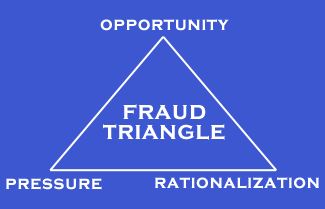
Why Fraud Occurs: The Fraud Triangle

Pressure, opportunity and rationalization. Those are the three factors that must be present for a person to commit fraud in workplace.

I’ve written a lot about the effects of fraud, the cost of it to the US economy and how to prevent it. But why is there so much fraudulent activity going on every day?

Criminologist Dr. Donald Cressey asked the same question in 1950. Cressey, who is considered the founder of the modern study of organized crime, became fascinated with embezzlers and wrote his dissertation on them for his Ph.D. in criminology. He was puzzled because most people who commit fraud are not criminals. They are generally “good” people. So what happens?

He interviewed 250 criminals who must have accepted a position of trust in good faith and must have violated that trust. His research was published in Other People’s Money: A Study in Social Psychology of Embezzlement in 1953. His theory on why fraud occurs eventually became know as the Fraud Triangle and is still the classic model to explain why people commit fraud in the workplace.

Cressey wrote that all three factors of the fraud triangle must be in place for an employee to commit fraud.

fraud7Pressure/Incentive

The thief is initially motivated because he or she has some type of non-sharable financial pressure or incentive. They may be involved in gambling, have a drug addiction or possibly took on more debt than they can handle. Or they could have a desire for material goods beyond their means, such as designer clothes and handbags or a new car. Sometimes an employee feels unfairly treated by a company and this is their way to get back.

The non-sharable aspect is an important distinction because the person generally feels shame or embarrassment over the situation or is concerned about potential disgrace. These are generally crimes committed in secret.

Amy Wilson was a respected office manager when she was caught for embezzling $345,000 and sent to jail. Now out and reformed, she speaks about what she did to help businesses prevent fraud. The first time she embezzled, ironically, was to hire a lawyer for her 18-year-old son, who had been charged with a felony and put in jail. When she was caught, not even her husband knew of her crime.

Opportunity

The second factor is opportunity. The criminal has to see what he perceives to be an opportunity and one that he can keep secret. He has gained the knowledge and has the authority to circumvent internal controls and devises a scheme to exploit those.

Amy’s company had no internal controls and as the office manager, she had access to all the bank accounts and computers. “For me, stealing money was as easy as printing checks in the accounting software test module and forging the vice president’s signature,” she says. “I then paid my personal credit card account with a company check.”

Rationalization

Most people who commit fraud in the workplace have no criminal past. They are first-time offenders and despite stealing from their companies, believe themselves to still be honest and decent people. To continue along the path of denial, they come up with ways to justify their crimes to themselves. These include: I was stealing to provide for my family; I am underpaid at work and deserve to have this money; I was going to eventually pay it back; everyone else at work steals things like office supplies and no one seems to care.

Amy worked long harder and longer hours, one of the ways she was able to justify her theft to herself. “Somehow, this made me feel less guilty and less shameful about my behavior,” she says. “I vowed to find a way to pay back the money I’d ‘borrowed.’”

There are great lessons to learn about how to handle fraud by looking at the fraud triangle and the behavior of people like Amy. Read next week’s column to find out what the fraud triangle tells us about how to handle fraud in the workplace. What works, and what doesn’t?

The Red Flags of Fraud

In a continuing series on fraud, this week’s column is about how to spot the signs that an employee may be engaged in fraudulent activity. Please see last week’s column, “Employee Tips Key to Fraud Preventionfor tips on decreasing fraud in your company.

It happens every day. Employees are caught stealing from their companies. Then the messy business of uncovering the amount of money stolen, how it was taken and how to prevent it in the future begins.

Fraud not only hurts businesses financially — an estimated $9 billion a year is lost to fraud in the US annually — but it takes a toll on the company in other ways. Employees are demoralized and time is lost to dealing with the results of the fraud.

A strong fraud prevention program is critical. Part of that program should include managers being trained to be on the lookout for red flags that employees may be involved in fraudulent activity. Here are just a few of those red flags.

imgres1. Refusal to take vacation and rarely taking personal or sick days

Isn’t that great to have such a dedicated employee? Except that often the employee who never takes off is not dedicated to the company. That employee is dedicated to continuing to perpetrate the fraudulent activity he or she has begun, and doesn’t take off work because of the risk the activity may be uncovered.

I’ve mentioned dear Aunt Tess in this column before. She was the beloved payroll clerk who showed up the day after she had major surgery to hand out the paychecks. In 25 years she hadn’t missed a payroll and a little thing like an appendectomy wouldn’t keep her away.

Turned out she had to show up to handle the paychecks for her non-existent employees whose creation had allowed her to steal around $100,000 year from the company.

Be wary of the employee who never takes off work.

2. Getting annoyed at reasonable questions or offering unreasonable explanations

If a simple question about how an invoice is handled, or who double checks the list of vendors or changes to payroll evokes a defensive or irritated response, don’t back down until you get an answer. The same is true if the responses don’t make sense or sound unreasonable. Guilty people will act defensive when questioned about why they do things a certain way.

3. An employee wants to remain in his or her current position

Staying in the same position is not necessarily a bad thing, and many people enjoy staying in a job that they feel comfortable with for years. But if that person turns down opportunities to advance or otherwise better his or her situation in some manner, that can be a warning sign that they are afraid of being unable to continue their fraudulent activity or that it may be uncovered if they leave or change their position.

4. An employee that exhibits behavioral changes, undergoes a sudden change in lifestyle or has financial difficulties

If an employee starts talking about his new lake home, wearing an expensive watch or driving a new car with no explanation for his new-found wealth, that may be worth a closer look. If she starts acting more stressed at work for no discernible reason and claims all is fine at home, that could be a sign that engaging in the fraudulent activity is causing stress.

Having financial difficulties can be a precursor to fraudulent activity. A law student in Atlanta was arrested for stealing more than $100,000 of jewelry at his part-time job at a department store. When he was caught, he said he did it because he had so much debt in student loans.

5. An employee has unusually close relationship with vendors

Friendships do develop in the business world when we deal closely with each other and are often a source of pleasure in our work environment. However, an employee that seems to spend a lot of time with a vendor could indicate a kickback scheme that involves vendor overbilling.

Be on the lookout for these red flags at your company. To learn more about why fraud occurs, read my next column later this week about the Fraud Triangle.

Employee Tips Key to Fraud Prevention

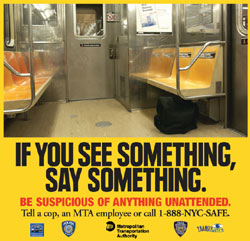
The simple slogan, “If You See Something, Say Something ™” was first used by The New York Metropolitan Transportation Authority to raise public awareness about terrorism, and later licensed by the Department of Homeland Security (DHS) for a national campaign.

You may have seen some of their public service announcements that urge people to report suspicious activities to local law enforcement or in the case of an emergency, call 911.

I urge companies to institute a similar campaign to help them fight fraud. According to the Association of Certified Fraud Examiners (ACFE), the most common way internal fraud is detected is receiving a tip from someone. While many of these are received from employees, some come from customers, an anonymous person or even outside vendors who notice something not quite right. Just over half of internal frauds are detected with tips, according to the ACFE’s 2012 Report to the Nation on Occupational Fraud and Abuse.

if-you-see-something1In my career as the Turnaround Authority, I’ve uncovered fraud in all types of ways — through audits, following up on suspicions I had, or in one memorable case, installing fake cameras (until the company could afford real ones) to stem the problem of inventory walking out the door. But employee tips have also helped me uncover millions of dollars of fraud.

When I am working with an out-of-town company, I assure the employees that no one will lose their jobs for sharing information with me. Later I will drop into casual conversation the name of hotel where I’m staying. Then I ask them for restaurant recommendations around that hotel. I do this so they know where they can find me outside of the office if they wish to share sensitive information.

Once, in the middle of the night someone pushed a bunch of USB drives under my floor. The drives detailed where the company’s money had gone. I’ve also had file folders with documents with valuable inside information pushed under my door. Some people in hotels just wake up to a USA Today and a bill. I never know what surprises I may get!

Companies should have fraud awareness training for managers and employees. The ACFE recommends these programs include what actions constitute fraud, how fraud hurts everyone in the company and how to report any suspicious activity.

Frequent communication is critical to letting employees understand that the company is dedicated to fraud prevention. This can be done at meetings, in newsletters and on the company website. It is also important to let them know, as I always make a point of doing, that employees will not lose their jobs if they report something suspicious. They must feel protected from retaliation.

Many companies successfully use hotlines where employees can make anonymous calls. They can also set up an online reporting system.

Early detection is crucial to cutting the cost of fraud. The ACFE reports that the average fraud scheme lasts about 18 months before discovery and that U.S. businesses lose more than 6 percent or revenues each year due to fraud.

In my next column, I’ll talk about the behavioral red flags that are often associated with fraudulent conduct. What should you be looking out for?

Fraud Prevention Tips from a Former Con Man

Talk about using your super powers for good. Before he was even old enough to vote, Frank Abagnale became one of the most notorious con men in history. From the age of 16-21, he posed as a pediatrician, lawyer, sociology teacher, film director and even an airline pilot to hitch rides all over the world. He estimates he flew a million miles to more than 26 countries, all in his impressive Pan Am uniform he got by calling the company’s headquarters and telling them he had lost his while traveling.

He also defrauded a lot of banks. After stealing more than $300,000, he was caught and served time in France, Sweden and the United States. After being granted parole at the age of 26, he was hired by the FBI and is now a respected authority on forgery, embezzlement and document fraud.

Once a notorious con man, Frank Abagnale is now a respected authority on fraud prevention. “What I did 40 years ago is 4,000 times easier to do today than when I did it," he said.

Once a notorious con man, Frank Abagnale is now a respected authority on fraud prevention. “What I did 40 years ago is 4,000 times easier to do today than when I did it,” he said.

After appearing on Johnny Carson’s show nine times, Frank was urged by him to write a book. “Catch Me If You Can” is the fascinating story of his life, which Steven Spielberg made into a movie starring Leonardo DiCaprio in 2002.

Frank also started his own company, Abagnale & Associates, to educate others on fraud prevention. Looks like he’ll never run out of work. Fraud is still a huge problem in the U.S., costing more than $900 billion a year.

According to the most recent Payment Fraud and Control Survey, 87 percent of cash managers, analysts and directors claim to have incurred instances of check fraud in 2012.

Although claims have been made for years that the U.S. would soon be a checkless society, around 75 percent of payments from one company to another are still made by check. Abagnale believes the U.S. is still 20-30 years away from being completely paperless. And it’s never been easier to create a counterfeit check.

“What I did 40 years ago is 4,000 times easier to do today than when I did it,” he said in an interview on CNN, talking about his counterfeiting. Back then he needed an entire room to set up a large press to create fake checks, a tedious process. Today all you need is a stolen check for the account number, a laptop and a scanner.

Frank shares tips on how to prevent all types of fraud. Here are a few of his tips for businesses:

Tear out the hard drive of any printer or copier you discard. They store images of everything that is copied on them, some of which may be confidential information. Be sure to destroy any hard drives before getting rid of them.

Use a black uni-ball 207 pen when you sign documents, especially checks. The ink in these pens forms a bond to the paper that prevents the signature from being stripped. It is the only pen whose ink cannot be altered by chemicals or solvents.

• CFOs and chief auditors need to play an active role into the purchasing of the company’s checks. Purchasing agents often opt for the cheapest checks. Companies need to invest in checks that contain the latest security features. These include Thermochromatic inks that react to temperature changes and cannot be replicated and prismatic backgrounds with multiple colors that are difficult to reproduce.

For more fraud prevention tips from Frank, buy his book “The Art of the Steal: How to Protect Yourself from Fraud, America’s #1 Crime.” (There are also plenty of tips in my book, “How Not to Hire a Guy Like Me: Lessons Learned from CEO’s Mistakes.”)

Frank has made it his life’s mission to prevent people being stolen from. “If you make it easy for someone to steal from you, someone will,” he says. “Don’t make it easy.”

As the Turnaround Authority, I’ve worked with many companies that made it way too easy for employees to steal from them. One of my favorite stories is about a company in Dallas that had invested in surveillance equipment to keep a watch on inventory that might walk out the door. The problem was that the surveillance room was kept unlocked.

This was back in the days of cassette tapes, so after somebody stole some inventory, he or she simply went to the surveillance room and either erased or replaced the tape. One thoughtful fellow merely placed the tape player on pause, then restarted it when he was done.

While some thieves have to be incredibly creative, like Frank, to steal, others merely jump on an available opportunity. Don’t give them one.

Putting the CEO in Time-Out

Angered at rumors that the co-founder of Specialty Medical Supplies was shutting down its factory near Beijing, the workers took the next logical step: they locked him in his office.

Despite his claims that employees are not losing their jobs when he moves part of the operations of the company to India, around 80 of his 110 employees have blocked entrances and locked Chip Starnes in his office for a week, according to an article in the Wall Street Journal.

While I don’t condone such drastic action, I will admit to having been tempted to put some of the CEOs I’ve dealt with as a turnaround authority in time-out. Just for a while so they could consider their less-than-desirable behavior.

There was the guy whose ego was so large he refused to admit that he has missed some major errors in cost accounting and tried to cover up the cash shortfall, which led to a series of problems with the business that ultimately cost it $8 million in equity. The bank called the loan and he lost his fortune.

Or the CEO who changed his sales manager’s commission structure after exceeding yearly goal for the following year so wouldn’t make more money than he did. The sales manager went to work for his competitor and the CEO was fired.

I once worked with a CEO who was convinced that people would respond to solicitations at a higher rate if they were mailed from within their home town. So he spent about $400,000 a year having trucks drive the solicitations all over his company’s territory to get a local postmark on them, despite the fact there was no evidence to support that theory.

Perhaps the CEO that may have saved his company and his marriage if he put himself in time-out for a bit was the one who was married, yet managed to have a photo of him and his girlfriend having a grand old time on a yacht on the cover of a national magazine.

A nice payback for the CEO and his wife who ran a multi-million dollar company but rationed toilet paper and caffeinated coffee to their employees would have been for them both to spend a few days confined somewhere. Without it.

There are stories like this happening every day. You can read plenty more of my stories of CEOs behaving badly in my new book, “How Not to Hire a Guy Like Me: Lessons Learned from CEOs’ Mistakes.”

If only these CEOs’ employees could have locked these guys up for a bit and fed them a continuous diet of General Tso’s chicken until they came to their senses, would the outcome have been different?

There’s no way of knowing and it probably wouldn’t be good for my business to be known as the guy who recommends locking up CEOs.

I’ve seen no evidence that Mr. Starnes has done anything wrong, other than suffer a communication problem with his Chinese employees. But, he weathered the confinement okay, despite three meals a day of sweet deep-fried chicken.

And he did do one thing every CEO needs to do: think ahead and expect the unexpected. When he constructed his office, he had the foresight to put a toilet in.